Learn how chiplet design, platform longevity, and cooling compatibility impact your next PC build in 2026.
The Evolving CPU Socket Standard: LGA vs. AMD (AM5 vs. LGA 1700)
In the rapidly shifting landscape of PC hardware, the "socket" is far more than just a physical interface; it is a contract between the manufacturer and the consumer. It determines how long your motherboard remains relevant, which cooling solutions you can carry forward, and how much you will spend on your next major upgrade. As of 2026, the battle between Intel’s LGA 1700 (and its successor, LGA 1851) and AMD’s AM5 socket has become the defining narrative for enthusiasts and budget builders alike.
The Philosophical Divide: Platform Longevity vs. Rapid Innovation
The most significant difference between Intel and AMD today lies in their platform longevity philosophy. Historically, Intel has followed a "tick-tock" or two-generation cycle. The LGA 1700 socket, introduced with the 12th Gen "Alder Lake" CPUs, was a landmark for Intel, supporting three generations (12th, 13th, and 14th Gen). However, as we move through 2026, LGA 1700 has reached its definitive end-of-life, replaced by the LGA 1851 socket for the Core Ultra series.
In contrast, AMD has leveraged its upgrade path commitment as a primary marketing strength. Following the legendary success of the AM4 platform—which saw support for over five years and multiple architectures—AMD launched the AM5 socket with a promise of support through "2027 and beyond." This means a user who bought a high-end X670 or B650 motherboard in 2022 can likely drop in a cutting-edge Zen 6 or Zen 7 processor years later without swapping a single cable.
Comparison of Current Standards
| Feature | Intel LGA 1700 | AMD AM5 Socket |
|---|---|---|
| Generations Supported | 12th, 13th, 14th Gen | Ryzen 7000, 8000, 9000 |
| Status in 2026 | Legacy / End of Life | Active / Future-Ready |
| Memory Support | DDR4 & DDR5 | DDR5 Only |
| Primary Design | Monolithic (mostly) | Chiplet Design |
Architecture and the Rise of Chiplet Design
The physical evolution of these sockets is driven by internal architecture. AMD's transition to the AM5 socket (which moved from Pins on the processor to Pins on the motherboard, or LGA) was necessitated by the complexity of their chiplet design. By separating the CPU cores (CCDs) from the Input/Output die (IOD), AMD can scale performance efficiently.
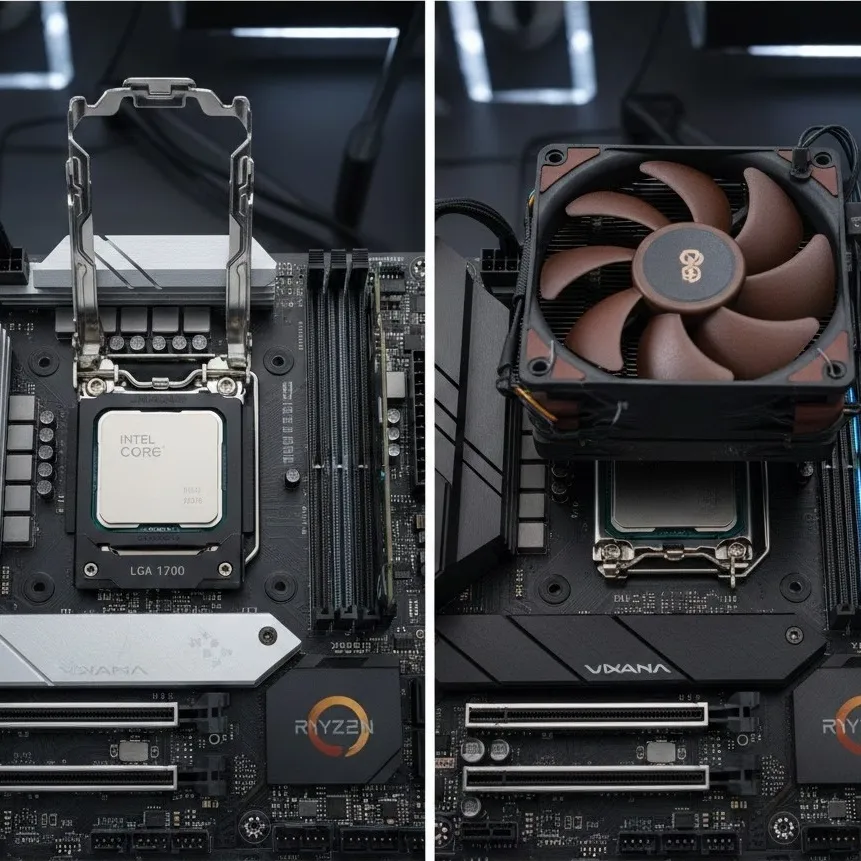
However, this design creates unique thermal challenges. Because the heat-producing "chiplets" are not always in the center of the CPU, cooling compatibility and mounting pressure have become vital topics. Modern coolers for AM5 often use offset mounting brackets to ensure the cold plate sits directly over the heat-dense silicon, rather than the geometric center of the integrated heat spreader (IHS).
Intel’s LGA 1700 introduced a different physical challenge: the "long" socket. Unlike the square sockets of the past, LGA 1700 is rectangular. This change caused early issues with "IHS bowing," where the pressure from the loading lever would slightly bend the CPU, leading to poor contact with coolers. This gave rise to the "contact frame" market—a third-party fix that has now become a staple for enthusiasts wanting to maximize thermal efficiency on Intel platforms.
Cooling Compatibility: Can You Reuse Your Old Heatsink?
For many builders, the "hidden cost" of a socket change is the CPU cooler.
- LGA 1700: Required entirely new mounting hardware because the hole spacing on motherboards changed from the previous LGA 115x/1200 standards. Most major brands like Noctua or Corsair provided "LGA 1700 upgrade kits," but it added a layer of friction to the building process.
- AM5 Socket: AMD made a concerted effort to maintain cooling compatibility with AM4-era coolers. Because AM5 uses the same mounting height and hole spacing for many clip-based coolers, thousands of older heatsinks remained functional. However, builders using coolers that require a custom backplate often need a specific AM5 kit, as the AM5 motherboard backplate is non-removable.
Consumer Impact: Choosing Your Path in 2026
When choosing between these standards, you are choosing an ecosystem.
The Case for AM5
If you value platform longevity, AM5 is the undisputed winner. The ability to buy a motherboard today and know it will support a CPU upgrade three years from now provides a level of "future-proofing" that saves hundreds of dollars in the long run. AMD's upgrade path commitment ensures that the secondary market for AM5 motherboards will remain strong, much like it did for AM4.
The Case for LGA 1700 (and 1851)
Intel's approach is often viewed as "cleaner" for a single-build lifecycle. While LGA 1700 is now a legacy platform, it remains an excellent budget choice in 2026 because it supports cheaper DDR4 memory. For those moving to the latest tech, the LGA 1851 socket offers the newest I/O capabilities, though consumers must accept that a motherboard purchase today may only last two CPU generations before another socket change occurs.
Future Trends: Beyond 2026
As we look toward the end of the decade, the industry is moving toward even higher pin counts to handle increased power delivery and more PCIe lanes. The "socket war" will likely continue to center on how much "extra" tech—like integrated AI NPU communication or specialized cache links—can be squeezed into the physical interface.
Would you like me to help you pick a specific motherboard and cooler combination based on your budget for these sockets?