Explore the world of custom mechanical keyboards.
The Renaissance of the Desktop: The Return of Custom Mechanical Keyboards
For decades, the computer keyboard was viewed as a disposable commodity—a beige plastic slab or a mushy laptop membrane designed for utility, not pleasure. However, the last few years have seen a massive cultural shift. The "clack" is back, and it’s more sophisticated than ever.
The return of custom mechanical keyboards isn't just a tech trend; it is a full-scale artisanal movement. It’s a hobby that blends engineering, interior design, and sensory ASMR, transforming a tool of labor into a centerpiece of self-expression.
The Shift from Utility to Experience
The resurgence began in niche internet forums like Geekhack and Reddit, but it exploded during the shift to remote work. As people spent more time at their desks, the "workspace" became the "living space." Enthusiasts began to realize that the primary interface between humans and their digital lives—the keyboard—could be improved.
The draw isn't just about speed; it's about the ASMR typing experience. The rhythmic, acoustic feedback of a well-tuned keyboard provides a tactile grounding that modern touchscreens and flat laptop keys lack. This community is built around the "thock" (a deep, resonant sound) and the "clack" (a higher-pitched, crisp sound).
The Anatomy of Customization
To understand why this hobby has captured the hearts of millions, one must look at the components that make a keyboard "custom."
1. Mechanical Keyboard Switches: The Heart of the Board
The most critical choice for any builder is the selection of mechanical keyboard switches. Unlike standard keyboards that use a rubber dome, mechanical boards use individual physical switches for every key.
- Tactile vs Linear: This is the fundamental debate in the community.
- Linear switches provide a smooth, consistent keystroke from top to bottom, favored by gamers for their speed and predictability.
- Tactile switches feature a physical "bump" at the actuation point, providing sensory feedback that many typists find satisfying and helpful for accuracy.
- Clicky switches: These add an intentional high-pitched "click" sound to the tactile bump, though they are often polarizing in office environments.
2. Hotswap Sockets: Lowering the Barrier to Entry
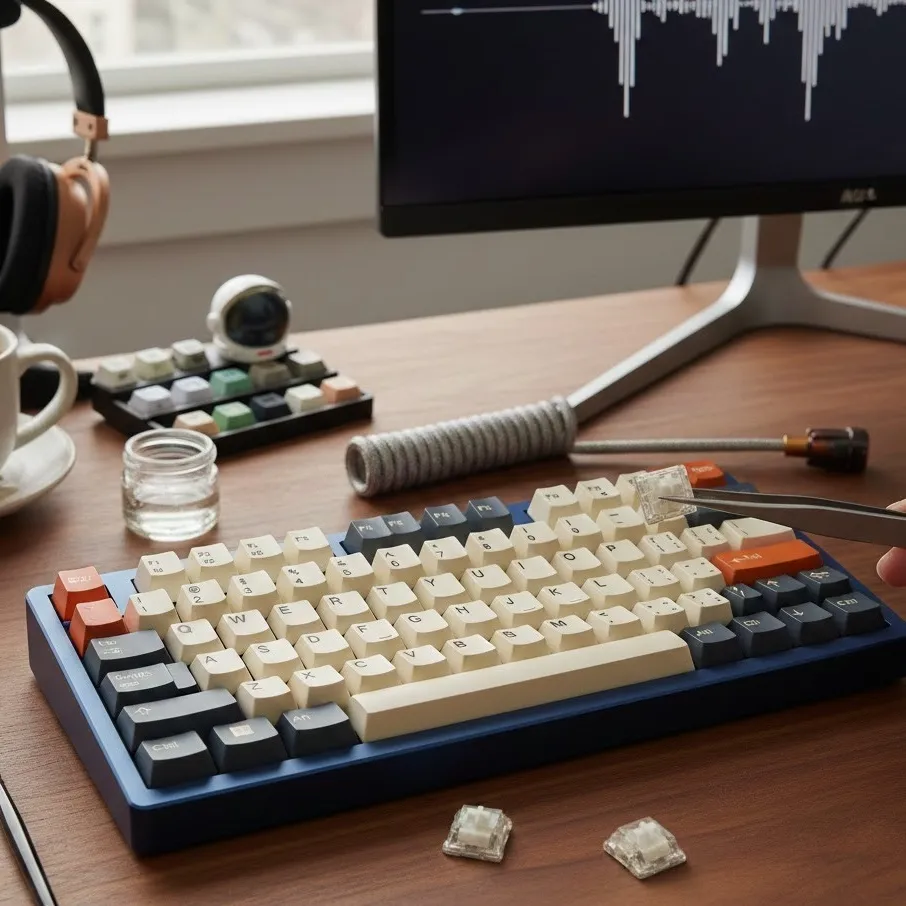
In the past, building a keyboard required a soldering iron and hours of tedious work. The introduction of hotswap sockets changed everything. These sockets are pre-installed on the Printed Circuit Board (PCB), allowing users to simply "plug and play" their switches. This innovation turned keyboard building from a daunting electronics project into something akin to "LEGO for adults."
3. Custom Keycaps: The Visual Statement
If the switches are the heart, custom keycaps are the soul. High-end keycap sets, often made from thick PBT or ABS plastic using "double-shot" molding, offer colors and themes that standard manufacturers can't match. From retro-inspired 1980s aesthetics to minimalist botanical themes, keycaps are how enthusiasts signal their personal style.
The Art of Keyboard Modding
A "stock" keyboard is rarely the end goal. The true culture of this hobby lies in keyboard modding. Enthusiasts treat their boards like project cars, constantly "tuning" them for better sound and feel.
Common mods include:
- Lubricing Switches: Applying specialized grease to the internal components of a switch to eliminate friction and "scratchiness."
- The "Tape Mod": Applying masking tape to the back of the PCB to alter the acoustic profile, usually creating a deeper sound.
- Stabilizer Tuning: Modifying the larger keys (like the Spacebar) to ensure they don't rattle or wobble.
The Cultural Phenomenon and Community
The "Keyboard Community" is a global network of designers, vendors, and content creators. High-end boards are often sold through "Group Buys"—limited-run pre-orders that can take months or even years to manufacture. This scarcity has created a secondary market where rare boards are traded like fine art.
YouTube and TikTok have played a massive role in this growth. ASMR typing videos, featuring nothing but the sound of someone typing on a $500 custom build, garner millions of views. It’s a form of "tech-zen" that emphasizes the tactile beauty of a well-made object.
Why It Matters: The Future of the Desk
The return of custom keyboards represents a broader rebellion against the "disposable" nature of modern technology. A custom board is built to last decades. It can be repaired, upgraded, and personalized. It turns a chore (typing an email) into a curated sensory experience.
Whether you prefer the smooth glide of a linear switch or the sharp snap of a tactile vs linear one, the custom keyboard movement proves that the tools we use every day deserve to be beautiful.