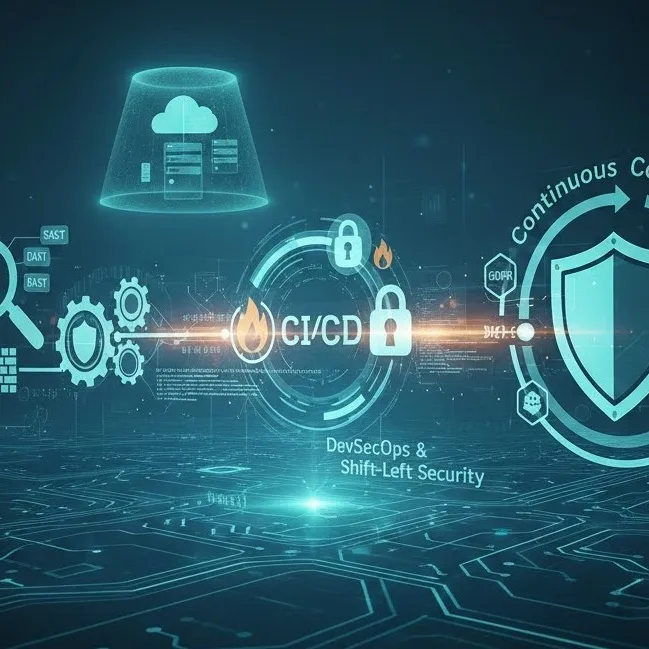
Learn how DevSecOps and shift-left security integrate SAST/DAST and automated security testing into the CI/CD pipeline
The Evolution of Security: Mastering DevSecOps and Shift-Left Security
In the modern era of rapid software delivery, the traditional "security-as-an-afterthought" model is no longer viable. As organizations transition from annual releases to daily or even hourly deployments, security must evolve from a final hurdle into a foundational element. This transformation is driven by DevSecOps and the strategic implementation of shift-left security.
By integrating security measures—including automated scans and governance policies—into every stage of the development pipeline, organizations can transform security from a bottleneck into a competitive advantage.
Defining DevSecOps: Security as a Shared Responsibility
DevSecOps is the practice of integrating security into the DevOps lifecycle. It represents a cultural and technical shift where security is no longer the sole domain of a siloed "security team." Instead, it becomes a shared responsibility between developers, operations, and security professionals.
The goal is to ensure that security is "baked in" rather than "bolted on." When security is integrated into the CI/CD (Continuous Integration/Continuous Deployment) pipeline, vulnerabilities are identified and remediated in real-time, significantly reducing the risk of a breach in production.
The Power of Shift-Left Security
To understand shift-left security, one must visualize the traditional software development life cycle (SDLC). Traditionally, development flows from left to right: Requirements → Design → Coding → Testing → Deployment. In the old model, security testing happened at the far right, just before release.
Shift-left security refers to moving security testing and consideration to the earliest possible stages of the SDLC.
Why Shift Left?
-
Reduced Costs: Finding a bug during the design phase is significantly cheaper than fixing a breach in a live environment.
-
Faster Velocity: Early detection prevents the "emergency stop" that occurs when a major vulnerability is found 24 hours before a product launch.
-
Improved Quality: Developers become more security-aware, leading to inherently more resilient code.
Integrating Security into the Pipeline
Integrating security into the pipeline requires a multi-layered approach involving tools, processes, and people.
Secure Coding Practices
The first line of defense is the developer's keyboard. Implementing secure coding practices ensures that common vulnerabilities, such as SQL injection or Cross-Site Scripting (XSS), are avoided during the initial writing phase. This involves:
-
Standardizing input validation.
-
Implementing principle of least privilege in code.
-
Using secure, vetted libraries and frameworks.
Automated Security Testing: SAST vs. DAST
Automation is the engine of DevSecOps. Without it, security cannot keep pace with DevOps. Two primary pillars of automated security testing are SAST/DAST:
-
SAST (Static Application Security Testing): This analyzes the source code, bytecode, or binaries for patterns that indicate security vulnerabilities. Since it doesn't require a running application, it is the ultimate "left" tool, used right in the IDE or during the build phase.
-
DAST (Dynamic Application Security Testing): This tests the application from the outside in while it is running. It identifies issues like configuration errors or vulnerabilities that only appear in a functional environment.
Continuous Compliance and Governance
In regulated industries, security isn't just about stopping hackers; it’s about meeting legal standards. Continuous compliance is the practice of automatically monitoring your environment to ensure it adheres to regulatory requirements (like SOC2, GDPR, or HIPAA) and internal policies at all times.
Instead of a once-a-year audit, DevSecOps teams use "Compliance as Code" to:
-
Automatically audit cloud configurations.
-
Monitor for unauthorized access.
-
Enforce encryption policies across the entire infrastructure.
Overcoming Challenges in DevSecOps Adoption
While the benefits are clear, the transition to a DevSecOps model isn't without friction.
Cultural Resistance
The biggest hurdle is often the "us vs. them" mentality. Developers want speed; security teams want safety. Bridging this gap requires executive buy-in and a focus on empathy. Security teams should act as enablers—providing tools and guidance—rather than gatekeepers.
Tool Overload and False Positives
Automated tools can sometimes produce a high volume of "false positives." If a developer is bombarded with 100 alerts, 99 of which are harmless, they will eventually ignore the 100th critical alert. Tuning tools to provide high-fidelity results is crucial for maintaining developer trust.
The Future of Secure Software
As we look forward, the integration of AI and Machine Learning will further refine DevSecOps. Predictive analysis will help teams identify high-risk code changes before they are even committed. Furthermore, the rise of "Security Observability" will allow teams to see how their security posture changes in real-time as they scale.
In conclusion, DevSecOps and shift-left security are not just trends—they are necessities. By embracing automated security testing, leveraging SAST/DAST, and fostering secure coding practices, organizations can build a resilient culture of continuous compliance. In this new world, security is everyone’s job, and the result is faster, safer, and more reliable software for everyone.