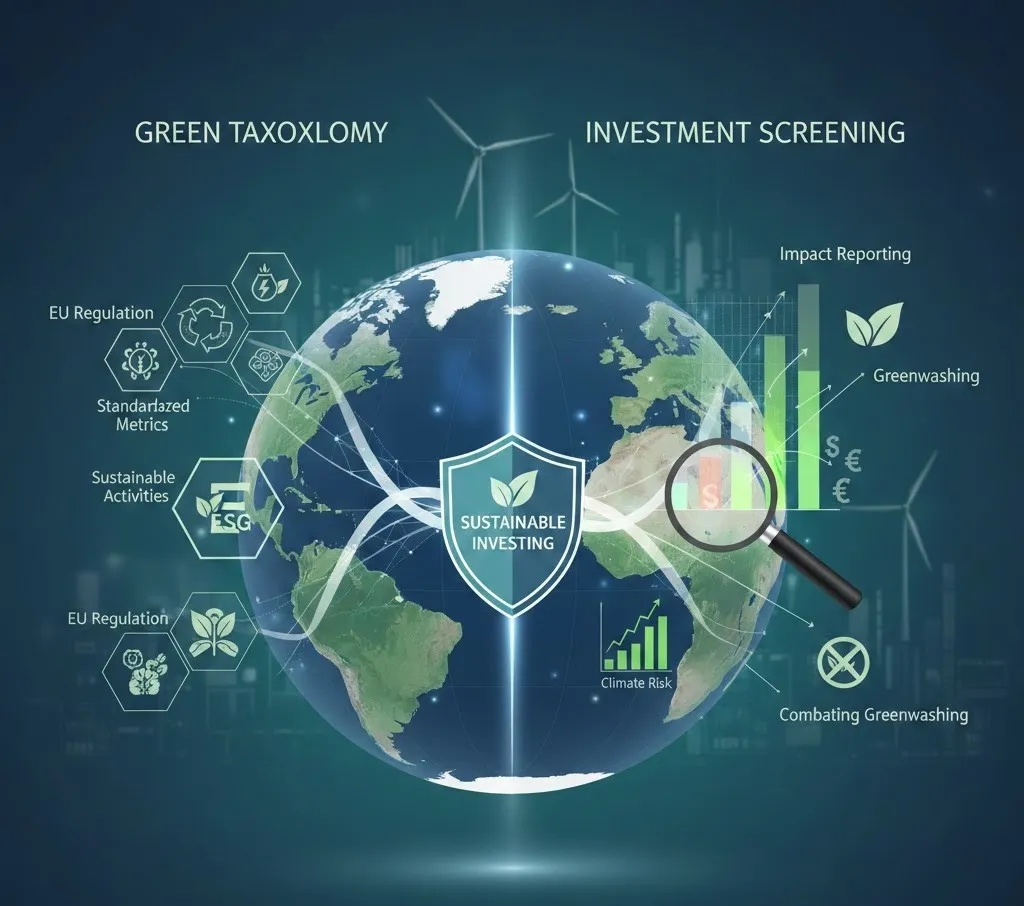
Understand how the Green Taxonomy, EU regulation, and standardized metrics are revolutionizing sustainable investing, ESG screening, and climate risk management.
The convergence of global finance and the imperative of environmental sustainability has birthed a critical regulatory tool: the Green Taxonomy. This classification system is fundamentally reshaping the landscape of sustainable investing by providing a common, scientifically grounded language for defining "green" economic activities. Its rise is a direct response to the urgent need to combat greenwashing and efficiently guide the trillions of dollars required for the global transition to a low-carbon, resilient economy. Coupled with robust Investment Screening mechanisms, taxonomies offer the transparency and accountability necessary to instill confidence in the market and ensure capital genuinely flows towards environmentally sound projects.
Defining Sustainability: The Push for Standardized Metrics
For years, the concept of sustainable investing was mired in ambiguity. Different investors, companies, and jurisdictions held varying, often self-serving, definitions of what constituted a "green" or "sustainable" activity. This lack of clear, comparable data created significant market friction and allowed for "greenwashing"—the deceptive practice of portraying an organization's products, aims, or policies as environmentally friendly when they are not.
The Problem of Greenwashing
The core issue was a crisis of credibility. Without verifiable, universally accepted criteria, investors could not confidently assess the true environmental impact of their portfolios, and companies faced uncertainty when making sustainability claims. This confusion threatened to undermine the entire sustainable finance movement, which is crucial for meeting global climate objectives like the Paris Agreement.
The push for standardized, regulated definitions of "sustainable" economic activities to combat greenwashing and guide capital flows is the principal driver behind the development of national and regional taxonomies.
The Cornerstone of Regulation: The EU Green Taxonomy
The European Union has emerged as a global leader in this regulatory drive with its landmark EU regulation: the **EU Taxonomy for Sustainable Activities**. Enacted as a cornerstone of the EU’s Sustainable Finance Strategy and the European Green Deal, it is arguably the most comprehensive framework of its kind.
The Four Conditions for Sustainability
The EU Taxonomy establishes four overarching conditions an economic activity must meet to qualify as environmentally sustainable:
- Substantial Contribution: The activity must make a significant positive contribution to at least one of the six defined environmental objectives.
- Do No Significant Harm (DNSH): The activity must not significantly harm any of the other five environmental objectives. This is a critical safeguard against trade-offs (e.g., a renewable energy project that significantly harms biodiversity would not qualify).
- Minimum Social Safeguards: The company carrying out the activity must comply with minimum social and governance safeguards, covering areas like labor rights and anti-corruption.
- Compliance with Technical Screening Criteria (TSC): The activity must meet specific, science-based quantitative and qualitative thresholds developed for each sector and objective.
The Six Environmental Objectives
The EU regulation framework focuses on six key environmental objectives:
- Climate change mitigation
- Climate change adaptation
- Sustainable use and protection of water and marine resources
- Transition to a circular economy
- Pollution prevention and control
- Protection and restoration of biodiversity and ecosystems
The taxonomy's detailed, sector-specific standardized metrics and criteria provide the essential data points for financial and non-financial companies to assess and disclose their activities' alignment, fostering transparency and accountability across the market.
Green Taxonomy and Investment Screening
The Green Taxonomy directly integrates with Investment Screening processes by supplying the essential criteria for assessing the environmental merit of assets. Investment screening refers to the practice of evaluating potential investments based on specific criteria, typically non-financial ones, before they are included in a portfolio.
ESG Screening and Climate Risk
The taxonomy is fundamentally linked to ESG screening (Environmental, Social, and Governance). Instead of relying on a multitude of subjective internal or external ratings, the taxonomy provides a robust, regulatory-backed standard for the "E" in ESG.
- Positive Screening: Investors use the taxonomy to identify and select activities that are fully aligned with the technical screening criteria, often for products marketed as "green" or "dark green."
- Negative Screening/Exclusion: While not explicitly a tool for exclusion, the taxonomy naturally facilitates the identification of activities that do not contribute to the environmental objectives, allowing investors to screen out high-polluting or non-transitional sectors.
Integrating Climate Risk
A critical benefit of the taxonomy is its ability to operationalize the assessment of climate risk. By explicitly defining activities that contribute to climate change mitigation and adaptation, it enables financial institutions to:
- Measure Portfolio Alignment: Quantify the percentage of their portfolio that is aligned with the long-term climate goals (i.e., taxonomy-aligned turnover, Capital Expenditure (CapEx), and Operational Expenditure (OpEx)).
- Identify Transition Risks: Recognize which assets are most exposed to the risks associated with the transition to a low-carbon economy (e.g., assets in non-aligned sectors that face obsolescence or higher operating costs).
- Manage Physical Risks: The "Climate Change Adaptation" objective forces companies and investors to assess the physical vulnerabilities of assets to climate change impacts, such as extreme weather events.
By providing clear metrics, the taxonomy shifts the focus from simple compliance to strategic alignment with a low-carbon transition pathway, effectively embedding climate risk management into core financial decision-making.
Disclosure and Impact Reporting
The utility of a Green Taxonomy is only as strong as the resulting disclosures. In the EU, the Taxonomy Regulation is closely tied to the Sustainable Finance Disclosure Regulation (SFDR) and the Corporate Sustainability Reporting Directive (CSRD), which mandate how financial market participants and large companies must report on their taxonomy alignment.
Standardized Metrics for Transparency
Companies are required to report on Key Performance Indicators (KPIs) like the proportion of their turnover, CapEx, and OpEx that relates to taxonomy-aligned economic activities. These standardized metrics offer a level of detail and comparability previously unavailable.
| KPI | Definition/Focus | Investor Relevance |
|---|---|---|
| Turnover | Percentage of revenue from taxonomy-aligned activities. | Reflects current green performance. |
| CapEx | Investment in assets/processes contributing to alignment or transition. | Indicates future commitment and transition pathway. |
| OpEx | Operating costs related to maintaining green assets or improving sustainability. | Shows costs related to current sustainability efforts. |
Beyond Disclosure: Impact Reporting
Ultimately, the goal is not just to report alignment, but to measure and communicate the real-world impact. Impact reporting leverages the standardized metrics established by the Green Taxonomy to articulate the positive environmental outcomes of sustainable investments.
For example, taxonomy-aligned investments in renewable energy allow for quantified reporting on impact reporting metrics such as:
- Tons of $\text{CO}_2$ avoided.
- Megawatt-hours of clean energy generated.
- Cubic meters of water saved.
This data is crucial for investors who seek not only financial returns but also demonstrable, positive environmental change. The combination of regulatory reporting and voluntary impact reporting strengthens the accountability loop, ensuring that sustainable investing delivers on its promise.
Conclusion: The Path Forward
The development and adoption of the Green Taxonomy represent a monumental step towards a transparent and credible system of sustainable investing. By providing a clear, scientific, and regulated definition of "green," frameworks like the EU regulation directly address the pervasive threat of greenwashing. The integration of these standardized metrics into ESG screening and Investment Screening processes allows financial institutions to accurately assess climate risk and reallocate capital towards genuinely sustainable activities. The resulting mandatory disclosure and voluntary impact reporting ensure accountability, forging a crucial link between financial strategy and real-world environmental outcomes. As more jurisdictions develop their own taxonomies, the focus will shift towards harmonization to create a seamless, globally interoperable framework for the transition to a sustainable global economy.