Unlock agility with Composable Architecture and Headless Commerce
The Digital Revolution: The Evolution of Headless and Composable Architecture
The digital commerce landscape is in a state of perpetual acceleration, driven by ever-increasing customer expectations for speed, personalization, and seamless experiences across a multitude of channels. In response to this dynamic environment, a fundamental shift in how businesses build and manage their digital platforms has emerged. The era of the all-encompassing, inflexible, and slow-to-change monolithic system is giving way to a new paradigm defined by modularity, agility, and best-of-breed components: the evolution of headless commerce and composable architecture. This transition is not merely a technical upgrade; it represents a strategic business imperative for enterprises aiming to achieve true digital agility and future-proof their operations.
Moving Away from Monolithic Systems
For decades, the dominant architectural model for enterprise applications, especially e-commerce and content management, was the monolithic system. This architecture is characterized by a single, tightly coupled codebase where the frontend (user interface) and backend (business logic, database) are inseparable. While this approach offered simplicity in initial deployment and a unified technology stack, its disadvantages became glaringly apparent as the digital world matured:
- Inflexibility and Vendor Lock-in: Changing one part of the system often necessitates modifying the entire application, leading to complex, costly, and high-risk updates. Businesses were locked into a single vendor's technology stack.
- Slow Time-to-Market: The sheer size and complexity of the codebase meant that new features or updates could take months to develop, test, and deploy, severely hindering a business’s ability to respond to market trends.
- Scaling Challenges: Monolithic systems often require scaling the entire application even if only one component (like product catalog or checkout) is experiencing high load, leading to inefficient resource utilization.
- Technology Debt: Adopting new technologies or programming languages was virtually impossible without a complete, costly replatforming.
The need for a more adaptable, scalable, and resilient architecture fueled the initial move towards decoupling, setting the stage for the rise of the headless approach.
The Dawn of Headless Architecture and Headless Commerce
The concept of "headless" fundamentally addresses the tight coupling of the monolithic model. Headless architecture is an approach where the presentation layer (the "head" or frontend, what the customer sees) is completely separated and decoupled from the application's underlying content and business logic (the backend).
What is Headless?
In a headless system:
- The backend is the single source of truth for content, data, and core business functionality (like pricing, inventory, or user authentication).
- The frontend—which could be a website, a mobile app, a smart device, a social media channel, or an in-store display—communicates with the backend solely through Application Programming Interfaces (APIs).
The most common application of this principle is headless commerce (separating the e-commerce engine from the storefront) and headless CMS (separating the content repository from the content presentation layer).
Key Benefits of the Headless Model:
- Omnichannel Reach: By using APIs to deliver content and services, a single backend can power any number of frontend channels consistently and simultaneously, creating a truly unified customer experience.
- Frontend Agnosticism: Developers are free to use modern, specialized frontend frameworks (like React, Vue.js, or Angular) optimized for speed and user experience, without being constrained by the backend technology.
- Faster Development: Frontend and backend development teams can work in parallel, accelerating the delivery of new features and iterative improvements.
While headless was a significant step toward flexibility, it often still relied on a single, large backend platform for the majority of the business logic. The next evolutionary step—composable architecture—takes the concept of decoupling even further.
Composable Architecture: The Best-of-Breed Evolution
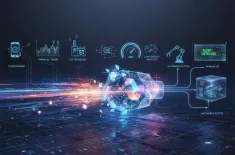
Composable architecture is the strategic progression from headless, extending the principle of modularity across the entire business technology stack. Where headless primarily decouples the presentation layer from the core platform, composable architecture breaks down that core platform into a collection of smaller, independent, and specialized services.
This model is centered around the idea of building a Digital Experience Platform (DXP) not as a single, all-in-one suite, but as a system of interchangeable parts. A business can choose the "best-of-breed" component for every specific function—be it search, payments, customer relationship management (CRM), or personalization—and connect them via APIs.
The Foundational Pillars: MACH Principles
The core philosophy enabling composable systems is captured by the MACH principles—an acronym representing four non-negotiable architectural tenets:
- M - Microservices: The entire application is broken down into small, independently deployable, and autonomously operating services. Each microservice is responsible for a single business capability (e.g., product catalog, order history, payment processing). This promotes true modularity.
- A - API-first: All functionality, both internal and external, must be exposed and accessible through APIs. APIs become the 'contract' that enables seamless communication and interoperability between all components and services.
- C - Cloud-native: All components are built and deployed to fully leverage the features of modern cloud computing platforms (like AWS, Azure, or GCP). This enables automatic scalability, resilience, and fast deployment via containers and serverless functions.
- H - Headless: The architecture maintains the decoupling of the frontend from the backend, as described in the previous section.
The strict adherence to the MACH principles ensures the system flexibility required to assemble and reconfigure the digital platform at speed.
Realizing the Promise of Modularity: Swapping Components and Customization
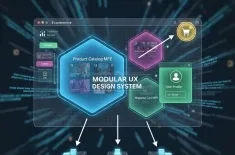
The true power of composable architecture lies in its fulfillment of the promise of moving away from monolithic systems to modular, interconnected services that allow businesses to quickly swap components and customize user experience.
- Quick Component Swaps: Imagine a business decides its current search engine is too slow or lacks advanced AI capabilities. In a monolithic system, replacing the search engine would be a massive, risky, and costly project. In a composable architecture, the old search microservice is simply disconnected from the API network, and the new best-of-breed search service is plugged in—with minimal disruption to the rest of the system.
- Hyper-Customization: Since the frontend is decoupled (headless) and the backend is composed of specialized services, businesses gain granular control. They can select the exact payment gateway for a specific region, integrate a hyper-local recommendation engine, and design a unique checkout flow for a single channel (e.g., a kiosk) without impacting the main e-commerce website.
- Innovation Without Risk: Teams can test new technologies or integrate a new third-party service (like a virtual try-on tool or an augmented reality feature) on a small scale. If it succeeds, it's integrated fully; if it fails, it's easily removed, drastically reducing the risk associated with innovation.
This system flexibility allows businesses to build an ecosystem that is perfectly tailored to their unique commercial needs, not one dictated by the limitations of a single software suite.
Strategic Benefits and Business Outcomes
The evolution to headless and composable models delivers tangible strategic advantages that translate directly into business value:
| Benefit | Impact on Business |
|---|---|
| Agility & Speed | Dramatically reduced time-to-market for new features, products, and campaigns, allowing businesses to outpace competition. |
| Lower Total Cost of Ownership (TCO) | Paying only for the specific best-of-breed services you need, scaling individual components efficiently, and avoiding expensive, all-encompassing platform upgrades. |
| Future-Proofing | The ability to adopt new technologies (e.g., AI, Web3, new devices) without replatforming the entire system. Technology stacks can evolve component by component. |
| Optimal User Experience | Freedom to build highly optimized, blazing-fast, and personalized frontends for every customer touchpoint, leading to higher conversion rates and customer satisfaction. |
| Increased Resilience | Due to fault isolation in microservices, an issue in one component will not cause the entire digital platform to crash, ensuring business continuity. |
Conclusion: A Foundation for Tomorrow’s Digital Business
The shift from the monolithic era to composable architecture is the most significant strategic move in digital commerce since the advent of the internet. It fundamentally redefines how software is built, deployed, and scaled. By embracing MACH principles, businesses are gaining the system flexibility necessary to be truly customer-centric—offering hyper-personalized experiences across every touchpoint, and adapting at the speed of the market. This transition, led by headless commerce and its evolution into full composability, is more than a technical trend; it is the resilient, modular, and interconnected foundation that allows businesses to thrive in the complex and constantly shifting digital ecosystem of the future.