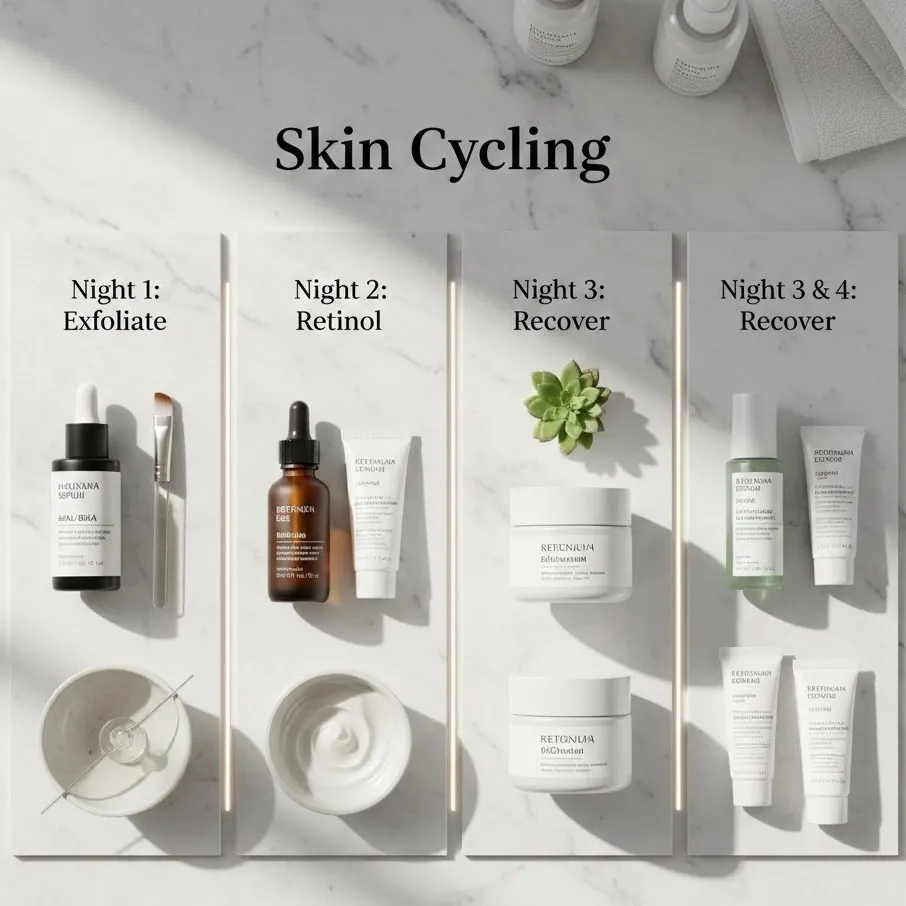
Master the skin cycling routine
The Ultimate Guide to Skin Cycling: Transform Your Complexion Without the Irritation
In the ever-evolving world of skincare, we often fall into the "more is better" trap. We stack acids, serums, and retinoids thinking that a more aggressive approach leads to faster results. However, this often leads to a compromised skin barrier, redness, and "retinol burn."
Enter Skin Cycling. This strategic method has revolutionized how we approach our nightly rotation, prioritizing barrier repair without sacrificing the transformative power of active ingredients.
What is Skin Cycling?
Skin cycling is a four-night skin cycling routine designed to maximize the efficacy of your products while minimizing the risk of irritation. Popularized by dermatologists, it moves away from the "hammering" approach of daily exfoliation or nightly retinol use and instead adopts a rhythmic cycle of treatment and recovery.
The core philosophy is simple: Your skin needs time to heal to perform its best. By giving your skin "off days," you allow the moisture barrier to remain intact, which actually makes your active nights more effective.
The Four-Night Skin Cycling Routine
The classic skin cycling method follows a specific four-night schedule. Here is the exact breakdown:
Night 1: Exfoliation
The cycle begins with exfoliation. On this night, you use chemical exfoliants (like AHAs or BHAs) to remove dead skin cells from the surface.
-
Why it works: Removing the "top layer" of debris prepares the skin to better absorb the active ingredients that follow on Night 2.
-
What to use: Look for glycolic acid, lactic acid, or salicylic acid. Avoid physical scrubs, which can create micro-tears.
Night 2: Retinol Use
Night 2 is dedicated to retinol use. Retinol is the gold standard for anti-aging and acne, but it is notoriously irritating.
-
Why it works: Because you exfoliated the night before, the retinol can penetrate more deeply and work more efficiently.
-
Pro Tip: If you have sensitive skin, use the "sandwich method"—apply moisturizer, then retinol, then moisturizer again to buffer the strength.
Nights 3 & 4: Recovery Nights
These are the most critical steps often skipped by skincare enthusiasts. Recovery nights focus solely on hydration and barrier repair.
-
Why it works: This 48-hour break allows the skin to calm down after two nights of intense activity. It prevents the stinging, peeling, and inflammation often associated with high-potency skincare.
-
What to use: Focus on ingredients like ceramides, hyaluronic acid, squalane, and centella asiatica.
The Science of Barrier Repair
Your skin barrier (the stratum corneum) is your body's first line of defense. When we over-apply active ingredients, we strip the lipids that hold our skin cells together. This leads to "transepidermal water loss" (TEWL).
By incorporating two consecutive recovery nights, you are literally giving your cells the "building blocks" (ceramides and fatty acids) needed to patch up the barrier. A healthy barrier means your skin can tolerate retinol use much better over the long term, leading to more consistent results.
Benefits of the Skin Cycling Method
Reduced Irritation: Ideal for those with eczema-prone or sensitive skin.
-
Consistency: It is easier to stick to a schedule than to guess what your skin needs every night.
-
Cost-Effective: You use your expensive "active" products less frequently, making them last longer.
-
Versatility: You can "dial up" or "dial down" the cycle based on how your skin feels.
Frequently Asked Questions
| Question | Answer |
| Can I do 3 recovery nights? | Yes, if your skin is particularly dry or sensitive, extending the recovery phase is encouraged. |
| Should I exfoliate in the morning? | No. Keep your nightly rotation for actives. Morning should be for Vitamin C and SPF. |
| Is this good for acne? | Absolutely. It prevents the "purge" from being too painful and keeps the skin hydrated. |