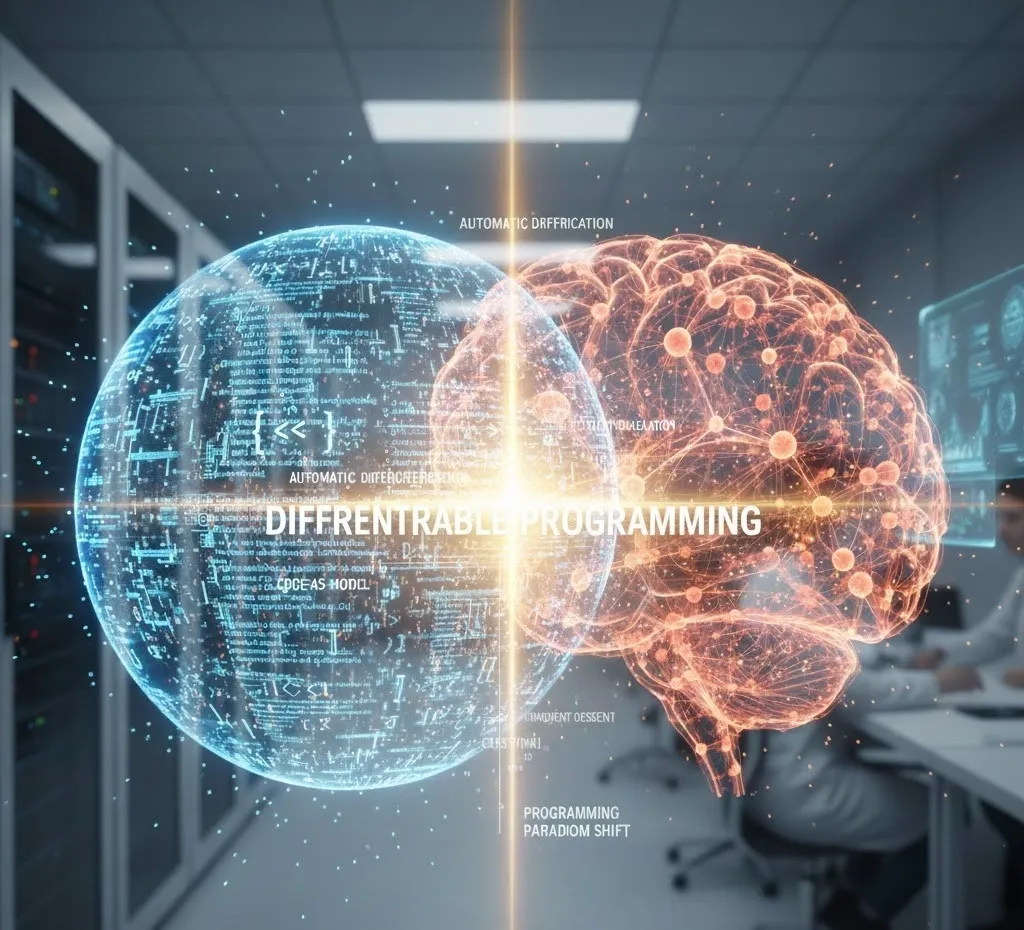
Explore Differentiable programming, the new programming paradigm shift using automatic differentiation for seamless machine learning integration
Differentiable Programming: The Paradigm Shift Unifying Code and Learning
The landscape of computer science is constantly evolving, driven by the relentless pursuit of more efficient, powerful, and adaptable computational models. In recent years, a revolutionary concept has emerged from the intersection of traditional software engineering and artificial intelligence: Differentiable programming. This is not merely an incremental update to existing tools; it represents a profound programming paradigm shift, fundamentally changing how we conceptualize and build complex systems, especially those designed to learn from data.
At its core, Differentiable programming defines a programming paradigm where programs can be easily trained and optimized using gradient descent, blurring the lines between coding and model training. Unlike conventional software, where code executes a fixed set of logic, a differentiable program is essentially a parameterized mathematical function—a computation graph—whose output can be smoothly and predictably optimized with respect to its input parameters.
The Foundation: Automatic Differentiation
The linchpin of the entire Differentiable programming revolution is automatic differentiation (AD). This sophisticated technique allows a program to automatically and efficiently compute the exact derivatives (gradients) of a complex function with respect to its parameters, even if that function is defined by arbitrary code that includes loops, conditionals, and data structures.
Beyond Traditional Calculus
Before automatic differentiation, computing gradients for complex functions—like those found in large neural networks—was a significant bottleneck.
-
Symbolic Differentiation: Tries to find an analytical expression for the derivative, which becomes computationally intractable and often impossible for highly complex, program-defined functions.
-
Numerical Differentiation: Approximates the derivative using finite differences, which is computationally expensive for high-dimensional parameter spaces and introduces numerical errors.
Automatic differentiation elegantly bypasses these issues. It works by decomposing the entire program (the function) into a sequence of elementary operations (like addition, multiplication, and standard functions). It then uses the chain rule of calculus to compute the derivative of the composite function by tracking the derivatives of these elementary operations through a computational graph.
This process is typically executed in two main modes:
-
Forward-Mode AD: Computes the derivative alongside the forward pass, efficient when the input dimension is small relative to the output dimension (e.g., computing Jacobian-vector products).
-
Reverse-Mode AD (The Core of ML): Computes the derivative after the forward pass, efficiently accumulating the gradient information backward through the graph. This is computationally ideal for scenarios like machine learning integration where the function has many input parameters (the model weights) but typically a single scalar output (the loss function). This reverse-mode is what is commonly known as backpropagation in the context of neural networks.
The result is the ability to compute the exact gradient—the direction of steepest ascent on the loss surface—with an efficiency comparable to the function's initial forward computation. This efficiency is paramount for enabling model optimization across massive parameter spaces.
Machine Learning Integration: A Seamless Workflow
Differentiable programming is fundamentally about merging the traditional code-centric world with the data-centric world of machine learning.
In the classical machine learning workflow, the model is a rigid structure (e.g., a pre-defined neural network architecture) and the training is a separate optimization process. In contrast, the philosophy of Differentiable programming treats any parameterized computation, no matter how complex—a custom physics simulator, a rendering pipeline, a numerical solver, or a traditional algorithm—as a trainable model.
Bridging Neural Networks and Algorithms
Deep learning, which uses complex neural networks, is essentially a subset of Differentiable programming. Frameworks like PyTorch and TensorFlow, by providing libraries for automatic differentiation, allow users to define a sequence of operations (the neural network) and then automatically calculate the gradients needed for gradient descent.
However, the true power of this new programming paradigm shift lies in its ability to go beyond simple feedforward or recurrent neural networks. It enables:
-
Differentiable Simulators: Instead of training a neural network to approximate the behavior of a physical system, you can integrate the actual physics simulation code directly into your training pipeline. Since the simulator itself is differentiable, you can use gradient descent to optimize the parameters of the simulation (e.g., friction coefficients, material properties) to match real-world data.
-
Probabilistic Programming: Allows systems to combine structured prior knowledge with data-driven learning. Differentiable programming tools can automatically compute gradients through complex probabilistic models, making techniques like variational inference significantly more scalable.
-
Neural Algorithmic Reasoning: Integrating classical data structures and algorithms (like sorting or graph traversal) into neural networks. By making these algorithmic components differentiable, the entire hybrid system can be trained end-to-end. This is a crucial step towards creating AI that can reason and plan, not just pattern-match.
This seamless machine learning integration transforms what was once a multi-step, fragile pipeline (model definition $\rightarrow$ data pre-processing $\rightarrow$ rigid optimization $\rightarrow$ post-processing) into a single, cohesive, end-to-end differentiable system.
Model Optimization through Gradient Descent
The core goal of Differentiable programming is high-performance model optimization. Once the program is made differentiable via automatic differentiation, any parameterized computation can be optimized using standard gradient-based methods, most notably gradient descent and its variants (Stochastic Gradient Descent, Adam, etc.).
The process typically involves:
-
Defining the Loss Function: A differentiable function that quantifies the error between the program's output (prediction) and the desired target value (ground truth). The loss function must also be differentiable to allow the gradient to flow backward.
-
Forward Pass: Executing the program with the current set of parameters to get a prediction and calculate the loss.
-
Backward Pass (Automatic Differentiation): Computing the gradient of the loss function with respect to every parameter in the program using reverse-mode automatic differentiation. This gradient indicates how much each parameter should change to reduce the loss.
-
Parameter Update: Adjusting the parameters in the direction opposite to the gradient, scaled by a learning rate. This is the model optimization step. The update rule is given by:
This iterative process continues until the loss function is minimized, and the program's parameters are optimally tuned to perform the desired task based on the training data. This mechanism ensures that the learning process is mathematically grounded and highly efficient, distinguishing it from heuristic or trial-and-error optimization methods.
The Programming Paradigm Shift and Its Future
The conceptual shift introduced by Differentiable programming is profound. It moves programming from defining explicit rules to defining parameterized functions that learn their own optimal rules from data. The focus shifts from how to do it (procedural logic) to what to optimize (loss function definition).
This programming paradigm shift unifies two traditionally separate groups: machine learning researchers and general-purpose software engineers.
-
For ML Researchers: It expands the toolkit far beyond conventional neural network layers, allowing them to embed complex, structured, and symbolic knowledge directly into their models, resulting in more explainable and data-efficient AI.
-
For Software Engineers: It provides a native mechanism to inject "learnable" components into any part of a larger software system, allowing code to adapt and optimize itself based on runtime data.
Conclusion: The Differentiable Future
Differentiable programming is not a fleeting trend; it is the natural evolution of software engineering in an era dominated by data and learning. By leveraging the power of automatic differentiation and enabling seamless machine learning integration, it has introduced a fundamental programming paradigm shift where model optimization is no longer a separate, manual process but an intrinsic feature of the code itself.
The ability to treat any parameterized program—from a simple function to a complex physics simulator—as a trainable entity opens up unprecedented possibilities. It promises to deliver a new generation of software that is inherently adaptive, highly optimized, and capable of solving complex problems in science, engineering, and commerce that were previously out of reach. We are moving toward a future where "code" and "model" are increasingly synonymous, and the barrier to creating powerful, self-optimizing systems has been dramatically lowered.