Explore how generative AI in games is revolutionizing dynamic NPC dialogue and realistic interactions
Gaming’s AI NPCs: The Future of Dialogue
For decades, the "living" worlds of video games were built on a foundation of clever illusions. You might have walked through the sprawling streets of a digital metropolis, but every shopkeeper and guard was essentially a wind-up toy. They had a set number of lines, a fixed path, and a predictable reaction to your presence. However, we are currently witnessing an immersion breakthrough that is fundamentally altering the DNA of interactive storytelling. The catalyst? The integration of generative AI in games.
The Shift from Scripts to Sentience
Traditional game design relies on "branching dialogue trees." Writers painstakingly draft thousands of lines to cover every possible player choice. While effective in masterpieces like The Witcher 3 or Baldur's Gate 3, this method is inherently finite. Once you’ve exhausted the script, the illusion of a living person vanishes.
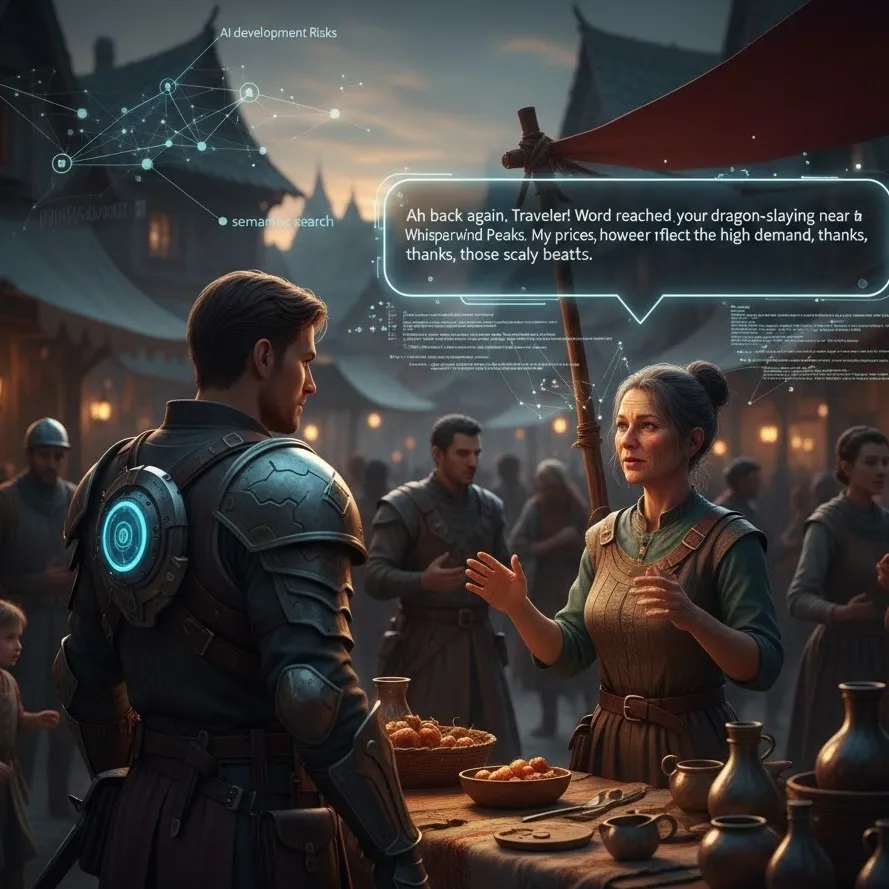
Today, dynamic NPC dialogue is replacing these static scripts. By utilizing Large Language Models (LLMs) similar to GPT-4 or specialized engines like NVIDIA ACE and Inworld AI, developers are imbuing characters with the ability to "think" and "respond" in real-time. Instead of choosing from a list of pre-written responses, players can type or speak naturally, and the NPC will interpret the intent, tone, and context to generate a unique reply.
Achieving Realistic Interactions
What makes a conversation feel "real"? It isn't just the words; it's the memory, the emotion, and the world-awareness. Realistic interactions in modern gaming now involve three core pillars:
-
Persistent Memory: If you insult a merchant in the first hour of the game, they might refuse to sell to you in the tenth hour. AI NPCs now store "vector embeddings" of past interactions, allowing them to recall player behavior.
-
Emotional Intelligence: Using sentiment analysis, NPCs can detect if a player is being threatening, sarcastic, or helpful, adjusting their body language and tone accordingly.
-
Contextual Awareness: Characters are no longer isolated. They know if it’s raining, if there’s a war going on, or if the player is currently wearing a legendary suit of armor, and they can weave these facts into their speech.
Procedural Content and the Infinite World
The scope of modern games has grown so large that manual creation is becoming a bottleneck. Procedural content generation has moved beyond just creating random landscapes; it is now being applied to the very souls of the characters. By combining AI-driven logic with world-state simulations, developers can create "emergent" stories. An NPC might decide to start a trade war with a neighboring village not because a developer scripted it, but because its AI goal (accumulating wealth) and the current world state (a shortage of grain) led it to that logical conclusion.
Navigating the AI Development Risks
Despite the excitement, the path to fully autonomous digital beings is fraught with AI development risks. Developers must balance innovation with several critical challenges:
-
Hallucinations and Lore Breaking: An AI NPC might accidentally claim they are a robot from the future in a medieval fantasy setting. Maintaining "lore-accuracy" requires strict guardrails and "context windows" that limit what the AI can say.
-
Toxic Outputs: Without robust filtering, generative models can produce offensive or inappropriate content, which is a major concern for studio reputations and player safety.
-
Computational Costs: Running high-level LLMs in real-time requires significant server power or powerful local hardware, which can lead to latency (the "awkward silence" before an NPC speaks) and high operational costs.
-
The Loss of "Auteur" Vision: Critics argue that if everything is generated by an algorithm, the unique creative voice of the human writer might be diluted, leading to experiences that feel "mushy" or lack a focused narrative punch.
Summary Table: Traditional vs. AI-Driven NPCs
| Feature | Traditional NPCs | AI-Driven NPCs |
| Dialogue | Scripted / Pre-recorded | Generative / Real-time |
| Memory | Flag-based (Yes/No) | Persistent / Contextual |
| Player Agency | Limited to choices A, B, or C | Unlimited natural language |
| Development | Manual writing & recording | Prompt engineering & Model training |
The future of gaming isn't just about higher resolutions or more realistic shadows; it's about the characters looking back at us and truly understanding what we say. As we refine the technology and mitigate the AI development risks, we are stepping into an era where every player’s journey is truly their own.