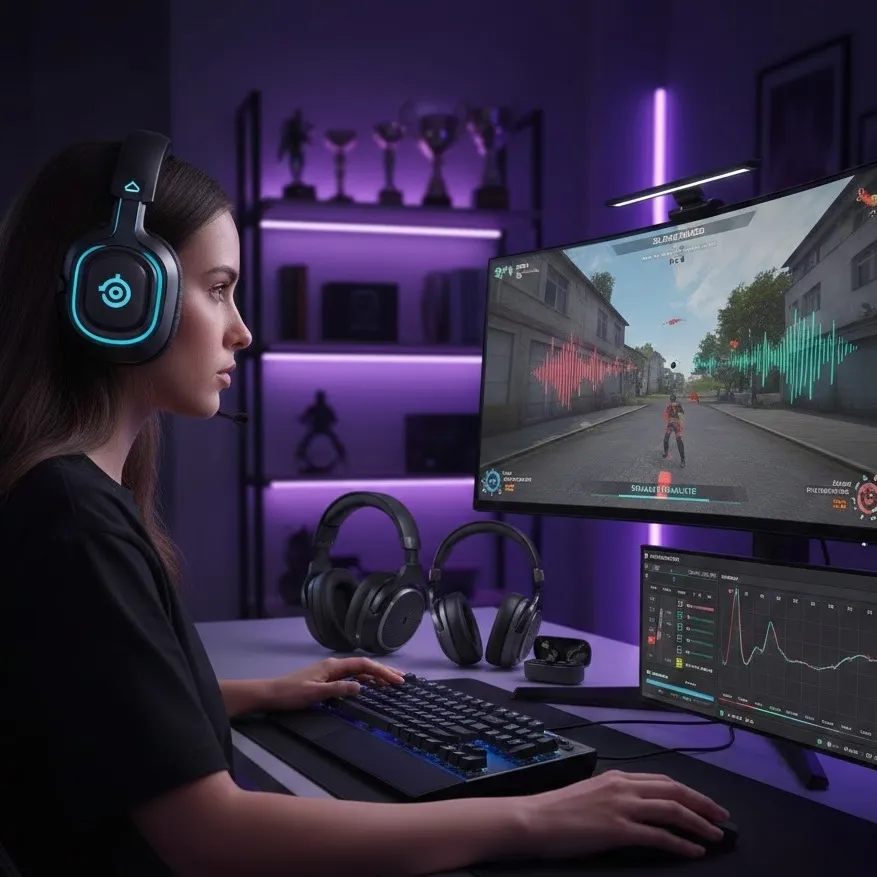
Explore how 3D audio and spatial sound provide a positioning advantage in FPS games with our 2025 pro gear reviews.
The Evolution of the Audio Positioning Meta
For years, "gaming audio" was synonymous with bloated bass and aggressive marketing. However, the rise of Battle Royale titles like Apex Legends and Warzone, alongside tactical shooters like Valorant and Counter-Strike 2, has forced a paradigm shift. In these environments, sound is the most vital data stream.
From Stereo to Spatial Awareness
The old meta relied on simple stereo panning—left and right. Today’s 3D audio engines use Object-Based Spatial Audio. Instead of sending sound to a specific "channel," the game engine treats a footstep as an object in a 3D coordinate system. Modern headsets must translate these coordinates into a believable auditory environment.
Why Positioning is the New Skill Ceiling
High-level players now utilize a "sound-first" approach to rotations and utility usage. Understanding the verticality of a sound (knowing if an enemy is on the floor above or below you) is the difference between a successful flank and a quick trip back to the lobby. This is where spatial sound becomes a literal "wallhack" for your ears.
Key Technology: Breaking Down the Terms
To understand the pro gear review section, we must first define the technologies that allow for a sound positioning advantage.
- 3D Audio & Virtual Surround: Unlike traditional 7.1, which simulates speakers around you, 3D audio (like PlayStation’s Tempest Engine or Dolby Atmos) simulates sound from every angle, including above and below.
- Competitive Audio Cues: These are specific frequency ranges where vital information lives. Footsteps usually sit in the mid-range (200Hz–2kHz), while the "snap" of a sniper rifle or the "clink" of a grenade pin sits in the higher frequencies.
- Imaging vs. Soundstage: Soundstage is the perceived size of the environment (how "far" away the sound feels). Imaging is the accuracy of the location (pinpointing the exact degree of the sound). In the competitive meta, imaging is king.
Pro Gear Review: Top Headset Recommendations for 2025
The following headset recommendations are based on their ability to deliver precise competitive audio cues and maintain a clean frequency response.
1. The King of Imaging: SteelSeries Arctis Nova Pro Wireless
The Arctis Nova Pro remains the "gold standard" for the current meta. Its inclusion of the Sonar Software suite allows players to use specific EQ profiles for games like Rainbow Six Siege or Valorant, effectively boosting footstep frequencies while dampening deafening explosions.
Best For: All-around competitive play and multi-platform users.
Key Feature: 360° Spatial Audio via the GameDAC Gen 2.
2. The Audiophile’s Choice: Audeze Maxwell
By utilizing Planar Magnetic drivers instead of traditional dynamic drivers, the Maxwell offers a level of speed and detail that is nearly unmatched. The transient response (how fast a driver starts and stops) ensures that spatial sound doesn't become "muddy" during intense firefights.
Best For: Players who want the most realistic and detailed soundstage possible.
Key Feature: Massive 90mm Planar drivers.
3. The Lightweight Precision Tool: Razer BlackShark V3 Pro
Razer has refined the BlackShark line to focus almost exclusively on "esports-tuned" audio. The V3 Pro features specialized profiles developed with pro players to highlight the exact competitive audio cues needed for top-tier performance.
Best For: FPS purists who prioritize comfort and microphone clarity.
Key Feature: THX Spatial Audio integration.
4. The Open-Back Specialist: Turtle Beach Atlas Air
Open-back headsets allow air and sound to pass through the earcups, resulting in a more "natural" and wider soundstage. The Atlas Air is one of the few wireless open-back options that provides a massive sound positioning advantage by making the game world feel less like it's "inside your head."
Best For: Long sessions and maximum spatial awareness.
Key Feature: High-fidelity 24-bit wireless audio.
The Secret Meta: IEMs (In-Ear Monitors)
A surprising trend in the 2025 competitive meta is the migration from over-ear headsets to In-Ear Monitors (IEMs). Pro players in the Apex Legends and CS2 circuits often prefer IEMs like the Sony INZONE E9 or the Sennheiser IE 600.
Pro Tip: IEMs provide superior passive noise isolation and "pinpoint" imaging because the sound source is closer to the ear canal. This eliminates the acoustic interference caused by the shape of an over-ear earcup.
How to Optimize Your Current Setup
You don't always need a $300 headset to gain a sound positioning advantage. Follow these meta-adjustments to improve your competitive audio cues:
- Turn off "Bass Boost": While it makes explosions sound cinematic, heavy bass "masks" (hides) the subtle high-frequency sounds of footsteps and reloading.
- Use a Flat EQ Baseline: Start with a neutral profile and only boost the 1kHz–4kHz range slightly to bring out the "crunch" of footsteps.
- Check Your Windows Settings: Ensure "Spatial Sound" is enabled (Windows Sonic, Dolby Atmos, or DTS:X) but avoid stacking multiple spatializers, as this can cause "phasing" and ruin your accuracy.
Summary: Why Audio is the Ultimate Force Multiplier
In the current gaming landscape, the sound positioning advantage is no longer a luxury—it is a requirement. By choosing gear that prioritizes spatial sound and 3D audio, you are essentially expanding your "field of view" to 360 degrees. Whether you choose a flagship wireless model or a precision-tuned IEM, the goal remains the same: hearing the threat before you see it.