Learn how Adaptive Cybersecurity Mesh integrates distributed security and centralized policy into an identity-centric
Understanding Adaptive Cybersecurity Mesh: The Future of Distributed Security
In the modern digital landscape, the traditional "castle and moat" approach to network security is no longer sufficient. As organizations shift toward remote work, multi-cloud environments, and edge computing, the perimeter has effectively vanished. Enter the Adaptive Cybersecurity Mesh—a security structure that integrates separate security tools into a cohesive fabric, ensuring consistent identity and access management across diverse environments.
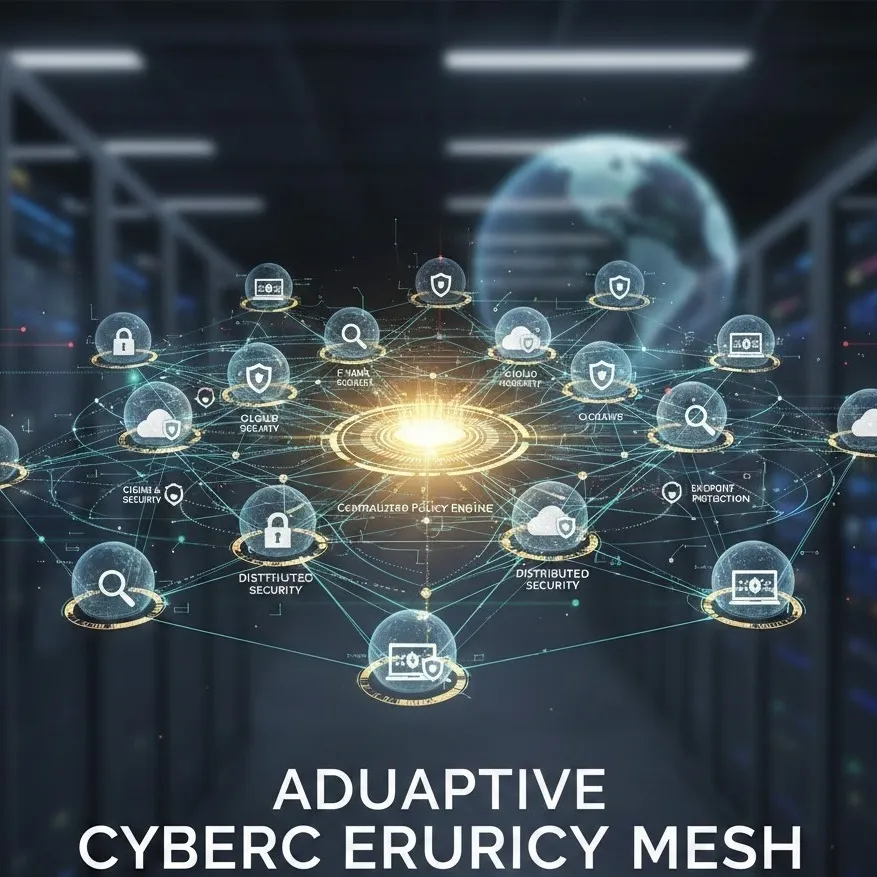
By decentralizing security controls while maintaining a centralized policy, the cybersecurity mesh provides a flexible, scalable, and resilient defense mechanism. This architecture is not just a trend; it is a fundamental shift in how we protect digital assets in a world without boundaries.
What is Cybersecurity Mesh Architecture (CSMA)?
Cybersecurity Mesh is an architectural approach that enables the definition of security perimeters around individual identities—whether they are users, devices, or applications—rather than the entire network. Introduced by Gartner, this framework advocates for interoperability and coordination between individual security products.
The core goal of a mesh is to move away from isolated security silos. In a traditional setup, your firewall, endpoint protection, and identity management might not talk to each other. In a mesh, these tools operate as a single, collaborative ecosystem.
The 4 Foundational Layers of CSMA
-
Security Analytics and Intelligence: Collects and analyzes data from all tools to detect threats in real-time.
-
Distributed Identity Fabric: Provides a unified way to manage and verify identities across different platforms.
-
Consolidated Policy Management: Allows administrators to create one set of rules that apply everywhere.
-
Consolidated Dashboards: Offers a "single pane of glass" view for security teams to monitor the entire ecosystem.
Core Pillars of the Adaptive Mesh
To understand why this model is so effective, we must look at the keywords and concepts that drive its functionality: distributed security, identity-centric security, and zero trust architecture (ZTA).
1. Distributed Security: Moving Protection Closer to the Asset
In a mesh, security is not a single gateway. It is distributed across the network. Each node (a laptop, a cloud database, or an IoT sensor) acts as its own perimeter. If one part of the network is compromised, the "mesh" prevents the threat from moving laterally because every other asset is independently secured.
2. Identity-Centric Security: Identity is the New Perimeter
In the past, we trusted anyone inside the office building. Today, we must trust the "identity." Identity-centric security ensures that access is granted based on who you are and what device you are using, regardless of where you are. This shift makes identity the most critical component of the modern security stack.
3. Zero Trust Architecture (ZTA): Never Trust, Always Verify
The zero trust architecture (ZTA) is the philosophical foundation of the cybersecurity mesh. It operates on the principle that no entity should be trusted by default. Every request for access must be continuously authenticated and authorized. The mesh provides the physical infrastructure that makes implementing Zero Trust possible at scale.
4. Centralized Policy with Decentralized Enforcement
This is the "brain" of the mesh. While security controls are spread out (decentralized), the rules governing them are managed from a centralized policy engine. This ensures that a "Minimum Privilege" rule created in the head office is automatically enforced on a remote developer's laptop in another country.
Why Organizations are Switching to Adaptive Mesh
The transition to an adaptive cybersecurity mesh is driven by the limitations of legacy systems. Here is a comparison:
| Feature | Traditional Perimeter Security | Adaptive Cybersecurity Mesh |
| Focus | Protecting the Network Edge | Protecting the Identity & Asset |
| Structure | Monolithic / Centralized | Composable / Distributed |
| Trust Model | Implicit Trust (Inside the Network) | Zero Trust (Continuous Verification) |
| Scalability | Difficult and Costly | Highly Scalable and Flexible |
| Visibility | Siloed Dashboards | Consolidated, Real-time View |
Benefits of Implementation
-
Reduced Financial Impact: Gartner predicts that organizations using CSMA can reduce the financial impact of security incidents by an average of 90%.
-
Faster Response Times: Because tools share intelligence, the time to detect and contain a breach is significantly reduced.
-
Support for Hybrid Work: The mesh is designed for a world where employees access data from coffee shops, homes, and offices interchangeably.
-
Flexibility and Agility: It allows companies to "plug and play" new security tools without rewriting their entire security strategy.
Implementing a Cybersecurity Mesh: A Step-by-Step Guide
Transitioning to this architecture is an incremental process. It doesn’t require ripping and replacing your current tools; rather, it's about making them work together.
Step 1: Establish an Identity Fabric
The first step is to move toward identity-centric security. Unify your Identity and Access Management (IAM) systems. This ensures that every user and device has a verifiable digital identity that remains consistent across cloud and on-premise apps.
Step 2: Adopt Zero Trust Principles
Start enforcing "Never Trust, Always Verify." Implement Multi-Factor Authentication (MFA) and micro-segmentation to ensure that users only have access to the specific resources they need for their jobs.
Step 3: Centralize Your Policy Management
Identify tools that support open APIs and standards. Use an orchestration layer that can push a centralized policy to various distributed security points, such as cloud firewalls, endpoints, and email gateways.
Step 4: Integrate Analytics and Dashboards
Connect your tools to a central analytics engine (like a SIEM or SOAR). This allows the mesh to share threat intelligence. For instance, if an endpoint tool detects a virus, it can automatically tell the identity fabric to revoke that user’s access until the device is cleaned.
The Role of AI in the Adaptive Mesh
The "Adaptive" part of the name comes from the use of Artificial Intelligence (AI) and Machine Learning (ML). An adaptive mesh doesn't just follow static rules; it learns.
If a user normally logs in from New York at 9 AM but suddenly attempts to access a sensitive database from an unrecognized IP in another country at 3 AM, the mesh recognizes this anomaly. It can automatically step up authentication requirements or block the request entirely based on the real-time risk score.
Conclusion: Securing the Borderless Enterprise
The Adaptive Cybersecurity Mesh represents the evolution of digital defense. By integrating distributed security with a centralized policy and focusing on identity-centric security, organizations can finally keep pace with the speed of digital transformation.
As threats become more sophisticated, the ability to weave a cohesive fabric of protection across your entire ecosystem is no longer optional—it is the only way to ensure a resilient zero trust architecture (ZTA).