Learn how Hyper-automation and Intelligent Process Automation (IPA) combine RPA and AI to drive digital transformation
The Ultimate Guide to Hyper-automation with Intelligent Process Automation (IPA)
In the current landscape of rapid digital transformation, businesses are moving beyond simple task-based automation to embrace a more holistic, intelligent approach. This evolution is defined by the synergy of Hyper-automation and Intelligent Process Automation (IPA). While traditional RPA (Robotic Process Automation) revolutionized the way we handle repetitive, rule-based tasks, the integration of Artificial Intelligence (AI) and Machine Learning (ML) has ushered in a new era of operational efficiency.
What is Hyper-automation?
Hyper-automation is a strategic, business-driven approach that seeks to identify, vet, and automate as many business and IT processes as possible. It is not a single technology but a framework that orchestrates multiple tools—including RPA, AI, machine learning, and event-driven software architecture—to create a "fully automated enterprise."
The Core Pillars of Hyper-automation
-
Discovery: Using process mining and task mining to find automation opportunities.
-
Analysis: Evaluating the potential ROI and impact of automating a specific workflow.
-
Design: Creating AI-driven workflows that can handle complexity.
-
Automation: Deploying bots and algorithms to execute tasks.
-
Monitoring: Tracking performance in real-time to ensure continuous improvement.
Understanding Intelligent Process Automation (IPA)
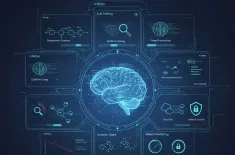
Intelligent Process Automation (IPA) represents the "thinking" component of the automation spectrum. If RPA provides the "brawn" to execute manual clicks and data entry, IPA provides the "brains" to understand context and make decisions.
The IPA Technology Stack
To achieve end-to-end automation, IPA combines several critical technologies:
-
Robotic Process Automation (RPA): The foundation that handles structured data and repetitive tasks.
-
Artificial Intelligence (AI): Provides decision-making capabilities and pattern recognition.
-
Machine Learning (ML): Allows the system to improve over time by learning from historical data.
-
Natural Language Processing (NLP): Enables the automation of communication, such as reading emails or interpreting voice.
-
Computer Vision: Allows bots to "see" and interact with legacy interfaces or scanned documents.
How RPA and AI Create End-to-End AI-Driven Workflows
The true power of Hyper-automation lies in the transition from "task automation" to "process orchestration." In a traditional setup, RPA might stop if it encounters an unstructured invoice or a vague customer query. By integrating IPA, the workflow becomes truly end-to-end.
The Synergy in Action
-
Data Ingestion: A bot receives an unstructured PDF.
-
Cognitive Analysis: AI (via OCR and NLP) reads the document, understands the intent, and extracts relevant data.
-
Decision Making: Machine learning models assess the data against historical patterns to approve or flag the request.
-
Execution: RPA bots update the ERP system, notify the customer, and trigger the next step in the supply chain.
This seamless flow is the hallmark of operational efficiency in 2025. It eliminates the "human-in-the-loop" requirement for mundane decisions, allowing the workforce to focus on strategy and innovation.
Why Hyper-automation is Essential for Digital Transformation
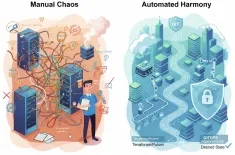
For many organizations, digital transformation has been a fragmented journey. They might have a chatbot here and a data entry bot there, but these "islands of automation" don't talk to each other. Hyper-automation bridges these gaps.
Key Benefits for the Modern Enterprise
-
Scalability: Unlike human teams, AI-driven workflows can scale instantly to meet demand without increasing overhead.
-
Unprecedented Accuracy: By removing manual data entry, businesses can achieve near-zero error rates in critical functions like finance and compliance.
-
Enhanced Employee Experience: By automating the "drudge work," employees are empowered to take on more creative, value-added roles.
-
Agility: Organizations can pivot faster because their processes are documented, digitized, and easily modifiable through low-code/no-code platforms.
The Future of Automation: Agentic AI and Beyond
As we look toward the future, Hyper-automation is evolving into "Agentic AI." These are autonomous agents that don't just follow a script but can reason, plan, and execute multi-step goals independently. This will be the next frontier of operational efficiency, where systems can self-correct and optimize in real-time.
Conclusion
The integration of Hyper-automation and Intelligent Process Automation (IPA) is no longer an optional luxury—it is a competitive necessity. By combining the execution power of RPA with the cognitive intelligence of AI, businesses can complete their digital transformation and unlock levels of operational efficiency that were previously impossible.