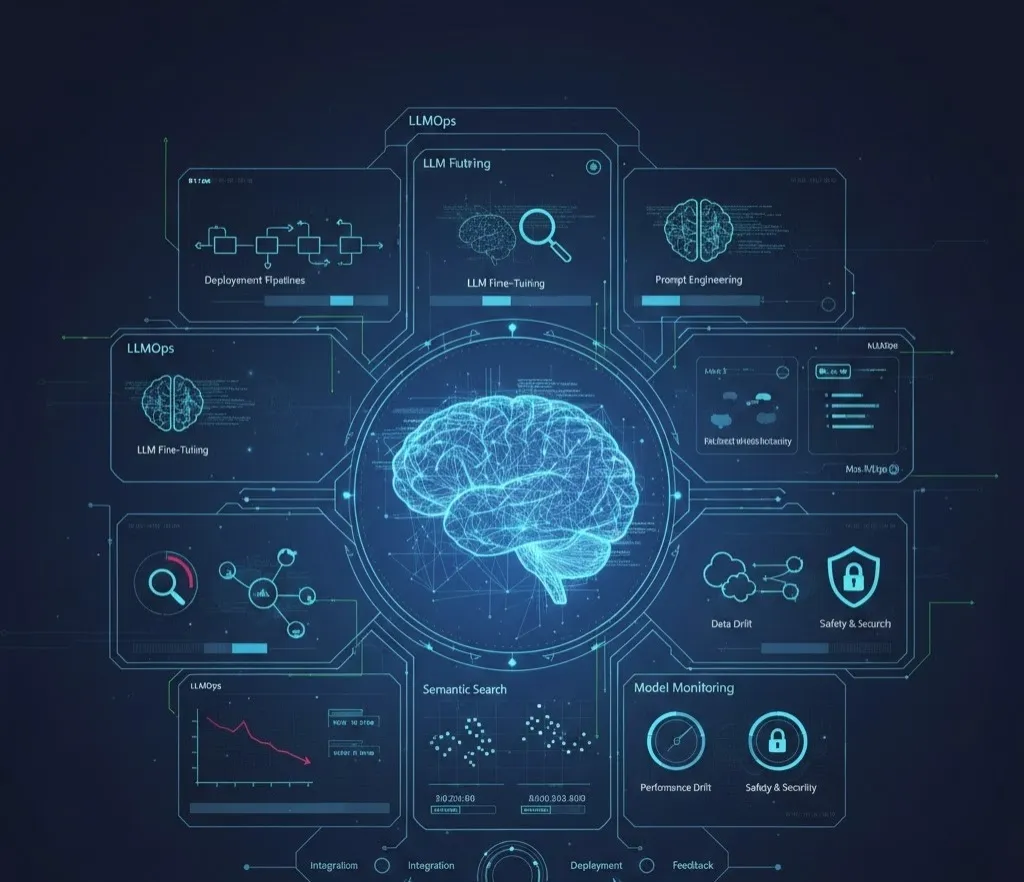
Learn about deployment pipelines, prompt engineering, LLM fine-tuning, and performance drift.
The surge of Large Language Models (LLMs) like GPT-4, Llama, and Claude has ushered in a new era of generative AI applications. These models are capable of complex text generation, sophisticated reasoning, and dynamic interaction, making them transformative tools for enterprises. However, moving an LLM from an experimental environment to a reliable, scalable production system presents unique and substantial challenges. This necessity has given rise to a specialized discipline: Large Language Model Operations, or LLMOps.
LLMOps is the specialized set of practices and tools for deploying, managing, monitoring, and updating Large Language Models (LLMs) in production. It is an extension and adaptation of MLOps (Machine Learning Operations), tailored to address the sheer scale, computational demands, non-deterministic nature, and unique evaluation requirements of massive language models.
While MLOps provides the foundational principles for managing the entire machine learning lifecycle—from data preparation and training to deployment pipelines and monitoring—LLMOps specifically handles the complexities associated with models that boast billions of parameters and primarily deal with unstructured, natural language data.
Core Components of the LLMOps Lifecycle
The LLMOps lifecycle is a continuous loop designed for iteration and improvement. It encompasses stages that go beyond traditional ML workflows, integrating LLM-specific techniques and infrastructure.
1. Data and Model Management
The process begins with the critical task of managing data and the model itself. Given the resource demands of LLMs, organizations rarely train them from scratch. Instead, they utilize powerful foundation models and adapt them:
-
Foundation Model Selection and Versioning: Choosing the right base LLM (open-source or proprietary) and establishing a robust versioning system for both the model weights and the underlying data is crucial for reproducibility and auditing.
-
Data Preparation for LLMs: High-quality, domain-specific data is essential. This stage involves sophisticated data cleaning, deduplication, and pre-processing techniques specifically for text corpora to reduce bias and improve contextual relevance during adaptation.
2. Adaptation and Customization
Instead of full retraining, LLMs are typically adapted for specific business tasks through two primary methods:
A. LLM Fine-Tuning
LLM fine-tuning is the process of further training a pre-trained LLM on a smaller, task-specific dataset. This is done to specialize the model's knowledge and behavior for a niche domain or specific task (e.g., summarizing legal documents, generating medical reports). Techniques like Parameter-Efficient Fine-Tuning (PEFT), such as Low-Rank Adaptation (LoRA), have emerged to make fine-tuning feasible by drastically reducing computational and storage costs. Fine-tuning allows an organization to achieve superior performance for a targeted use case compared to simply using the generic foundation model.
B. Prompt Engineering
Prompt engineering is the art and science of designing and optimizing the input prompts sent to an LLM to elicit a desired output. Since LLMs are often used via API calls without modification to their core weights, the prompt acts as the primary means of control and customization.
This discipline involves techniques like:
-
Zero-shot/Few-shot Prompting: Providing a few examples within the prompt to guide the model's behavior.
-
Chain-of-Thought (CoT): Structuring the prompt to encourage the model to show its reasoning steps before providing the final answer.
-
System Prompts: Using pre-defined instructions to set the model's persona, guardrails, and constraints.
Robust LLMOps includes systems for prompt versioning, testing, and A/B testing prompts in production, as a small change in the prompt can have a massive impact on the output quality.
3. Deployment and Orchestration
Deployment involves integrating the LLM into the end-user application.
-
Deployment Pipelines: Automated deployment pipelines are a hallmark of LLMOps. These CI/CD (Continuous Integration/Continuous Deployment) pipelines automate the testing, packaging, and deployment of the LLM or its associated application components. Given the size of LLMs, this often involves specialized infrastructure like high-performance GPUs/TPUs and fast inference servers (e.g., vLLM).
-
Retrieval-Augmented Generation (RAG): Many modern LLM applications utilize RAG, where the LLM is "grounded" by external, up-to-date information retrieved from a vector database (using vector embeddings) based on the user's query. The LLMOps architecture must efficiently manage this orchestration, including the health and performance of the vector store and the search/retrieval components.
The Imperative of Model Monitoring
Once an LLM is in production, the work of LLMOps transitions into continuous management and model monitoring. Given the dynamic, non-deterministic, and context-dependent nature of LLM outputs, monitoring is arguably more complex and critical than for traditional ML models.
Why is LLM Model Monitoring Essential?
Model monitoring for LLMs ensures that the deployed system maintains its performance, safety, and alignment with business goals over time. The primary risks that monitoring addresses are:
-
Performance Drift: The model's real-world effectiveness degrades because the nature of the production data changes over time.
-
Safety and Security: The model begins producing toxic, biased, or harmful outputs, or is susceptible to malicious inputs like prompt injection attacks.
-
Cost Spikes: Unoptimized usage or sudden changes in traffic lead to high token consumption and increased inference costs.
The Evolution: From MLOps to LLMOps
LLMOps stands on the shoulders of MLOps, inheriting best practices like CI/CD, version control, and automated deployment pipelines. However, the differences are significant:
| Feature | MLOps (Traditional ML) | LLMOps (Large Language Models) |
| Model Scale | Smaller, task-specific models (MB to few GBs). | Massive foundation models (GB to TBs), billions of parameters. |
| Data Type | Primarily structured data (tabular, images, sensor signals). | Primarily unstructured text and natural language. |
| Customization | Full model retraining or transfer learning. | LLM fine-tuning, RAG, and heavy reliance on prompt engineering. |
| Evaluation | Deterministic metrics: Accuracy, Precision, Recall, F1-Score. | Non-deterministic, subjective metrics: Coherence, Relevance, Safety, Hallucination Rate. Often requires LLM-as-a-Judge or Human-in-the-Loop. |
| Key Operational Challenge | Data drift (input features change). | Performance drift, prompt injection, and high inference costs. |
Conclusion and Future Outlook
LLMOps is not just a buzzword; it is a critical necessity for enterprises serious about productionizing generative AI. By providing a structured framework for LLM fine-tuning, managing prompt engineering workflows, establishing robust deployment pipelines, and executing continuous model monitoring to detect performance drift, LLMOps transforms promising research into reliable business value.
As LLMs become further integrated into complex, multi-step applications (like autonomous agents), the future of LLMOps will involve even more sophisticated observability tools that track the entire "trace" of an interaction, from the initial user prompt and semantic retrieval to the final generated response, ensuring that these complex systems remain safe, cost-efficient, and effective.