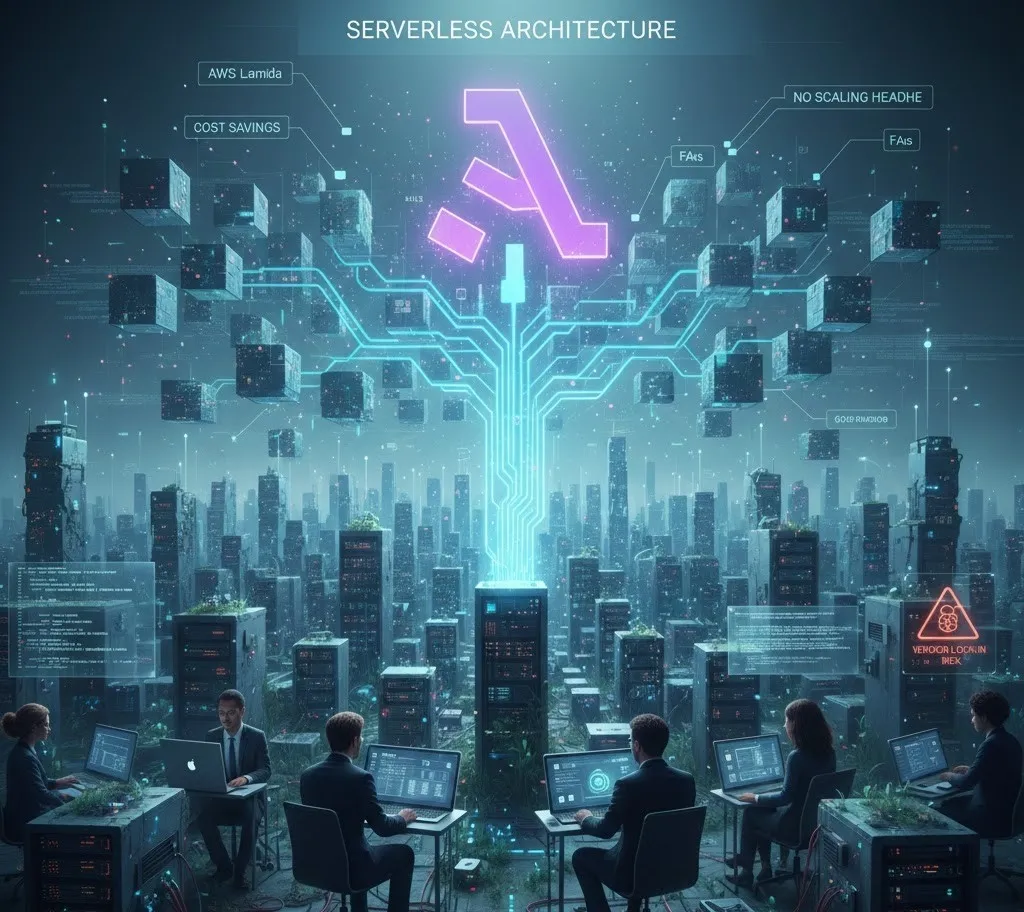
Learn the operational benefits, drawbacks, and the future of cloud computing.
The shift in cloud computing has moved decisively beyond merely renting virtual servers. Today, modern organizations are embracing Serverless Architecture, an evolutionary paradigm that fundamentally abstracts away the infrastructure burden, allowing developers to focus solely on writing code. Far from implying the absence of servers—which still exist, managed entirely by the cloud provider—the term signifies the elimination of server management, provisioning, and scaling concerns for the user. This revolutionary model, driven by functions as a service (FaaS), is rapidly becoming the new standard for building agile, scalable, and cost-effective applications in the cloud ecosystem.
The sheer scale of this transformation is reflected in market growth. The global serverless architecture market, valued at over $17 billion in 2025, is projected to surge to over $124 billion by 2034, expanding at a massive CAGR of over 24%. This explosive adoption across all major cloud providers—including industry leader AWS Lambda, Azure Functions, and Google Cloud Functions—demonstrates serverless computing’s pivotal role in the future of web development, microservices, and event-driven systems.
The Economics of Execution: The Pay-Per-Execution Model
The core disruptive element of serverless architecture is its financial model: pay-per-execution.
In traditional Infrastructure as a Service (IaaS) or even Platform as a Service (PaaS), developers provision a fixed amount of resources—such as a Virtual Machine (VM) or container—and are charged for its uptime, regardless of whether it is actively processing requests or sitting idle. Developers often over-provision to ensure they can handle peak traffic, resulting in significant wasted resources and a higher overall infrastructure cost.
The pay-per-execution model completely overturns this. With FaaS platforms like AWS Lambda, billing is granular and precise, based on three main factors:
- Invocation Count: The number of times a function is triggered.
- Execution Duration: The time the code actually runs, typically measured in 100-millisecond increments.
- Memory Allocation: The amount of memory consumed during execution (often billed in GB-seconds).
This approach allows organizations to achieve massive infrastructure cost savings because they literally stop paying the moment their code finishes executing. For applications with unpredictable, sporadic, or event-driven workloads—such as a file upload trigger, an authentication service, or scheduled batch jobs—this model is exceptionally cost-efficient. You pay for value, not for idle capacity.
Operational Benefits for Modern Web Development
The operational advantages of serverless architecture have been the primary driver of its rapid adoption, particularly within the domain of modern web development and microservices architecture.
Eliminating the Scaling Headache
Perhaps the most compelling benefit is the complete removal of the scaling headache. In traditional environments, handling a sudden, massive spike in traffic—a Black Friday sale, a viral marketing campaign, or a DDoS attack—requires complex auto-scaling groups, load balancers, and rigorous capacity planning.
Serverless platforms, by design, provide elastic scalability out-of-the-box. The cloud provider automatically provisions and de-provisions the underlying containers to meet demand. If your function receives one request or one million concurrent requests, the architecture handles it seamlessly, scaling instantly from zero to peak capacity without any manual intervention. This inherent elasticity ensures performance stability and system resilience.
Reduced Operational Overhead and Faster Time-to-Market
By abstracting server management, patching, operating system maintenance, and security hardening, serverless significantly reduces the operational burden on the development team. The shift in responsibility is profound:
Before Serverless: Developers and DevOps teams spend time on server patching, capacity planning, and managing container orchestration (e.g., Kubernetes).
With Serverless: Developers focus entirely on writing business logic.
This increased developer productivity translates directly into a faster time-to-market. New features, patches, and updates can be deployed rapidly as independent functions, accelerating the Continuous Integration/Continuous Deployment (CI/CD) pipeline and fostering a truly agile application development environment.
High Availability and Built-in Fault Tolerance
Serverless functions are inherently distributed and run across multiple availability zones within a cloud region. This architecture ensures built-in fault tolerance and high availability without the developer having to configure complex redundancy mechanisms. If one underlying container or zone fails, the cloud provider simply routes the execution to a healthy environment, maintaining application uptime and performance.
Key Drawbacks and Challenges
While serverless architecture offers revolutionary advantages, it is not a silver bullet. Organizations must be aware of its specific drawbacks to make informed architectural decisions.
The Cold Start Latency Problem
The most frequently cited performance drawback is cold start latency. Because the functions as a service (FaaS) model only runs code when triggered, an idle function is ‘spun down’ to zero. When a request arrives, the platform must first provision a new execution environment, load the code, and initialize the runtime. This initialization delay, or "cold start," can add anywhere from a few hundred milliseconds to several seconds, especially for functions written in heavier languages like Java or .NET.
While often negligible for background tasks or high-traffic APIs where functions are usually 'warm,' this latency can be detrimental to time-sensitive, user-facing applications requiring very low response times. Developers often resort to "warming" techniques (periodic dummy calls) to mitigate this, but it adds complexity and cost.
Vendor Lock-In Risk
A significant business drawback is the vendor lock-in risk. Serverless offerings are deeply integrated into their respective cloud ecosystems. Services like AWS Lambda are tightly coupled with other proprietary AWS services (e.g., SQS, DynamoDB, API Gateway).
Migrating a complex serverless application from one provider (like AWS) to another (like Azure or GCP) can be extremely difficult and costly. The proprietary APIs, deployment methodologies, and managed services do not have direct equivalents, often requiring a near-complete re-architecture of the code and the supporting infrastructure. Organizations must weigh the benefits of rapid development and tight integration against the strategic risk of becoming overly dependent on a single cloud vendor.
Complexity in Testing, Debugging, and Monitoring
The event-driven, distributed nature of serverless makes troubleshooting significantly more complex than in a monolithic application. A single user action can trigger a chain of multiple small, ephemeral functions across various services.
Debugging: Developers lack direct access to the underlying server operating system, making traditional debugging difficult. Replicating the full cloud environment locally for testing is challenging and often requires cloud-specific emulators or live deployment.
Monitoring: Tracing a request as it passes through a dozen separate functions requires sophisticated, costly, and specialized observability tools. Pinpointing the root cause of an error in this distributed chain is a steep learning curve for teams accustomed to traditional logging and monitoring.
Governance and Cost Sprawl
While serverless promises infrastructure cost savings, the pay-per-execution model can lead to unpredictable costs if not governed correctly. A simple bug—such as a recursive function call or an unintended event loop—can result in an explosion of invocations and an unexpectedly high bill. Cost governance requires careful monitoring, setting budget alerts, and optimizing the memory allocation and execution time of every function.
Conclusion: Serverless Architecture’s Future
Serverless computing is no longer a niche technology; it is the new cloud standard that defines agility and operational efficiency for modern web and application development. Its core value proposition—the elimination of server management and the transformative pay-per-execution model—allows organizations to achieve unprecedented infrastructure cost savings and focus developer talent purely on business value.
The transition from traditional VMs and containers to ephemeral functions as a service (FaaS) represents a profound philosophical shift in how we build on the cloud. While challenges like the vendor lock-in risk and initial complexity exist, the industry is actively addressing them through emerging multi-cloud abstraction layers and enhanced observability tools. For forward-thinking organizations, adopting platforms like AWS Lambda is an imperative. It eliminates the scaling headache, accelerates time-to-market, and positions the development team to be hyper-responsive to customer demands, ensuring that they remain competitive in the rapidly evolving digital landscape.