Learn about mixed reality SDKs, 3D interface design, and industrial training apps.
The New Dimension: A Comprehensive Guide to Spatial Computing and AR/VR Development
As we navigate through 2025, the boundary between our physical environment and the digital world is dissolving. We have moved past the era of looking at screens to an era of living inside them. This shift is driven by Spatial Computing, a paradigm that enables computers to perceive, navigate, and interact with the three-dimensional space we inhabit. By merging Augmented Reality (AR) and Virtual Reality (VR), developers are now building persistent digital environments that feel as tangible as the world around us.
Understanding the Ecosystem: AR, VR, and Spatial Computing
While the terms are often used interchangeably, they represent different degrees of immersion within the spatial spectrum:
-
Augmented Reality (AR): AR overlays digital information—such as 3D models, text, or navigational arrows—onto the real world. It enhances our perception without replacing it, primarily delivered through smartphones or lightweight smart glasses.
-
Virtual Reality (VR): VR provides total immersion by replacing the physical world with a fully synthetic environment. It is the go-to for gaming and high-stakes simulations where sensory isolation is required.
-
Spatial Computing: This is the "brain" behind the beauty. It is the collective technology (AI, computer vision, and sensors) that allows a device to understand the geometry of a room, the location of a table, or the movement of a hand. It ensures that a virtual lamp placed on your real desk stays there, even if you leave the room and return later.
The Architect’s Toolkit: Platforms and Mixed Reality SDKs
Developing for the spatial web requires more than just standard coding; it requires engines that can simulate physics and light in real-time.
1. The Core Engines: Unity and Unreal Engine
Unity remains the industry leader for mobile AR and cross-platform VR, thanks to its AR Foundation framework. However, Unreal Engine 5 is increasingly favored for high-fidelity "industrial metaverse" projects, where photorealism is necessary for architectural visualizations or complex engineering simulations.
2. Powering Interaction with Mixed Reality SDKs
To bridge the gap between hardware and software, developers rely on specialized mixed reality SDKs. These kits provide pre-built components for hand-tracking, eye-gaze interaction, and spatial mapping.
-
MRTK (Mixed Reality Toolkit): Originally by Microsoft, this is the gold standard for enterprise-grade apps. It allows developers to create interfaces that respond to "pinch" gestures or voice commands.
-
ARKit (Apple) & ARCore (Google): These are the foundations of mobile AR, providing world-tracking and plane detection for billions of devices.
-
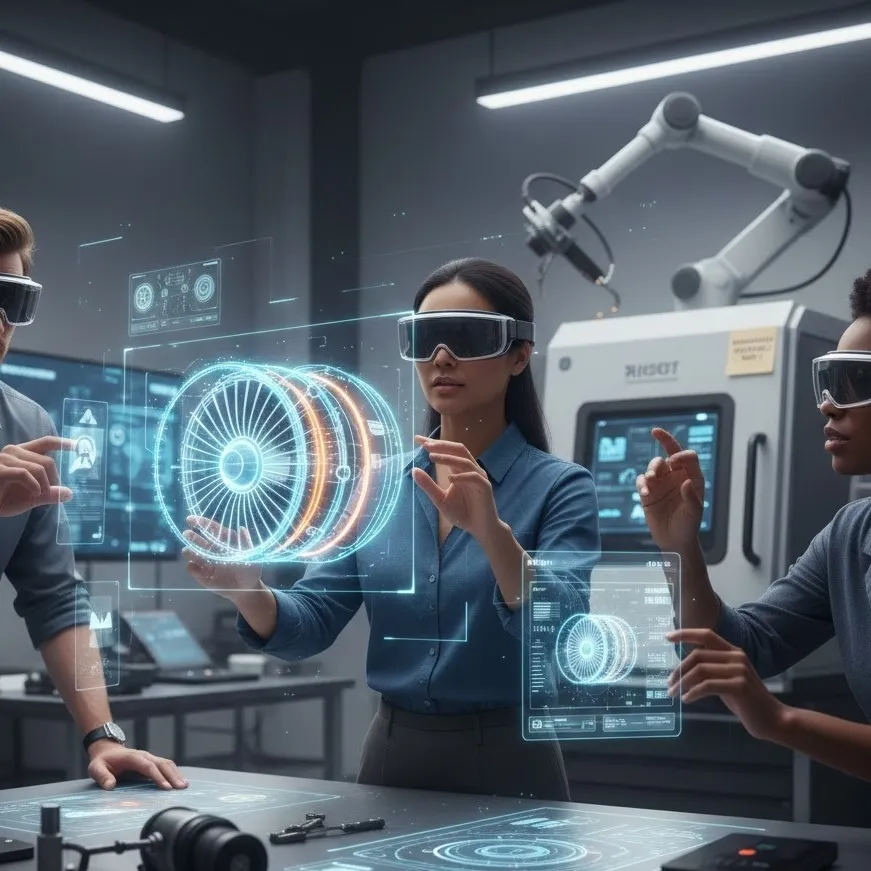
Vuforia: A veteran in the space, Vuforia is essential for industrial training apps, offering robust "Model Targets" that allow AR software to recognize and "attach" digital instructions to specific pieces of heavy machinery.
Principles of 3D Interface Design
In spatial computing, the "click" is dead. User experience (UX) designers are now architects of space. 3D interface design focuses on ergonomics and natural human behavior.
-
Diegetic UI: Instead of a floating menu that follows your head (which causes "nausea" and "visual clutter"), designers place menus on physical surfaces, like a "virtual tablet" on a real table.
-
Direct Manipulation: If you see a virtual slider, you should be able to reach out and push it with your finger. This tactile-first approach reduces the learning curve.
-
Spatial Audio: To make an environment feel "persistent," sound must behave realistically. If a virtual bird is chirping behind you, the audio must shift as you turn your head, providing a 360-degree sense of presence.
The Rise of Industrial Training Apps
The most significant ROI for spatial computing is currently found in the enterprise sector. Industrial training apps are revolutionizing how workforces learn.
Imagine a new technician tasked with repairing a complex jet engine. Instead of a 500-page manual, they wear an AR headset. The spatial computing software recognizes the engine, highlights the specific bolt that needs turning, and displays a 3D animation of the process. This "learn-while-doing" model reduces errors by up to 40% and drastically cuts down training time.
These apps leverage persistent digital environments, meaning a senior engineer in London can "drop" a virtual sticky note on a machine in a New York factory. That note remains there, visible to anyone with the right device, until the task is completed.
The Future: Persistent and Blended Realities
The ultimate goal of spatial development is the "Mirrorworld"—a digital twin of our physical world that is persistent and shared. As 5G and 6G networks mature, we will see digital layers that don't just "float" but interact with the physical world’s lighting and physics.
We are moving toward a future where "the world is your canvas," and the only limit to what we can build is the depth of our digital imagination.