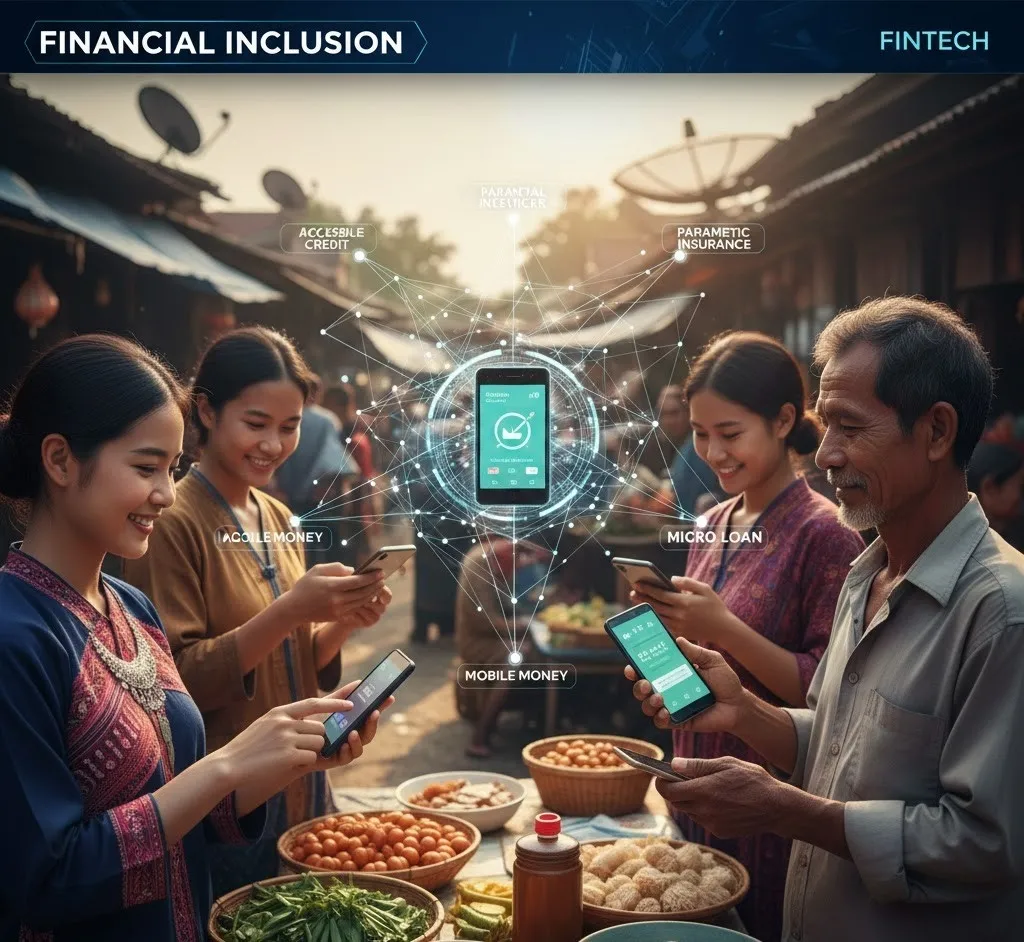
Discover how FinTech, mobile money, and digital wallets are providing accessible credit
Financial inclusion—the process of ensuring individuals and businesses have access to useful and affordable financial products and services—is a critical global imperative. Historically, a significant portion of the world's population, often referred to as the underbanked population or unbanked, has been systematically excluded from the formal financial system. This exclusion perpetuates poverty, hinders economic growth, and limits individuals' ability to save, invest, and manage risk.
The rise of FinTech, or financial technology, marks a turning point in this challenge. By leveraging digital innovation, FinTech companies are dismantling the traditional barriers of cost, physical distance, and cumbersome bureaucracy that have long kept billions outside the financial ecosystem. This long-form content will delve into the multifaceted ways technology is delivering banking, credit, and insurance services to those traditionally excluded, particularly in emerging markets, and explore the semantic and intent keywords driving this digital revolution.
FinTech: A Disruptor of Traditional Barriers
Traditional financial services, dominated by brick-and-mortar banks, have struggled to serve the unbanked for several reasons. High operational costs associated with physical branches, a lack of verifiable credit history, and the geographic isolation of many rural communities render these populations unprofitable or too risky for conventional institutions.
FinTech’s core value proposition is its ability to reduce costs, increase reach, and innovate on traditional models. By operating digitally, FinTech minimizes the need for extensive physical infrastructure, passing those savings on in the form of lower fees or zero-cost services. This accessibility, coupled with a focus on user experience, is the engine driving mass adoption.
The Foundation: Mobile Money and Digital Wallets
The most significant technological breakthrough enabling financial inclusion is the ubiquity of the mobile phone. In many emerging markets, cellular network penetration far surpasses traditional bank branch density, making the mobile phone the primary, and often only, tool for accessing digital services.
Mobile Money: The Game Changer
Mobile money platforms, pioneered by services like M-Pesa in Kenya, have transformed economies. These services allow users to store, send, and receive money using a simple feature phone, bypassing the need for a bank account or internet access. Millions of people, particularly in rural and remote areas, now use their phones to:
- Pay bills: Utility, school, and government fees.
- Send remittances: Cross-border or domestic money transfers, which are often faster and cheaper than traditional channels.
- Save: Access to secure, interest-bearing accounts.
This technology created a low-cost, high-reach distribution channel, effectively tackling the geographic and infrastructural challenges faced by the underbanked population. The simplicity of the user interface and the reliance on a vast network of human agents for cash-in and cash-out operations proved crucial for overcoming digital literacy barriers.
Digital Wallets and Payment Platforms
The evolution from basic mobile money to more sophisticated digital wallets—apps often tied to a smartphone—has further accelerated inclusion. These wallets, which power national and regional digital payment systems (like India’s UPI or Brazil’s Pix), enable seamless peer-to-peer (P2P) and consumer-to-business transactions.
Digital payments:
- Reduce the cost of transactions for micro-enterprises and small vendors.
- Create digital financial footprints, which are vital for accessing formal credit later.
- Improve government efficiency by enabling direct transfers of subsidies and social security benefits, reducing leakage and corruption.
This digital payment infrastructure is foundational, transforming everyday transactions from cash-based, opaque exchanges into trackable, digital events that feed the data ecosystem of FinTech.
Expanding Opportunities: Accessible Credit and Microfinance
One of the most profound impacts of FinTech is in the realm of credit. Traditional banks rely on established credit history, collateral, and stable income—metrics that automatically disqualify the majority of the underbanked population and small businesses in emerging markets. FinTech has pioneered a new path for accessible credit.
Alternative Data for Credit Scoring
FinTech lenders are using proprietary algorithms and machine learning to build alternative credit scoring models. Instead of solely relying on traditional credit bureau data, which is often non-existent for the unbanked, these models analyze:
- Mobile money and digital wallet transaction history.
- Utility bill payment consistency.
- Social media activity (in some models, though controversially).
- App usage and psychometric data (for behavioral assessment).
This use of alternative data allows FinTech lenders to accurately assess the creditworthiness of individuals and small businesses with "thin files," enabling the provision of small-value, short-term digital loans. Companies like Tala or Branch have successfully leveraged this model to offer instant, unsecured loans directly to mobile phones in multiple emerging markets, bridging a critical liquidity gap.
The Digital Transformation of Microfinance
Microfinance institutions (MFIs) have long been crucial for providing credit to low-income entrepreneurs, but their model was often constrained by the manual processes of loan officer-client interaction. FinTech integrates digital tools to supercharge and scale microfinance operations:
- Reduced Operational Costs: Digital loan applications, automated underwriting, and mobile repayments dramatically lower the cost per loan, making it viable to offer smaller loans at fairer rates.
- Faster Disbursement: Loan funds can be transferred instantly to a recipient’s digital wallets or mobile money account, a vital factor for urgent business needs.
- Enhanced Risk Management: The digital collection of repayment data in real-time allows for faster intervention and more personalized loan products, reducing default rates.
The synergy between technology and microfinance has made financial services more timely, efficient, and broadly available than ever before, proving that the provision of accessible credit is commercially viable.
Beyond Banking: FinTech's Role in Insurance and Savings
Financial inclusion is not just about payments and credit; it's also about resilience and security. Populations excluded from formal systems are often the most vulnerable to economic shocks (like crop failure, illness, or natural disasters) because they lack safety nets like formal insurance and secure savings mechanisms.
InsurTech for the Underbanked
FinTech is driving InsureTech models that overcome the traditional barriers of high premiums, complex products, and manual claims processing that previously excluded low-income households:
- Micro-Insurance: Small, bite-sized insurance products (e.g., life, health, crop, or livestock) are distributed and serviced entirely through mobile money channels. Premiums can be as low as a few cents per day, paid directly from the user's phone.
- Parametric Insurance: This innovative model automates payouts based on objective triggers. For example, a farmer’s crop insurance might pay out automatically if a weather station registers insufficient rainfall, eliminating the need for expensive, time-consuming on-site loss assessment.
- Digital Distribution: By partnering with mobile network operators or major consumer brands, InsurTech companies can embed insurance into everyday transactions (e.g., purchasing airtime), making the product purchase simple and culturally relevant.
Digital Savings and Investment
FinTech provides secure, interest-bearing savings vehicles that are easily accessible via a mobile phone. Unlike traditional savings, which often require minimum balances and long journeys to a branch, digital savings tools allow the underbanked population to start saving with minimal amounts and at their convenience. Furthermore, fractional ownership platforms and robo-advisors are making entry-level investment opportunities accessible to users who previously could not meet the high minimum investment thresholds of traditional wealth management.
Challenges and the Future of Digital Inclusion
Despite its rapid progress, the journey toward universal financial inclusion is not without hurdles, especially within emerging markets.
Overcoming the Digital Divide
While mobile phone penetration is high, a significant gap remains in digital literacy and smartphone ownership. FinTech solutions must remain interoperable with basic feature phones and incorporate user-friendly designs and local language support to ensure no one is left behind.
Regulatory and Consumer Protection Risks
The rapid pace of FinTech innovation often outpaces regulatory frameworks. Governments and central banks must strike a balance between fostering innovation and safeguarding consumers. Issues like data privacy, predatory lending practices (common in some digital lending apps offering accessible credit), and system security require vigilant RegTech (Regulatory Technology) solutions and strong oversight.
The Role of Digital Identity
A fundamental barrier to accessing formal finance is the lack of formal identification. FinTech, often in collaboration with governments, is leveraging digital ID systems (like India's Aadhaar or various national biometric databases) and blockchain technology to create secure, verifiable digital identities. This is essential for remote Know Your Customer (KYC) procedures, allowing the underbanked population to open accounts and access services without physical paperwork.
Conclusion
FinTech has unequivocally proven to be the most potent force for advancing financial inclusion in the 21st century. By transforming the mobile phone into a personal financial branch, FinTech has provided the underbanked population with access to essential financial services—from mobile money and digital wallets for payments, to algorithmic lending for accessible credit and microfinance, and low-cost insurance.
This digital revolution is not merely an act of corporate social responsibility; it is a sustainable, market-driven phenomenon. By turning the historically excluded into a viable customer base, FinTech is unlocking immense human and economic potential in emerging markets worldwide, building the foundation for a more equitable and prosperous global economy. The partnership between innovation, policy, and consumer education is the key to ensuring this digital bridge reaches every last person who needs it.