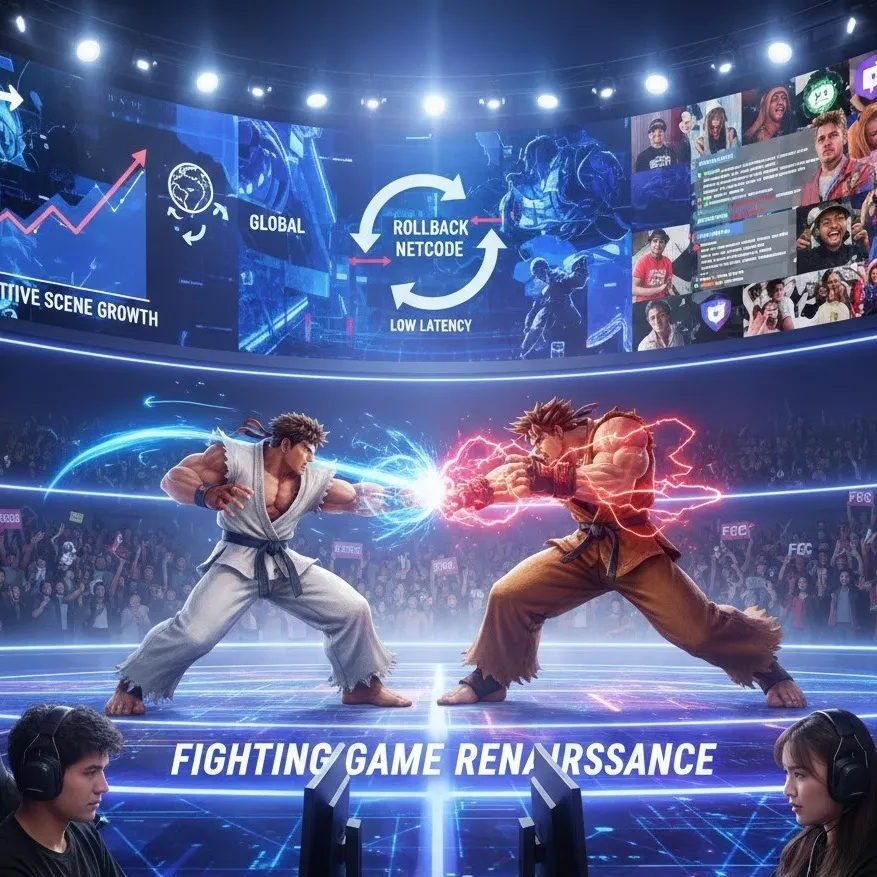
Learn how rollback netcode and competitive scene growth are fueling FGC culture.
The Resurgence of the Hardcore Fighting Game
For nearly a decade, the hardcore fighting game genre existed in a state of high-fenced isolation. While the broader gaming industry exploded into a multi-billion dollar mainstream phenomenon, the Fighting Game Community (FGC) remained a dedicated but niche subset, often held back by steep learning curves and, more importantly, a crumbling digital infrastructure. However, we are currently witnessing a massive fighting game renaissance. This era isn't just defined by shiny new graphics or iconic character rosters; it is a fundamental shift in how these games are played, viewed, and sustained globally.
The New Titans: Street Fighter 6 and Tekken 8
At the heart of this revival are two industry juggernauts that have redefined what a modern "hardcore" fighter should be. Street Fighter 6 arrived with a clear mission: to erase the stumbles of its predecessor and welcome a new generation without compromising its competitive integrity. By introducing "Modern Controls" alongside classic inputs, Capcom lowered the barrier to entry, allowing newcomers to experience the thrill of high-level strategy without spending months mastering execution.
On the other side of the ring, Tekken 8 doubled down on the "Heat System," a mechanic designed to reward aggressive play and cinematic flair. Unlike previous iterations that felt like iterative updates, Tekken 8 feels like a bombastic evolution. Together, these titles have spearheaded competitive scene growth, breaking registration records at major tournaments like EVO (Evolution Championship Series) and bringing mainstream sponsors like Red Bull and Chipotle into the fold.
The Technical Savior: Rollback Netcode
While marketing and accessibility are vital, the true catalyst for this renaissance is a technical breakthrough: rollback netcode. To understand why this changed everything, we must look at the "Dark Ages" of online fighting games.
For years, developers relied on "delay-based netcode." In this system, the game pauses and waits for data from both players to arrive before advancing a frame. If the connection flickered for even a millisecond, the game would stutter, eat inputs, and transform a precise match into a slideshow. For a genre where a single frame (1/60th of a second) can determine a win or a loss, delay-based netcode made serious online competition impossible.
Rollback netcode flipped the script. Instead of waiting for data, rollback predicts the opponent's next move based on their current state. If the prediction is correct, the game continues seamlessly. If the incoming data shows the opponent did something different, the game "rolls back" the state to the correct frame and updates it instantly. This happens so fast that players rarely notice.
This technical improvement effectively "deleted" distance. Suddenly, a player in New York could have a tournament-quality match against a player in California. By making the online competitive fighting game scene viable, rollback netcode allowed the community to thrive during the global pandemic and beyond, ensuring that the "grind" never had to stop just because local arcades were closed.
The Evolution of FGC Culture
The technical and commercial success of these games has fundamentally altered FGC culture. What was once a culture rooted in smoky arcades and "locals" has transformed into a global, digital-first powerhouse. Discord servers have replaced arcade basements, and Twitch has become the new arena.
However, the "hardcore" spirit remains. The competitive scene growth isn't just about the numbers; it’s about the democratization of high-level play. Players from Pakistan, the Middle East, and South America—regions previously isolated by laggy connections—are now dominating world stages. This influx of global talent has breathed new life into the community, creating a more diverse and hyper-competitive environment than ever before.
Looking Forward: A Sustainable Future
The resurgence of the fighting game genre shows no signs of slowing down. With upcoming titles like 2XKO (Riot Games' League of Legends fighter) and the continued support for Street Fighter 6 and Tekken 8, the industry has finally cracked the code on longevity. By combining deep, hardcore mechanics with robust technical infrastructure and accessible entry points, the FGC has moved from the fringes of esports to the center stage.
We aren't just playing fighting games anymore; we are participating in a global cultural movement that values precision, community, and the relentless pursuit of self-improvement.