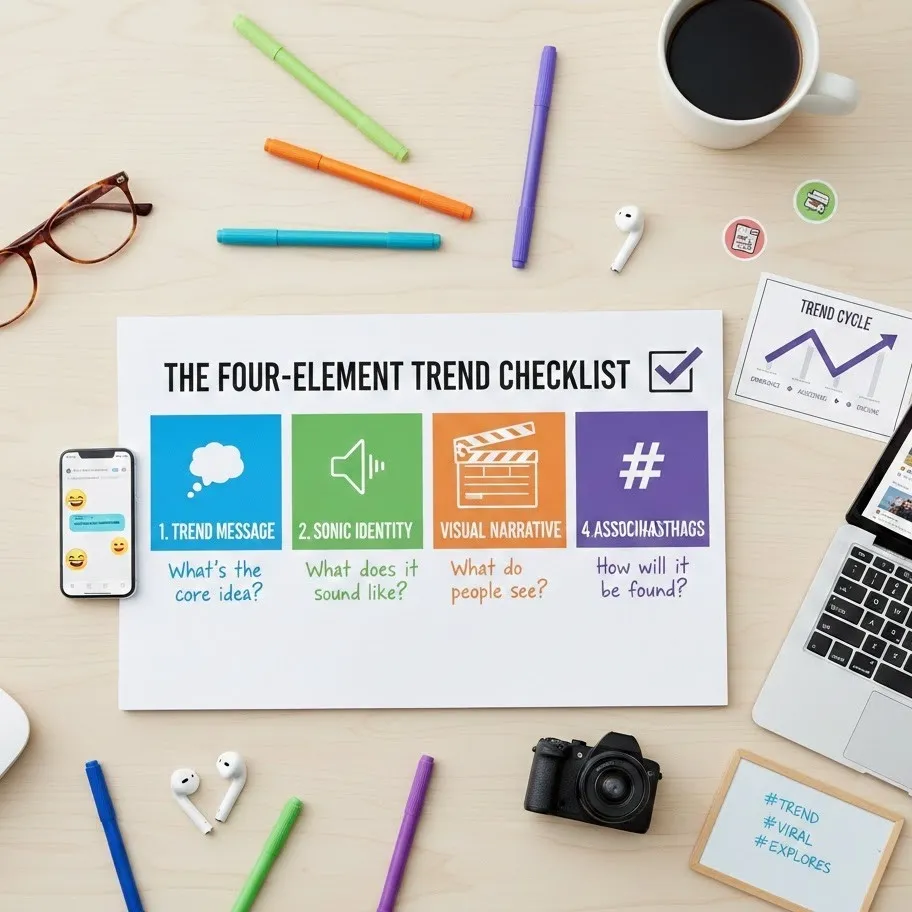
Master the Four-Element Trend Checklist.
Mastering the Four-Element Trend Checklist for Viral Success
In the current digital landscape, social media trends move at the speed of light. What is viral today may be "cringe" by next Tuesday. For content creators and marketers, the challenge isn't just finding a trend; it's understanding how to join it without losing your brand's soul.
The Four-Element Trend Checklist is a simple but powerful framework for jumping on a new trend. Before you hit record, you must identify:
-
The Trend Message: What is being said?
-
The Sonic Identity: What are people hearing?
-
The Visual Narrative: What are people seeing?
-
The Associated Hashtags: How is the algorithm finding it?
By vetting every idea through this checklist, you ensure your content is relevant, timely, and strategically aligned with the trend cycle.
1. Identify the Trend Message: The "What" and "Why"
The first step in the checklist is identifying the trend message. Every viral moment has an underlying theme or "inside joke." Is the trend about self-deprecation? Is it a "how-to" disguised as entertainment? Or is it a commentary on a current cultural event?
To find the message, ask yourself: If I stripped away the music and the visuals, what is the core point being made?
-
Case Study: The "POV" (Point of View) trend. The message is almost always about relatability—putting the viewer in a specific, often humorous situation.
-
Strategy: Your version of the trend must stay true to this message while pivoting the context to fit your niche.
2. Define the Sonic Identity: The Power of Audio
On platforms like TikTok and Instagram Reels, sound isn't just background noise; it is a sonic identity. Audio acts as the primary discovery tool. When a user clicks on a trending sound, they are presented with a feed of every video using that specific track.
A trend's sonic identity can be:
-
A specific snippet of a popular song.
-
An original voiceover or "original audio."
-
An ASMR sound effect (like a satisfying click or crunch).
Pro Tip: Don't just use the sound; understand the timing of the audio. Most trends have a "beat drop" or a specific audio cue that signals a transition. If your visuals don't align with these cues, the content will feel "off" to the audience.
3. Craft the Visual Narrative: Showing, Not Telling
The visual narrative is the sequence of images, clips, and text overlays that tell the story. Even a 15-second video needs a beginning, middle, and end.
The visual style of a trend often involves specific elements:
-
The Hook: An eye-catching first frame or text bubble.
-
The Transition: A snap, a spin, or a camera swipe that moves the story forward.
-
The Aesthetic: High-energy and fast-paced, or "lo-fi" and authentic.
Your visual narrative should be recognizable enough to signal "I'm part of this trend," but unique enough to stand out. For example, if a trend involves a "green screen" effect, using your unique brand colors or a surprising background can give you an edge.
4. Optimize with Associated Hashtags: The Algorithmic Map
Even the best video won't go viral if the algorithm can't categorize it. Associated hashtags are the metadata that tells the platform exactly who should see your video.
When jumping on a trend, your hashtag strategy should be three-fold:
-
The Core Trend Tag: (e.g., #RomanEmpireTrend)
-
Broad Niche Tags: (e.g., #MarketingTips or #Fitness)
-
Branded/Specific Tags: (e.g., #YourBrandName)
Using the right associated hashtags ensures your content appears in the search results and "For You" pages of people already engaging with that specific trend.
Understanding the Trend Cycle: When to Post
Success isn't just about what you post, but when. The trend cycle describes the life span of a viral moment.
| Phase | Description | Action for Creators |
| Emergence | The trend is niche; early adopters are starting to use it. | The Gold Mine. High risk, but highest reward for growth. |
| Ascension | The trend is gaining massive momentum. | The Sweet Spot. Jump on it now while the audience is hungry. |
| Peak (Saturation) | Everyone (including major corporations) is doing it. | Proceed with Caution. You need a very unique "spin" to stand out. |
| Decline | The audience is starting to get bored. | Avoid. Posting now makes your brand look "behind the times." |
Conclusion
By using the Four-Element Trend Checklist, you transform your social media presence from reactive to proactive. You stop "trying to go viral" and start building a structured process that leverages the trend message, sonic identity, visual narrative, and associated hashtags to your advantage.