Discover how genetic testing and AI drug optimization drive precision dosing
Hyper-Personalized Drug Tailoring: The New Era of Precision Medicine
For decades, medicine followed a "one-size-fits-all" philosophy. If you had a specific infection, you were given a specific antibiotic at a standard dose. If you suffered from hypertension, you received the same starting dosage of a beta-blocker as millions of others. However, we have long known that patients react differently to the same treatment—some experience miraculous recoveries, while others suffer from debilitating side effects or find the medication entirely ineffective.
Today, we are moving beyond trial-and-error healthcare. The convergence of Pharmacogenomics, high-resolution genetic testing, and AI drug optimization is ushering in the era of hyper-personalized drug tailoring. This paradigm shift ensures that every patient receives the right drug, at the right dose, at the right time, fundamentally transforming the safety and efficacy of modern therapeutics.
The Foundation: Understanding Pharmacogenomics
At the heart of hyper-personalized tailoring lies Pharmacogenomics. This field is the study of how a person’s unique genetic makeup influences their response to drugs. While traditional medicine looks at the "average" patient, pharmacogenomics looks at the individual's DNA.
Our bodies process medications through a complex system of enzymes, transporters, and receptors. The instructions for building these components are written in our genetic code. Even a single-letter change in a gene (known as a Single Nucleotide Polymorphism or SNP) can radically alter how an enzyme functions.
Why Genetics Matter for Medication
Most drugs are metabolized by a family of enzymes in the liver known as the Cytochrome P450 (CYP450) system. Genetic variations in these enzymes can categorize patients into four main groups:
- Poor Metabolizers: These individuals break down drugs very slowly. Standard doses can build up to toxic levels, leading to severe drug reactions.
- Intermediate Metabolizers: They have reduced enzyme activity and may need lower-than-average doses.
- Extensive (Normal) Metabolizers: They process drugs as expected.
- Ultra-rapid Metabolizers: They break down the drug so quickly that it never reaches therapeutic levels in the blood, making the treatment ineffective.
How Genetic Testing Directs the Optimal Drug Choice
The process of hyper-personalization begins with genetic testing. Unlike diagnostic tests that look for a specific disease, pharmacogenetic testing analyzes specific genes known to interact with common medications.
1. Identifying the "Right Drug"
Certain drugs are "prodrugs," meaning they are inactive when swallowed and must be converted into an active form by the liver (e.g., Codeine being converted to Morphine). For a "Poor Metabolizer," a prodrug will never work. Conversely, for other drugs, a specific genetic mutation might mean the drug’s target receptor is shaped differently, preventing the medicine from "locking" into place. By analyzing these markers, clinicians can skip medications that are genetically destined to fail, moving straight to a more compatible alternative.
2. Preventing Adverse Drug Reactions (ADRs)
Drug reactions are a leading cause of hospitalization and even death globally. Many of these are not "allergic" reactions but "toxic" ones caused by the body's inability to clear a substance. For example, the drug Abacavir (used for HIV) can cause a life-threatening hypersensitivity reaction, but only in patients with a specific genetic marker (HLA-B*5701). Screening for this marker has virtually eliminated this specific reaction in clinical settings.
AI Drug Optimization: The Brain of Precision Dosing
While genetics provide the blueprint, Artificial Intelligence (AI) provides the engine for real-time application. AI drug optimization is the process of using machine learning algorithms to synthesize vast amounts of data—far more than a human doctor could process—to refine treatment.
Beyond DNA: The Multimodal Approach
AI does not just look at a genetic report. It integrates "Multi-omics" data:
- Genomics: Your DNA.
- Proteomics: The proteins currently active in your body.
- Metabolomics: The chemical fingerprints left behind by cellular processes.
- Lifestyle Data: Information from wearable devices (sleep, heart rate, activity levels).
Precision Dosing through Predictive Modeling
The most critical challenge in medicine is often not the drug itself, but the dose. Precision dosing is the practice of adjusting a drug's dose based on individual characteristics to maximize benefit and minimize harm.
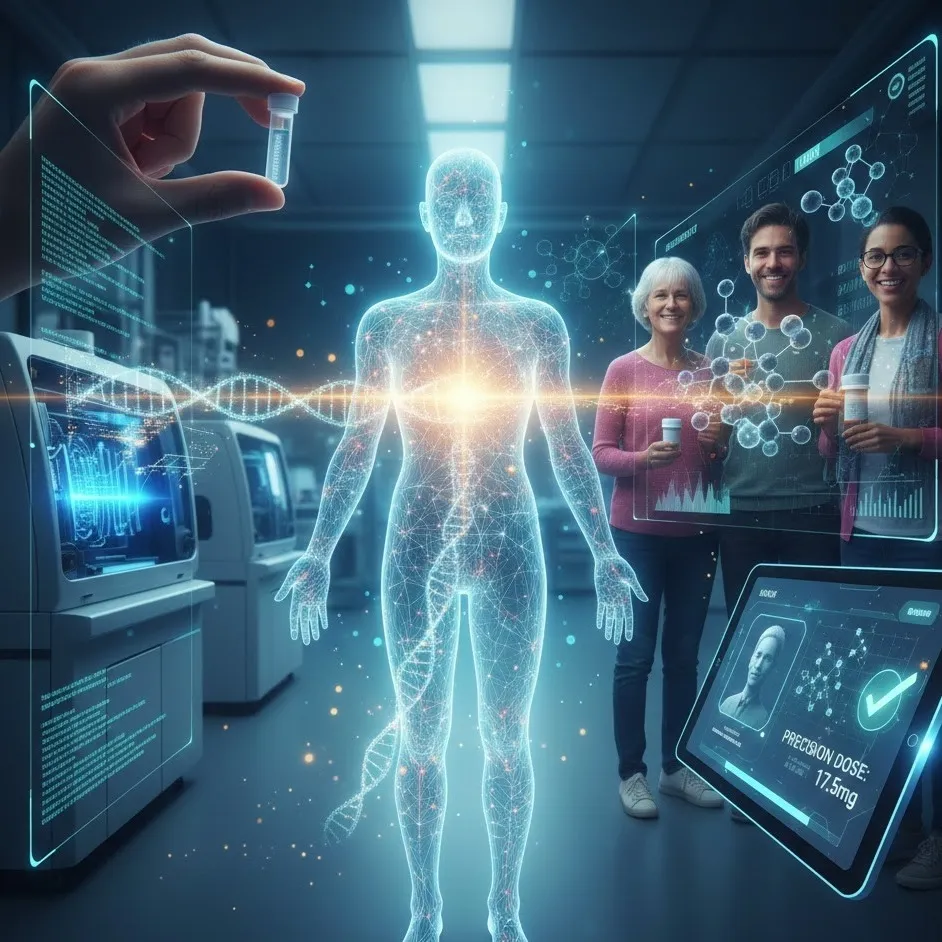
AI algorithms use "Bayesian forecasting" and "Reinforcement Learning" to predict how a drug will behave in a specific body. For instance, if a patient is an intermediate metabolizer (genetics) but is also taking a second medication that inhibits that same enzyme (drug-drug interaction) and has a high body mass index (physiology), the AI can calculate a specific, non-standard dose—perhaps 17.5mg instead of the standard 10mg or 20mg tablets.
The Workflow of Hyper-Personalized Care
The transition from a standard prescription to a hyper-personalized one follows a sophisticated digital-biological loop:
- Sample Collection: A simple cheek swab or blood draw is taken.
- High-Throughput Sequencing: The patient's relevant pharmacogenes are mapped.
- Data Integration: The genetic data is fed into an AI platform alongside the patient's Electronic Health Record (EHR).
- Simulation: The AI runs "In Silico" simulations to predict how the patient’s body will react to various drug-dose combinations.
- Clinical Decision Support: The physician receives a recommendation: "Drug A is likely to cause toxicity; prescribe Drug B at a 25% reduced starting dose."
- Continuous Monitoring: As the patient takes the medication, data from wearables or follow-up blood tests are fed back into the AI to refine the dose over time.
Personalized Medicine in Practice: Key Therapeutic Areas
The impact of this technology is most visible in three critical fields:
Oncology (Cancer Care)
Cancer is a disease of the genome. Hyper-personalization in oncology involves sequencing both the patient's healthy DNA and the tumor's DNA. This allows for "targeted therapies" that attack the specific mutations driving the cancer while sparing healthy cells, significantly reducing the brutal side effects of traditional chemotherapy.
Psychiatry
Finding the right antidepressant often takes months of "guessing." Many patients cycle through four or five medications before finding relief. Pharmacogenomics can identify which patients are likely to experience side effects from SSRIs or which will require higher doses of antipsychotics, cutting the time to recovery from months to days.
Cardiology
Blood thinners like Warfarin have a very narrow "therapeutic window." Too little and the patient risks a stroke; too much and they risk internal bleeding. AI-driven precision dosing models that incorporate the CYP2C9 and VKORC1 genes have made these dangerous drugs significantly safer to manage.
The Future: 2025 and Beyond
As we move through 2025, several emerging trends are pushing hyper-personalization even further:
- Digital Twins: Creating a virtual "clone" of a patient’s biological systems to test drug reactions digitally before the patient ever swallows a pill.
- Point-of-Care Testing: Rapid genetic tests that provide results in minutes, allowing for personalized prescribing during a single office visit.
- N-of-1 Trials: Designing a clinical trial for a single individual, particularly for those with rare genetic disorders that don't fit into large-scale studies.
Ethical and Implementation Challenges
Despite the promise, the road to universal hyper-personalization has hurdles:
- Data Privacy: Genetic data is the most sensitive information a person owns. Protecting this from breaches is paramount.
- Equity: There is a risk that these advanced technologies will only be available to the wealthy, widening the healthcare gap.
- Clinician Training: Doctors must be trained to interpret AI-generated recommendations and explain genetic results to patients.
Conclusion
Hyper-personalized drug tailoring is no longer a futuristic concept; it is the current frontier of clinical excellence. By combining the deep biological insights of Pharmacogenomics with the analytical power of AI drug optimization, we are finally treating patients as the unique biological entities they are. The result is a healthcare system defined by precision dosing, where drug reactions are a rarity and personalized medicine is the standard for every individual.
Related Keywords & Semantic Terms: PGx testing benefits, AI in clinical pharmacology, machine learning for medication management, genetic markers for drug toxicity, individualized therapy plans, DNA-based prescription, avoiding side effects with genetics, therapeutic drug monitoring.