Stimulate natural collagen for a subtle, long-lasting lift.
The world of non-surgical aesthetics is undergoing a profound and exciting transformation. For years, dermal fillers—primarily those based on hyaluronic acid—were the undisputed champions of facial rejuvenation, offering instant volume and the rapid smoothing of wrinkles. However, a significant shift is now underway, driven by both patient demand for more natural, enduring results and technological advancements focused on long-term skin health.
This movement marks the rise of the "anti-filler" philosophy—a look at modern non-surgical options aimed at stimulating the body's natural collagen production rather than just adding volume. The new frontier is no longer about simply filling a hollow space but about rebuilding the skin’s structural integrity from within. This article explores the cutting-edge procedures poised to replace the reliance on traditional fillers, focusing on collagen-stimulating treatments that deliver a more authentic and age-defying outcome.
Why the Shift? The Limitations of Volume-Only Treatments
While traditional fillers remain a valuable tool for specific concerns like lip augmentation or immediate static line correction, a growing number of patients and practitioners are moving beyond a volume-first approach. The primary concern with hyaluronic acid (HA) fillers, particularly when used aggressively or repeatedly over time, is the potential for an unnatural, over-filled, or "puffy" appearance—often referred to as 'filler fatigue.'
Age-related changes in the face are complex, involving not just volume loss, but also bone remodeling, fat pad migration, and—critically—a decline in the production of collagen and elastin. Simply adding volume with an HA filler often fails to address the underlying issue of skin laxity and poor structural support. The new generation of aesthetic treatments is designed to activate the body's own regenerative processes, leading to results that are more subtle, harmonious with natural facial movement, and, most importantly, longer-lasting because they rely on genuine tissue improvement.
The New Pillar: Procedures Focused on Bio-Stimulation and Lift
The future of facial rejuvenation rests on treatments that encourage neocollagenesis—the generation of new collagen—and provide genuine mechanical lift, bypassing the need for excessive dermal filling.
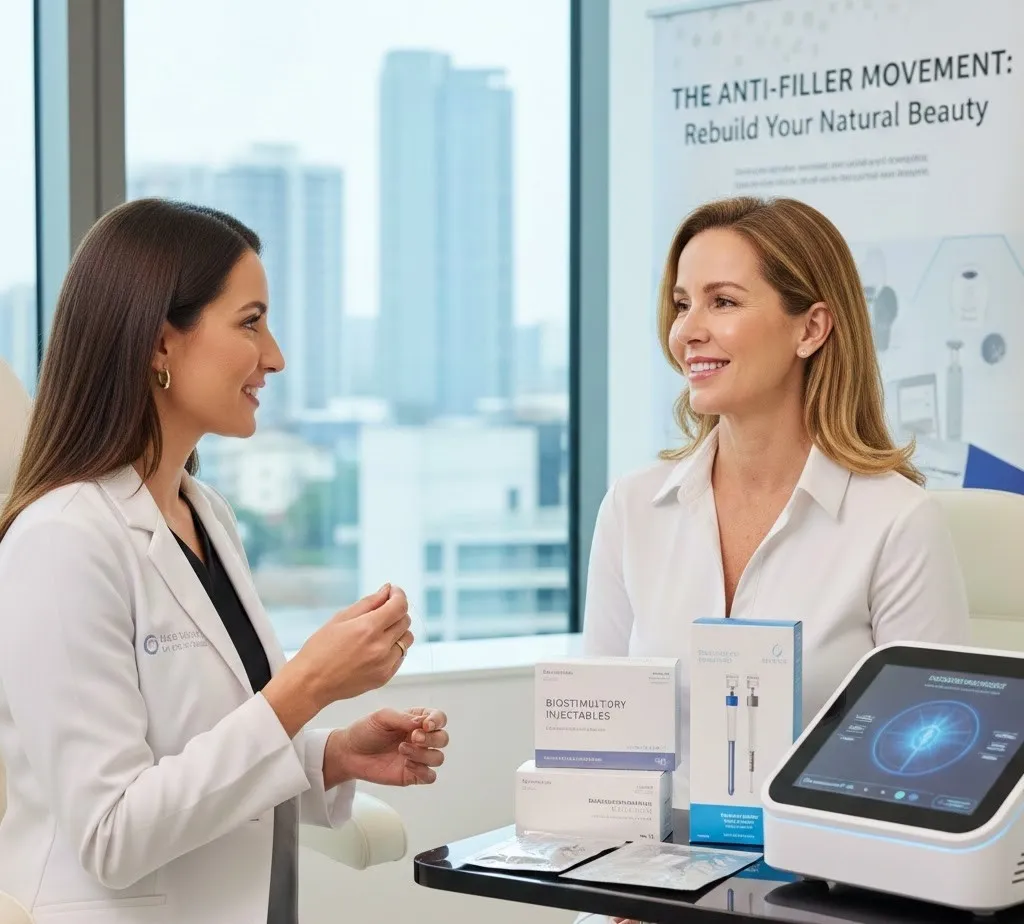
Biostimulatory Fillers: The Evolution of Injectables
The term "filler" is still used, but the mechanism of action is radically different with biostimulatory fillers. Unlike traditional HA gels that merely occupy space and hydrate, these injectables use different active ingredients to initiate a powerful inflammatory and healing response within the dermis. This response compels the body's fibroblasts—the skin cells responsible for collagen—to produce a new network of structural proteins.
- Poly-L-Lactic Acid (PLLA): Famously known for treating overall facial fat loss and hollowness, PLLA works by creating a scaffolding structure that triggers significant collagen growth. The injection itself provides subtle initial volume, but the true, long-term result develops gradually over several months as the body deposits its own collagen. This leads to a restoration of youthful projection and thickness that is incredibly natural and can last for up to two years or more.
- Calcium Hydroxylapatite (CaHA): CaHA microspheres suspended in a gel carrier offer both immediate volume and sustained biostimulation. Used primarily for deep-set lines, hand rejuvenation, and jawline contouring, CaHA’s main appeal is its ability to build durable, natural-looking structure. As the gel is absorbed, the microspheres continue to act as a scaffold for new collagen, enhancing skin elasticity and firmness.
- Polycaprolactone (PCL): A newer category, PCL threads and injectables offer a combination of immediate filler effect and a strong, sustained bio-stimulating action. These materials are known for their extended longevity and promote high-quality collagen formation, making them an exciting option for patients seeking maximum duration.
The profound advantage of biostimulatory options is that the improved structure is literally part of the patient’s own tissue, reducing the risk of an artificial look and creating a foundation that ages more gracefully.
Thread Lifts: The Minimally-Invasive Lift
The modern thread lifts have little in common with the barbed sutures of the past. Today, they are a sophisticated, minimally-invasive technique that offers a true mechanical lift and repositions sagging skin and tissue. Utilizing fine, dissolvable sutures—often made from PDO (Polydioxanone), PLLA, or PCL—these procedures offer a dual-action benefit that makes them one of the most compelling liquid facelift alternatives.
- Immediate Mechanical Lift: The threads, which feature tiny barbs or cogs, are inserted under the skin and then gently pulled back. This action physically lifts and suspends the underlying facial tissue, immediately addressing jowls, sagging cheeks, and neck laxity.
- Sustained Collagenesis: As with biostimulatory fillers, the material of the threads itself stimulates a significant foreign body reaction. The body encapsulates the dissolving threads with a sheath of new, natural collagen. This newly formed collagen matrix continues to hold the lift and improves skin texture and firmness long after the threads have been completely absorbed.
Thread lifts are rapidly gaining popularity for patients with mild to moderate skin laxity who want to avoid the downtime and risks associated with a traditional surgical facelift, offering a refreshed, lifted, and naturally contoured appearance.
Energy-Based Procedures: Rebuilding the Dermis from Heat
Beyond injectables, the most powerful alternative to volume replacement comes from energy-based devices that harness the power of controlled heat to induce a healing response. These treatments excel in non-invasive contouring and tightening.
Collagen Induction Therapy (CIT) with RF Microneedling
Collagen induction therapy (CIT), often referred to as microneedling, is a procedure that creates thousands of controlled micro-injuries in the skin. When CIT is paired with Radiofrequency (RF) energy, as in treatments like Morpheus8 or Potenza, the results are exponentially amplified.
- Mechanism: Tiny needles puncture the skin to a precisely controlled depth, and then the tips of those needles deliver focused RF heat energy into the deeper layers of the dermis. This thermal injury causes existing collagen fibers to contract immediately (tightening) and sends a strong signal to the skin to initiate a massive repair process, leading to the formation of new, strong collagen and elastin.
- Benefits: RF microneedling is highly effective for improving skin texture, reducing acne scarring, minimizing pore size, and providing significant skin tightening and remodeling on the face, neck, and body. It addresses the fundamental quality of the skin—the area where traditional fillers have no effect. The structural improvement it offers can subtly lift the lower face and define the jawline, serving as a key component in modern liquid facelift alternatives.
Focused Ultrasound and Radiofrequency Devices
The technologies of micro-focused ultrasound (e.g., Ultherapy) and bulk-heating radiofrequency (e.g., Thermage, Exilis) are foundational to the anti-filler movement. These are the ultimate non-invasive contouring tools because they target the deeper support structures—layers often unreachable by light injectables—to achieve true lift and contraction.
- Focused Ultrasound (HIFU): This technology delivers precise sonic energy to the foundational tissue layer, known as the Superficial Musculoaponeurotic System (SMAS). This is the same layer that surgeons manipulate during a surgical facelift. Heating this layer causes immediate contraction and, over several months, a massive production of new, load-bearing collagen. The result is a non-surgical lifting of the brow, jawline, and neck.
- Bulk-Heating RF: Devices like Thermage use controlled RF energy to heat the entire volume of the dermis and underlying tissue. This tightens existing collagen and stimulates new production, leading to a smoother, firmer appearance. This is a crucial element for patients with early-to-moderate skin laxity who prioritize tightness over volume.
The Philosophical Shift: The "Anti-Filler" Movement Explained
The aesthetic philosophy of the "anti-filler" movement is centered on achieving longevity and authenticity. It’s an embrace of regeneration over replacement.
A look at modern non-surgical options aimed at stimulating the body's natural collagen production rather than just adding volume (the "anti-filler" movement) is fundamentally a paradigm shift from a "replace-and-fill" mindset to a "stimulate-and-rebuild" approach.
- Restoring Youthful Quality: Traditional fillers address the symptoms of aging (hollows, wrinkles) by replacing lost volume. The new era treatments address the cause—the degradation of collagen and elastin—by kick-starting the body’s own healing and rebuilding mechanisms. The goal is to make the skin itself look and act younger, not just to stretch it out with gel.
- Harmonious Contouring: The focus moves from treating individual lines and folds to overall facial harmony and preservation of identity. When collagen is rebuilt using devices or biostimulatory injectables, the facial tissues lift and tighten in a way that respects the patient's native bone structure, creating natural non-invasive contouring without the risk of the 'pushed-out' or heavy look associated with over-filling.
- Long-Term Investment: While the initial cost of a course of collagen induction therapy or focused ultrasound may be higher than a syringe of HA filler, the results are often considered a more meaningful investment. Treatments like thread lifts and PLLA injections create structural support that continues to improve for months after the procedure and can last for years, significantly extending the time before a patient needs a subsequent touch-up.
Conclusion: The Future is Regenerative
The aesthetic landscape is moving away from the quick fix and embracing a philosophy of regeneration. For patients seeking a subtle, authentic, and enduring enhancement, the procedures that stimulate the body's natural processes—from thread lifts for structural repositioning, to biostimulatory fillers for deep tissue rebuilding, to energy-based collagen induction therapy for dermal quality—represent the sophisticated new standard. These treatments, whether used individually or as part of a tailored liquid facelift alternatives plan, are not just replacing fillers; they are setting a new, higher benchmark for natural, age-defying results. The rise of these regenerative modalities confirms that the most beautiful results are those the body creates for itself.