How to ensure proper broad spectrum sun damage prevention.
Sunscreen Application Mistakes That Ruin Your Routine: Stop Sabotaging Your Skin!
Sunscreen is the undisputed hero of any skincare routine, the **essential shield** against premature aging, hyperpigmentation, and the devastating risk of skin cancer. Yet, simply owning a great bottle of SPF isn't enough. Many of us, unknowingly, are committing critical **sunscreen application mistakes** that severely diminish its effectiveness, leaving our skin vulnerable to **sun damage prevention** failure.
This comprehensive guide will expose the 10 most common ways people sabotage their sun protection, ensuring you master the art of application for genuinely radiant and healthy skin.
The Cardinal Sin: Not Using the Proper Sunscreen Amount
The number one mistake people make is simply not using enough. That pea-sized dollop you gently pat onto your face? It's providing nowhere near the protection level stated on the bottle.
The consensus from dermatologists is that you need 2 mg of sunscreen per square centimeter of skin to achieve the labeled SPF. For the face and neck alone, this translates to a surprisingly large volume.
The Two-Finger Rule: Your Visual Guide to the Proper Sunscreen Amount
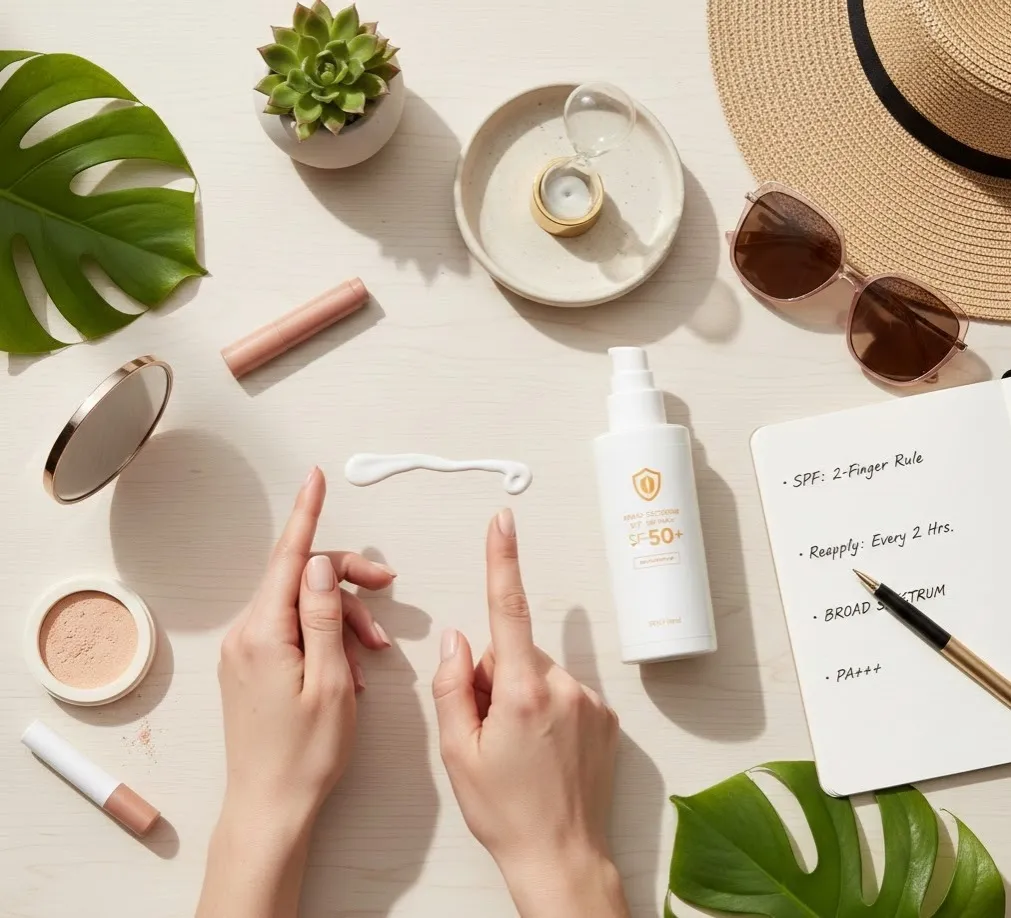
To make this measurable, dermatologists often recommend the **two-finger rule**. This method involves squeezing a line of sunscreen onto your index finger and middle finger, running from the base to the tip.
- **Visually demonstrating the correct two-finger rule quantity for the face and neck:** Squeeze a continuous, thick bead of sunscreen along the entire length of your index finger. Repeat the process for your middle finger. **This total amount is the minimum** required to cover your face, neck, and the tops of your ears adequately. Do not rub it in until it disappears instantly; you should be able to see a distinct layer before you fully blend it.
If you are also applying sunscreen to your chest and shoulders, you will need to extend this amount considerably. Under-dosing your application is the fastest way to drop your effective SPF from 30 down to as low as 5 or 10.
Ignoring the Clock: Neglecting Reapplication Frequency
You apply sunscreen perfectly in the morning, pat yourself on the back, and then assume your protection lasts until bedtime. This is mistake number two. Sunscreen, both **mineral vs chemical** formulas, breaks down over time from sun exposure, sweat, and simple contact (touching your face, wearing a mask).
- **Stressing the importance of reapplying every two hours:** You must adhere to the **reapplication frequency** of **every two hours**, especially during peak sunlight hours (10 AM to 4 PM), and immediately after swimming or excessive sweating.
Yes, this is inconvenient, especially over makeup. This is why many people turn to SPF-infused powders, mists, or sticks for easy midday touch-ups. Ignoring this step is akin to leaving the front door unlocked after setting the alarm—it defeats the entire purpose of your morning effort.
Missing the Spots: Ignoring Critical but Forgotten Areas
Think about where the sun hits you first. Your nose? Your forehead? Now think about the areas you always skip. These are the spots where **sun damage prevention** efforts crumble, and where skin cancers frequently develop.
- The Ears: The tops and backs of the ears are prime targets for sun damage.
- The Neck and Chest (Décolletage): These areas show aging signs first (crepiness, brown spots).
- The Hairline and Scalp: Use a dedicated SPF spray or wear a hat.
- The Lips: Use an SPF-rated lip balm.
- The Tops of the Hands and Feet: These spots are constantly exposed when driving or wearing sandals.
Relying Solely on SPF in Makeup
While SPF-rated foundation and moisturizers are a good *bonus*, they should never be your primary defense. Why? Because you would need to apply 7-14 times the normal amount of foundation to reach the stated SPF level—which is an impossible, cakey look.
Treat SPF in makeup as extra credit, not the core shield. Always apply a dedicated, standalone sunscreen *before* applying your makeup.
Waiting Until You're Outside to Apply
Sunscreen takes time to form a protective layer on the skin. Chemical sunscreens (oxybenzone, avobenzone) need time to absorb and become active, while mineral sunscreens (zinc oxide, titanium dioxide) need time to create a physical barrier.
Applying your sunscreen on the beach or right before you step out means your skin is unprotected for the 15-20 minutes it takes for the formula to settle and become fully effective.
- **The Rule:** Apply your sunscreen indoors, as the last step of your skincare routine, **15 to 20 minutes before** any anticipated sun exposure.
Misunderstanding the SPF and PA Rating System
Many people only focus on the SPF number (Sun Protection Factor) and ignore the equally critical **PA rating** and the term **broad spectrum**.
- **SPF (Sun Protection Factor):** Measures protection against **UVB rays** (the rays that cause sunburn). An SPF 30 blocks about 97% of UVB rays; SPF 50 blocks about 98%. Going above 50 offers negligible extra protection.
- **Broad Spectrum:** This label confirms the product protects against **UVA rays** as well as UVB. UVA rays penetrate deeper, causing aging, wrinkles, and long-term damage. **Always choose "broad spectrum."**
- **PA Rating:** This system, primarily used in Asia, specifically measures **UVA protection**. It ranges from PA (some UVA protection) to PA (extremely high UVA protection). The higher the PA rating, the better your **sun damage prevention** against aging. Aim for PA or PA .
Buying the Wrong Formula: Mineral vs Chemical Sunscreen
Understanding the difference between **mineral vs chemical** sunscreen is crucial for finding the right fit for your skin type and routine.
| Feature | Mineral (Physical) Sunscreen | Chemical Sunscreen |
|---|---|---|
| Active Ingredients | Zinc Oxide, Titanium Dioxide | Oxybenzone, Avobenzone, Octinoxate, etc. |
| Mechanism | Sits on the skin's surface and acts as a **physical barrier** to scatter UV rays. | Absorbs into the skin and converts UV rays into heat, which is then released. |
| Application | Works immediately upon application; can leave a white cast. | Needs 15-20 minutes to absorb and activate; typically sheerer. |
| Best For | Sensitive skin, children, acne-prone (zinc oxide is often soothing). | Active individuals (less likely to rub off), deeper skin tones (to avoid a white cast). |
If you have sensitive or reactive skin, an all-mineral formula is often the gentler choice, offering robust **broad spectrum** protection.
Mixing and Diluting Your Sunscreen
The trend of mixing sunscreen directly into your moisturizer or foundation to make it sheerer or easier to apply is a major application mistake.
When you mix products, you are not only **diluting the SPF** but you are also disrupting the way the UV filters are designed to evenly coat the skin. You end up with a patchy, diluted, and therefore ineffective shield. Keep your sunscreen application separate and allow it to fully absorb before applying makeup.
Ignoring the Expiration Date
Sunscreen isn't like lotion; its active ingredients degrade over time. The SPF you thought you were getting at the start of the summer might be significantly lower by the end of the season if the bottle has been sitting in a hot car or has passed its expiry date.
Most sunscreens are formulated to remain potent for up to three years. Always check the expiration date printed on the bottle, or if no date is present, look for the small open jar icon with a number (e.g., 12M, meaning use within 12 months of opening). If it smells off, has separated, or is past its prime, throw it out.
Forgetting About Indoor and Incidental Exposure
You might think you're safe inside an office or car, but UVA rays—the ones responsible for aging and deeper damage—can penetrate window glass. Furthermore, the blue light emitted from computer and phone screens can also contribute to hyperpigmentation.
While you don't need to stress as much about **reapplication frequency** indoors, your initial application of a **broad spectrum** SPF, ideally with ingredients like iron oxides (found in tinted mineral sunscreens) to counter blue light, is still mandatory for complete **sun damage prevention**.
Conclusion: Elevating Your Sun Protection
Mastering sunscreen application means more than just having SPF in your routine; it means understanding the science of protection. By ensuring you use the **proper sunscreen amount** (the two-finger rule), adhering to the crucial **reapplication frequency** of every two hours, and choosing a formula with adequate **PA rating** and **broad spectrum** protection, you stop making sunscreen application mistakes that ruin your routine.
This vigilance is the key to unlocking true skin health and successfully preventing the cumulative effects of **sun damage prevention** failure.