Explore Wi-Fi 7 (802.11be) and MLO (Multi-Link Operation).
The rapid evolution of wireless technology is entering a new, revolutionary phase with the imminent adoption of Wi-Fi 7 (802.11be). As digital life becomes increasingly immersive, driven by real-time applications like augmented reality (AR), virtual reality (VR), and cloud gaming, the demand for unprecedented high throughput and ultralow latency reduction for AR/VR is soaring. Wi-Fi 7 is designed to meet this colossal demand head-on, largely through its standout innovation: MLO (Multi-Link Operation).
This standard marks a massive leap, promising theoretical speeds up to 4.8 times faster than Wi-Fi 6/6E (reaching a staggering 46 Gbps), significantly lower latency, and enhanced reliability. The key to unlocking this performance is a fundamental shift in how devices communicate, moving away from single-band, single-channel connections to a sophisticated, multi-band aggregation and coordination model.
The Need for Speed and Real-Time Responsiveness
The limitations of previous Wi-Fi generations are becoming glaringly apparent under the pressure of modern digital consumption. Traditional Wi-Fi standards force a device to choose a single channel on a single frequency band (2.4 GHz, 5 GHz, or the newly available 6GHz spectrum) for its connection to the access point (AP). This single-link approach creates bottlenecks, especially in crowded environments or for data-intensive tasks.
For high-demand applications, the need for deterministic, ultra-low latency is paramount. A momentary lag, or "jitter," in a VR headset or during a cloud gaming session can instantly break immersion, cause motion sickness, or lead to a lost match. The current generation of Wi-Fi, while fast, cannot guarantee the consistent, sub-10-millisecond latency required for these real-time experiences. This is the chasm that Wi-Fi 7, powered by MLO, is built to bridge.
The Core Innovation: Multi-Link Operation (MLO)
MLO (Multi-Link Operation) is the defining feature of Wi-Fi 7 (802.11be) and is mandatory for all certified multi-link devices (MLDs). Conceptually, MLO is like combining multiple single-lane roads into a multi-lane, adaptive high throughput digital highway. It allows Wi-Fi 7 devices (both the Access Point/router and the client device like a laptop or smartphone) to simultaneously transmit and receive data across different frequency bands and channels.
How MLO Works: Aggregation and Switching
A Multi-Link Device (MLD) in Wi-Fi 7 operates across two or more links (e.g., a link on 5 GHz and a link on 6 GHz). MLO leverages two primary strategies to deliver its massive performance boost:
- Link Aggregation (Higher Throughput): MLO can bundle the bandwidth from the multiple links together, effectively treating them as a single, ultra-wide connection. For example, a client could aggregate a 160 MHz channel on the 5 GHz band with a 320 MHz channel on the 6GHz spectrum. This simultaneous use of channels dramatically increases the available capacity, leading directly to the promised multi-gigabit speeds and delivering truly phenomenal high throughput. This is the method of choice when the primary goal is maximum data transfer, such as downloading large 8K video files.
- Dynamic Link Switching (Lower Latency and Higher Reliability): For real-time applications, MLO offers a "failover" or "redundancy" mode. It can send identical data packets across multiple links simultaneously, ensuring the receiving device processes the first one that arrives. This virtually eliminates the delay associated with a busy or interfered channel, providing robust and consistent latency reduction for AR/VR and gaming. Furthermore, if one link experiences sudden interference or degradation, the connection instantly and seamlessly shifts traffic to the cleaner, faster link without dropping the connection, ensuring ultra-high reliability.
MLO Modes: Tailoring Performance
The Wi-Fi 7 standard defines several MLO modes to optimize for different performance metrics:
- Multi-Link Multi-Radio (MLMR) Simultaneous Transmit and Receive (STR): This is the most powerful mode, requiring multiple physical radios on the device. It allows a device to transmit and receive data simultaneously on different links (e.g., transmit on 5 GHz while receiving on 6 GHz), maximizing aggregate throughput and speed.
- Enhanced Multi-Link Single Radio (EMLSR): This mode is more cost and power-efficient, using a single, dynamically reconfigurable radio. It achieves MLO benefits by rapidly alternating between links, optimizing for low latency and load balancing with minimal switching overhead. This is particularly relevant for mobile devices and battery-powered client devices.
The Wi-Fi 7 Advantage: Beyond MLO
While MLO (Multi-Link Operation) is the headline feature, Wi-Fi 7 (802.11be) introduces several other key technological enhancements that collectively enable its next-generation performance:
- Ultra-Wide 320 MHz Channels: Wi-Fi 6E introduced the new, uncongested 6GHz spectrum, which is critical for future wireless technology. Wi-Fi 7 capitalizes on this by supporting channel widths up to 320 MHz—double the width of the 160 MHz channels in Wi-Fi 6E. These massive channels, primarily available in the 6 GHz band, are a direct path to achieving multi-gigabit high throughput capabilities, as they allow significantly more data to be transmitted at once.
- 4096-QAM (4K-QAM) Modulation: Wi-Fi 7 introduces a higher-order modulation scheme: 4096-QAM (Quadrature Amplitude Modulation). This is an upgrade from Wi-Fi 6/6E’s 1024-QAM. Essentially, 4K-QAM allows each transmission symbol to carry 12 bits of data instead of 10 bits, leading to a theoretical 20% increase in peak data rates for devices close to the AP and in clean signal environments.
- Preamble Puncturing and Multi-RU: The issue of channel interference has always hampered Wi-Fi efficiency. If a small portion of a wide channel is occupied by another signal (like a legacy Wi-Fi device), the entire channel is often rendered unusable in previous standards. Wi-Fi 7’s Preamble Puncturing feature solves this by allowing the AP to "puncture out" or selectively ignore the interfered portion of the channel while still utilizing the remaining clear bandwidth. This dramatically improves spectrum utilization, especially in the wider 320 MHz channels, and further contributes to consistent high throughput. Additionally, Multi-Resource Unit (Multi-RU) capabilities allow a single user to be assigned multiple Resource Units (RUs), providing greater flexibility and efficiency in spectrum allocation, optimizing performance for a wider range of traffic types.
Real-World Impact: Unleashing Latency-Sensitive Applications
The combination of MLO (Multi-Link Operation), 320 MHz channels, and 4K-QAM is specifically engineered to support the next wave of immersive and real-time applications.
AR/VR and Wireless Headsets
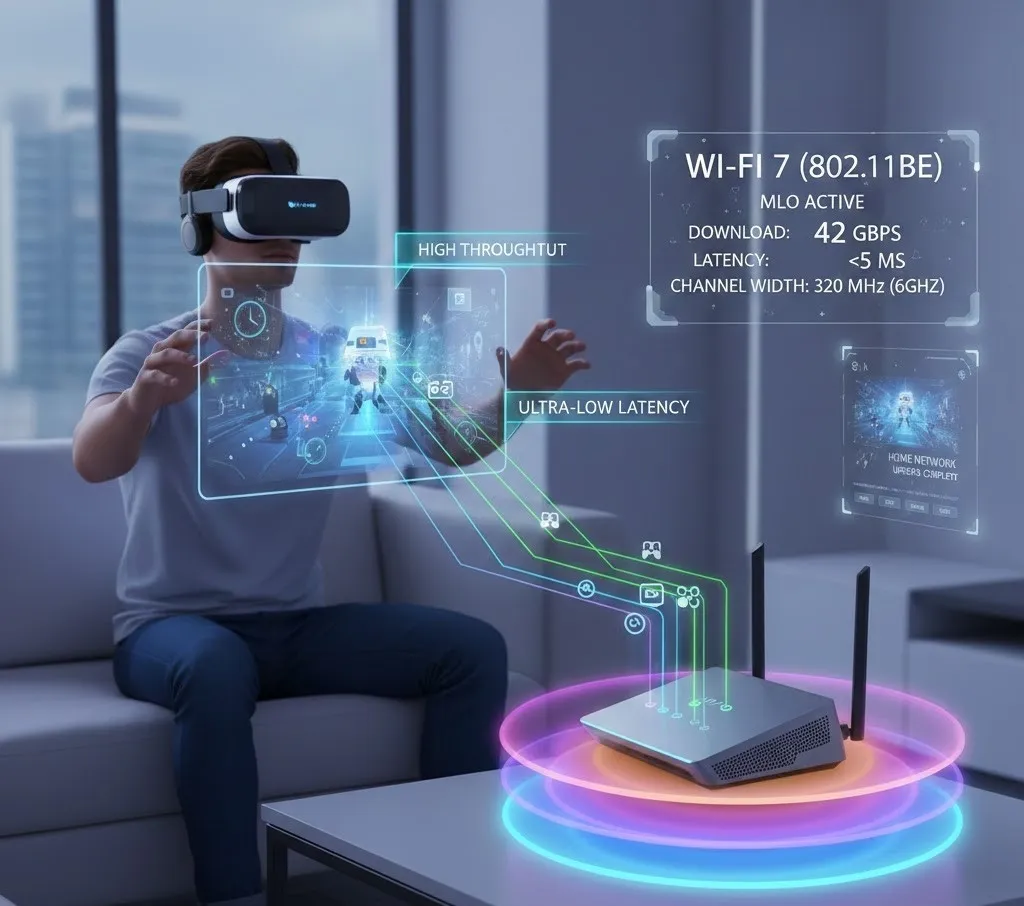
For high-fidelity, completely wireless AR/VR headsets, the user experience hinges on a stable, near-zero delay connection. If the visual feedback is delayed by more than 20 milliseconds, it can cause disorientation and motion sickness. Wi-Fi 7, with its MLO-enabled latency reduction for AR/VR, is the first Wi-Fi standard truly capable of supporting untethered 4K or 8K resolution VR, enabling the next generation of Metaverse experiences. MLO's ability to use a fast, stable link for critical control data (head/hand tracking) while simultaneously using a high throughput link for the heavy video stream makes the wireless VR experience virtually indistinguishable from a wired one.
Cloud Gaming and Ultra-HD Streaming
Cloud gaming relies on an extremely low-latency link to transmit controller inputs and receive video feedback instantly. MLO ensures that gaming traffic is routed over the clearest available link, minimizing input lag (ping), even if other devices are streaming 8K video or running large downloads in the background. Similarly, for multi-stream 8K video viewing, MLO's link aggregation provides the massive, guaranteed high throughput required to prevent stuttering and buffering.
Enterprise and Industrial Applications
Beyond the home, Wi-Fi 7 and MLO are crucial for the Industrial Internet of Things (IIoT) and enterprise connectivity. Automated manufacturing, robotics, and mission-critical remote operations require guaranteed, deterministic low latency and high reliability. MLO’s built-in redundancy and channel diversity ensure that these critical operations remain connected and responsive, even in challenging RF environments.
Planning Your Home Network Upgrade: The Path to Wi-Fi 7
The move to Wi-Fi 7 (802.11be) represents a significant but necessary home network upgrade for those looking to future-proof their connectivity.
The Role of the 6GHz Spectrum
The availability of the 6GHz spectrum—the "superhighway" for Wi-Fi 7—is arguably the most important physical factor for achieving maximum performance. This band offers wider, uncongested channels, which MLO heavily relies on for link aggregation and high-speed data transfer. When planning a home network upgrade, users should ensure their new router/AP supports the full 6 GHz band and that their regional regulatory body has cleared the band for use.
Phased Adoption and Compatibility
Adoption will follow a predictable path: first, high-end routers and laptops, followed by smartphones, tablets, and AR/VR headsets. While Wi-Fi 7 devices are backward- compatible with older standards (Wi-Fi 6, Wi-Fi 5), the benefits of MLO and 320 MHz channels only kick in when both the Access Point and the client device support Wi-Fi 7 (802.11be).
The true value of a home network upgrade to Wi-Fi 7 is the seamless experience it enables. The age of choosing between speed and stability is over. MLO (Multi-Link Operation) allows users to enjoy both, simultaneously and dynamically. This new standard doesn't just offer incremental speed bumps; it provides the robust, low-latency foundation required for the truly immersive, interconnected future of our digital lives.