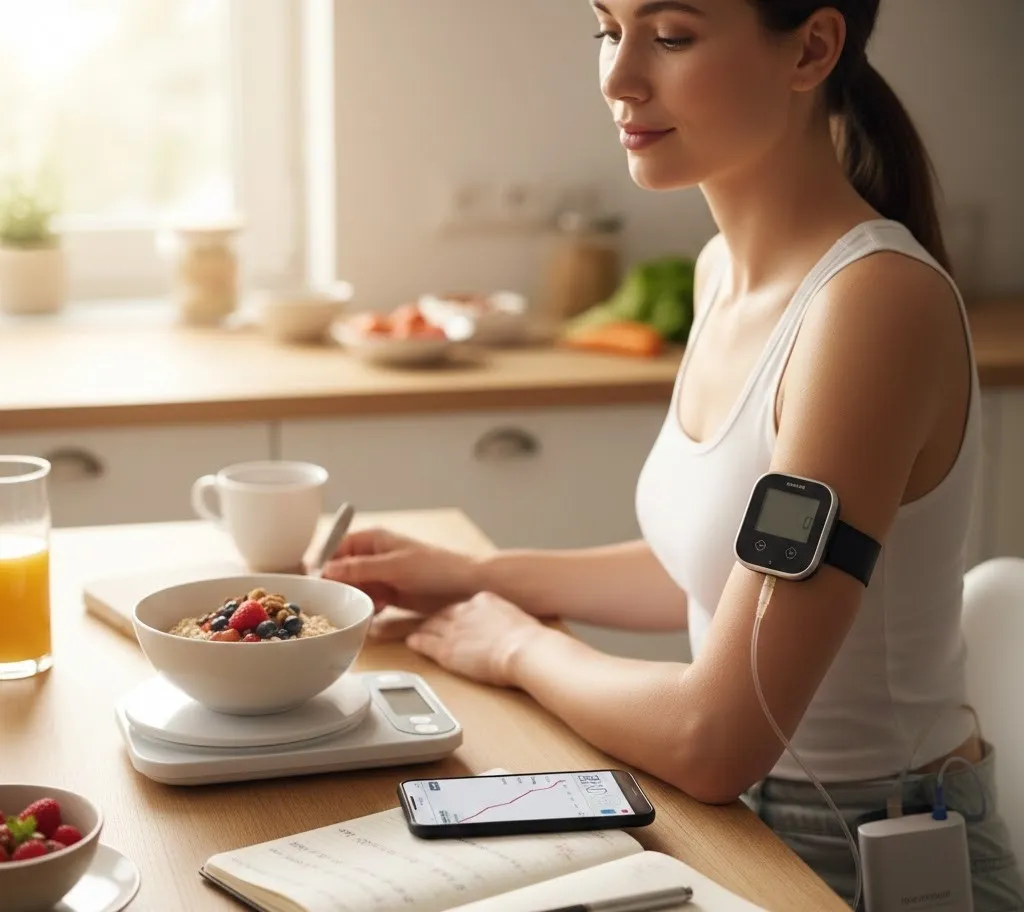
Master advanced carb counting for Type 1 Diabetes
For individuals managing Type 1 Diabetes (T1D), the ability to precisely match mealtime insulin to carbohydrate intake is the cornerstone of flexible and effective blood glucose control. While basic carbohydrate counting offers a foundation, Advanced Carb Counting for Precision Dosing is the skill set that unlocks true dietary freedom and tighter glycemic management. It moves beyond simple estimation, incorporating concepts like the insulin-to-carb ratio (ICR), carb factors, and sophisticated bolus calculation techniques.
This comprehensive guide delves into the advanced methodologies essential for those on intensive insulin therapy, providing the knowledge to personalize insulin delivery for virtually any meal, at any time.
The Fundamentals: ICR and Bolus Calculation
At the heart of advanced carb counting is the insulin-to-carb ratio (ICR), often simply called the carb ratio. This number represents the grams of carbohydrate that one unit of rapid-acting insulin is expected to cover.
Understanding the Insulin-to-Carb Ratio (ICR)
The ICR is a critical tool for calculating the mealtime, or meal bolus calculation. It is a highly individualized value, determined in consultation with a healthcare provider (endocrinologist or certified diabetes care and education specialist). ICRs are generally derived using an empirical formula, with the "500 Rule" being a common starting point:
ICR = 500 / Total Daily Dose (TDD) of Insulin
TDD is the sum of all basal and bolus insulin taken over a 24-hour period.
Example: If your Total Daily Dose is 50 units, your estimated ICR is 500 ÷ 50 = 10. This means your initial ratio is 1 unit of insulin for every 10 grams of carbohydrate (1:10).
Performing the Bolus Calculation
Once your ICR is established, the meal bolus calculation is straightforward. The meal bolus is the insulin required to cover the carbohydrates you plan to eat.
Meal Bolus = Total Carbs in Meal (grams) / ICR
Example: Using an ICR of 1:10, and a meal with 60 grams of carbohydrate: 60 grams ÷ 10 = 6 units. The required meal bolus is 6 units.
This meal bolus is then combined with any necessary Correction Bolus (insulin needed to bring down an elevated pre-meal blood glucose) to determine the final insulin dose.
A Tutorial on Calculating and Adjusting Personalized Insulin Ratios
A simple 1:10 ICR is rarely a one-size-fits-all solution, even for a single individual. The body's sensitivity to insulin changes throughout the day due to natural hormonal cycles (like the dawn phenomenon) and varying levels of activity. The key to precision dosing is customizing the ICR based on different types of food and times of day. This is a foundational element of advanced T1D tips.
Adjusting Ratios by Time of Day
The simplest way to refine your ICR is to segment it by time. Most people require a more aggressive ICR (meaning fewer grams of carbs covered per unit of insulin) in the morning and a less aggressive ratio in the evening.
| Time Slot | General Tendency | Example Adjustment (from 1:10 baseline) |
|---|---|---|
| Breakfast (e.g., 7 AM) | Insulin resistance is often highest (dawn phenomenon). | ICR: 1:8 (More insulin needed) |
| Lunch (e.g., 12 PM) | Sensitivity usually normalizes. | ICR: 1:10 (Baseline) |
| Dinner (e.g., 6 PM) | Sensitivity often peaks, or may drop after a long day. | ICR: 1:12 (Less insulin needed) |
The Adjustment Process:
- Isolate the Meal: Choose a meal (e.g., breakfast) and try to eat the same, accurately counted amount of carbohydrates (e.g., 50g) for three to five days.
- Monitor Post-Meal Glucose: Check your blood glucose (BG) at 2 hours post-meal.
- If BG is consistently high (above target): Your current ICR is too weak. You need more insulin. Decrease the grams of carb per unit. e.g., Change 1:10 to 1:9.
- If BG is consistently low (below target): Your current ICR is too strong. you need less insulin. Increase the grams of carb per unit. e.g., Change 1:10 to 1:11.
- Implement and Re-evaluate: Make small changes (1-2 grams) and monitor for another few days before making further adjustments.
Utilizing Carb Factors for Complex Meals
Not all carbohydrates are created equal in their impact on blood glucose. The Glycemic Index (GI) and macronutrient composition (especially fat and protein) can significantly alter the absorption rate. This is where the concept of carb factors comes into play for the most complex dosing.
| Food Characteristic | Effect on Glucose Curve | Advanced Strategy |
|---|---|---|
| High GI / Liquid Carbs | Rapid spike (within 1 hour) | Dose insulin right before or immediately after eating. |
| High Fat/Protein Meals | Slow, prolonged rise (lasting 4-8 hours) | Use an extended bolus (Square Wave or Dual Wave on a pump) or a manual split dose. |
| Pure Carbohydrates (low GI) | Normal 2-3 hour rise | Use the standard immediate bolus calculation. |
A true carb factor is sometimes used as an advanced term for the ICR itself, especially when referring to the calculation used by automated insulin delivery systems. However, in an advanced T1D context, it can also refer to the adjusted carbohydrate count for a mixed meal.
Example: High-Fat Pizza (Complex Carb Factor)
A meal like pizza, high in carbs, fat, and protein, causes a delayed spike. If a standard bolus of 6 units for 60g of carbs results in a low BG initially, followed by a high BG four hours later, your initial bolus calculation was only partially effective.
Advanced T1D Tip: Split the bolus. Take 60-70% of the calculated bolus (e.g., 4 units) immediately, and take the remaining 30-40% (e.g., 2 units) 90-120 minutes later.
Optimizing Timing: The Power of Pre-Bolusing
Even with a perfect ICR, the timing of your insulin injection relative to your meal can make or break your post-meal control. This technique is known as pre-bolusing.
The Principle of Pre-Bolusing
Rapid-acting insulin (like Novolog or Humalog) does not work instantly. It needs time to be absorbed and reach peak action. For optimal control, the insulin should begin to peak around the time the carbohydrates start to be fully absorbed into the bloodstream.
| Pre-Meal BG Level | Target Pre-Bolusing Time | Rationale |
|---|---|---|
| In Target Range (70-130 mg/dL) | 10–20 minutes before eating | Allows the insulin to start working before the carbs begin to raise BG. |
| Slightly High (131-180 mg/dL) | 20–30 minutes before eating | The longer delay allows the initial part of the insulin dose (the correction bolus portion) to begin lowering the high BG before the meal carbs are introduced. |
| Low or Falling BG | Inject *while* or *after* eating | Reduces the risk of a pre-meal hypoglycemic event. |
Failure to pre-bolus—or "chasing the high"—is a common reason for post-meal spikes, even when the carb count and ICR are correct.
High-Tech Management and Future Trends
The modern landscape of diabetes care leverages high-tech management tools to automate and refine these advanced counting principles.
Automated Insulin Delivery (AID) Systems
Hybrid closed-loop (HCL) systems (or insulin pumps integrated with Continuous Glucose Monitors, CGM) utilize the advanced concepts of ICR, Insulin Sensitivity Factor (ISF), and target BG to automatically adjust and deliver basal insulin and recommend or deliver boluses.
- Personalized Algorithms: These systems continuously learn individual needs, making subtle, automated adjustments to the insulin delivery that manual therapy cannot replicate.
- Automated Bolus Calculation: The system’s built-in bolus calculation is based on the user’s programmed ICR and ISF, but it takes current BG, Insulin-On-Board (IOB), and predicted BG trajectory into account for ultimate precision.
CGM and Post-Meal Analysis
A Continuous Glucose Monitor (CGM) is an indispensable tool for advanced carb counters. It provides the real-time feedback necessary to judge the efficacy of your bolus calculation and pre-bolusing strategy. A chart showing a high post-meal peak followed by a low 4-hour mark is a clear indicator that the pre-bolusing time needs to be lengthened or a split-bolus used.
Advanced T1D Tips for Precision Counting
To move from an accurate bolus to a truly precise bolus, incorporate these advanced T1D tips:
- Protein and Fat Influence: Calculate the calories from protein and fat. Many experts suggest adding a portion of the protein/fat calories to the carbohydrate count for extended boluses. A general rule of thumb is to count 35-50% of the total protein grams as "effective carbs" for delayed dosing over several hours.
- Fiber Deduction: Subtract fiber when calculating net carbs, especially for high-fiber foods. Dietary fiber is a non-digestible carb that does not raise blood glucose. If a food has more than 5g of fiber per serving, you can often subtract half of the fiber grams from the total carb count.
- Activity Adjustment: Anticipate exercise. If you plan to engage in aerobic activity shortly after eating, you may need to reduce your bolus calculation by 25-75% to prevent hypoglycemia.
- Sick Day Protocol: Illness increases insulin resistance. Your ICR and ISF may temporarily need to be adjusted (e.g., an ICR of 1:10 may need to be temporarily changed to 1:8).
- Master Your Measurements: Use a digital food scale to weigh and measure carbohydrate foods. This is the single most effective way to ensure the accuracy of your carb count, which directly impacts the accuracy of your bolus calculation.
By understanding and implementing individualized carb factors, carefully calculating the insulin-to-carb ratio, mastering the bolus calculation, and correctly utilizing pre-bolusing, individuals with T1D can achieve a level of glucose control and lifestyle flexibility that was unimaginable just a few decades ago. The integration of these skills with high-tech management tools truly represents the state-of-the-art in diabetes self-care.