Learn why this colorless gas is a major lung cancer risk and how to use an indoor radon test kit effectively.
The Silent Threat: Navigating Radon Exposure and Home Safety
Home is where we feel safest, yet for millions, a invisible danger lurks beneath the floorboards. It doesn't smell, it has no taste, and you cannot see it. This colorless gas, known as radon, is a naturally occurring radioactive element that has become one of the most significant yet overlooked environmental factors affecting public health today.
Understanding the gravity of radon exposure is not about inciting fear; it is about empowerment through awareness. This guide explores the lethal nature of radon and provides a practical roadmap for securing your home.
The Invisible Killer: What is Radon?
Radon is produced by the natural decay of uranium found in nearly all soils. While it safely disperses in the outdoor air, it becomes a concentrated toxin when it enters the confined spaces of our homes.
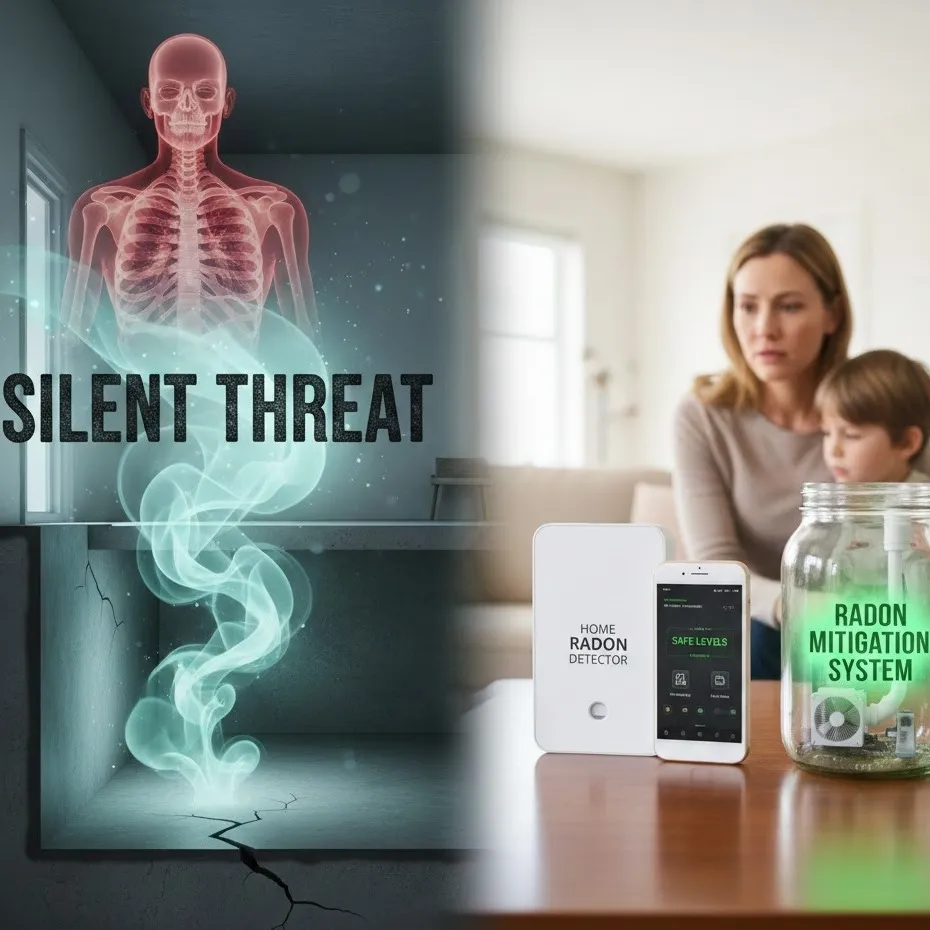
Because it is a colorless gas, it often goes undetected for decades. It seeps through cracks in foundations, construction joints, and gaps around service pipes. Once inside, it attaches to dust and other particles, which are then inhaled into the lungs.
The Lung Cancer Risk
Most people associate lung cancer exclusively with smoking. However, the Surgeon General has warned that radon is the second leading cause of lung cancer in the United States, and the leading cause among non-smokers.
The lung cancer risk increases exponentially if you are a smoker living in a high-radon environment, but even those who have never touched a cigarette are at significant risk. The alpha particles released by decaying radon damage the DNA in lung tissue, leading to mutations that can eventually turn into tumors.
Why Your Basement is a High-Stakes Zone
If your home has a lower level, you face a specific basement risk. Because radon originates in the soil and is heavier than air, it tends to settle in the lowest points of a structure.
- Pressure Differences: Homes often act like large vacuums, pulling air (and radon) from the soil through a process called "soil suction."
- Enclosed Spaces: Basements often have less ventilation than upper floors, allowing gas concentrations to reach dangerous levels.
- Foundation Cracks: Even hairline fractures in a concrete slab are wide enough for gas molecules to penetrate.
Taking Action: A Practical Guide to Testing
The only way to know if your family is breathing toxic air is to test. You cannot rely on your neighbor’s results; radon levels can vary significantly from one house to the next, even on the same street.
1. Choosing an Indoor Radon Test Kit
The most cost-effective starting point is an indoor radon test kit. These are available at hardware stores or through online environmental health retailers. There are two primary types:
- Short-Term Tests: These stay in your home for 2 to 90 days. They are excellent for quick screenings.
- Long-Term Tests: These remain for over 90 days and provide a more accurate picture of your year-round average exposure, accounting for seasonal fluctuations.
2. How to Conduct the Test
To ensure accuracy, follow these steps:
- Placement: Place the kit in the lowest lived-in level of the home (often the basement or ground floor).
- Avoid Drafts: Keep the kit away from windows, doors, and high-heat areas like kitchens or laundry rooms.
- Closed-House Conditions: During short-term testing, keep windows and outside doors closed as much as possible to maintain a stable environment.
- Send to Lab: Once the time is up, seal the kit immediately and mail it to the designated laboratory for analysis.
Interpreting the Results
Radon is measured in picocuries per liter of air (pCi/L).
- 0.4 pCi/L: The average outdoor radon level.
- 2.0 pCi/L: The level at which the EPA suggests considering mitigation.
- 4.0 pCi/L or higher: The "Action Level." You must take immediate steps to fix your home.
Mitigation: If Your Levels are High
If your test returns a high result, do not panic. Radon problems are fixable. A certified radon mitigation professional can install a "Sub-Slab Depressurization" system. This involves a vent pipe and fan that pulls the gas from beneath the house and vents it safely into the atmosphere above the roofline.
Summary Table: Radon Facts at a Glance
| Feature | Description |
|---|---|
| Appearance | Colorless, odorless, tasteless gas |
| Source | Natural decay of uranium in soil |
| Health Impact | Second leading cause of lung cancer |
| Detection | Professional testing or DIY indoor radon test kit |
| Action Level | 4.0 pCi/L (as defined by the EPA) |