Maximize Curcumin's power against chronic inflammation and joint pain.
Turmeric/Curcumin: The Anti-Inflammatory Star – Maximizing Its Power
Turmeric, the vibrant golden spice and a staple in South Asian cuisine, has been revered for centuries in Ayurvedic and traditional medicine. Its powerful therapeutic properties are chiefly attributed to a group of compounds called curcuminoids, the most active of which is **curcumin**. Curcumin is the molecule that gives turmeric its characteristic deep yellow color and, more importantly, its profound health benefits, particularly its potent **anti-inflammatory** and antioxidant effects.
The Core Problem: Curcumin Bioavailability
Despite its undeniable promise, there's a significant hurdle in harnessing curcumin’s full potential: its notoriously poor **curcumin bioavailability**. Bioavailability refers to the degree and rate at which a substance is absorbed into a living system or is made available at the site of physiological activity. When consumed alone, especially in its raw form or as a simple supplement, oral **curcumin bioavailability** is remarkably low.
The Barriers to Absorption
Several factors contribute to this low absorption rate:
- Poor Solubility: Curcumin is a hydrophobic (fat-soluble) compound, making it poorly soluble in the watery environment of the gastrointestinal (GI) tract. This limits its ability to dissolve and be absorbed.
- Rapid Metabolism: Once in the body, the liver and intestines rapidly metabolize (break down) and conjugate curcumin. These metabolic processes quickly convert the active curcumin into inactive compounds (metabolites) such as glucuronides and sulfates, which are then quickly eliminated from the body. This rapid "first-pass metabolism" significantly reduces the concentration of active curcumin reaching the bloodstream and target tissues.
- Rapid Systemic Elimination: Any curcumin that does manage to enter the bloodstream is often rapidly eliminated, limiting the time it has to exert its therapeutic effects.
The result is that even high doses of curcumin on their own may lead to very little active compound circulating in the body, rendering the supplement practically ineffective for systemic conditions. This is where the concept of the **absorption hack** becomes not just beneficial, but **essential**.
The Essential Hack: Piperine – The Game-Changing Catalyst
The essential hack: explaining why curcumin is almost useless without piperine (from black pepper) to dramatically enhance its absorption and anti-inflammatory power.
To overcome the challenge of poor **curcumin bioavailability**, researchers turned to traditional wisdom and discovered a powerful, synergistic partner: **piperine**, the main alkaloid found in **black pepper piperine**.
The Synergy of Curcumin and Piperine
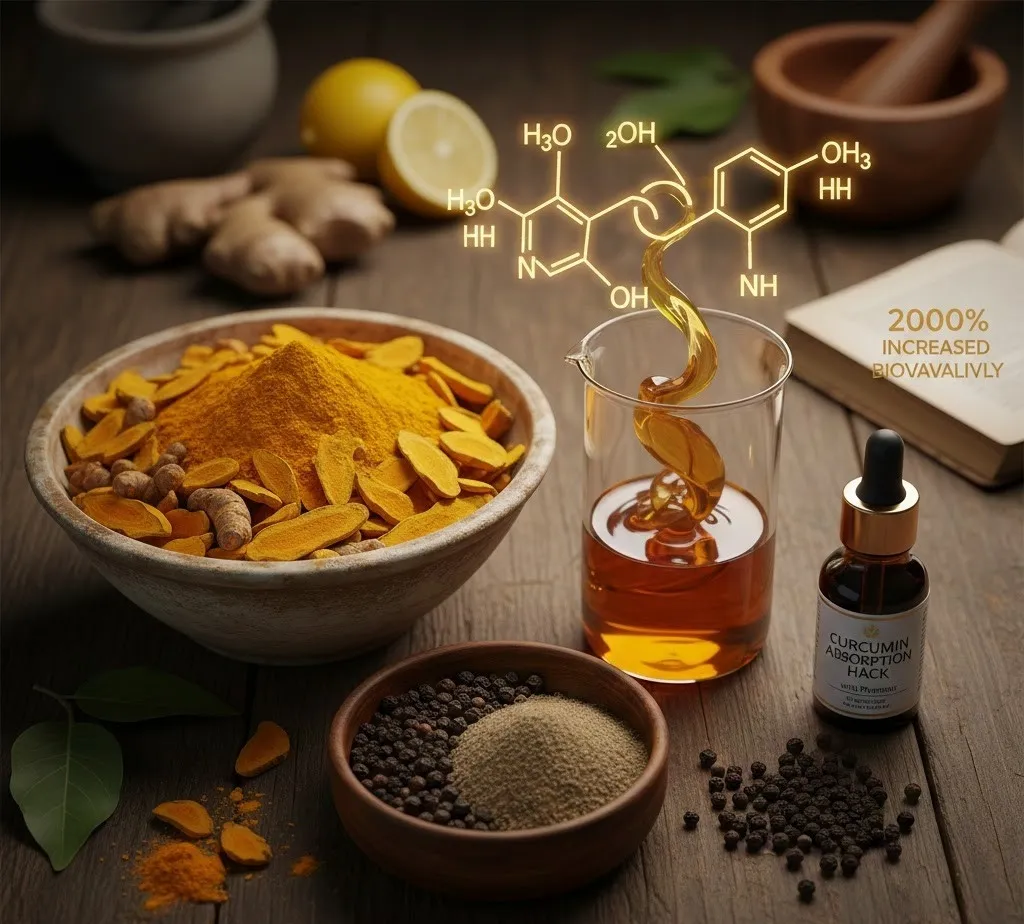
Piperine is a natural bio-enhancer. When combined with curcumin, it can dramatically increase the body's ability to absorb and utilize the compound. Studies have shown that co-administering a small amount of **black pepper piperine** with curcumin can increase its bioavailability by up to 2,000% in humans.
Mechanism of Action: How Piperine Works
**Piperine** primarily enhances **curcumin bioavailability** through two key mechanisms:
- Inhibition of Metabolic Enzymes: The most crucial mechanism is piperine’s ability to inhibit key metabolic enzymes in the liver and intestine, particularly Phase II detoxification enzymes like UDP-glucuronosyltransferases (UGT). These are the enzymes responsible for attaching a glucuronide molecule to curcumin, a process called glucuronidation, which essentially "tags" the compound for rapid excretion. By temporarily blocking these enzymes, piperine significantly slows down the metabolism of curcumin, allowing more of the active, unconjugated curcumin to remain in the bloodstream for a longer duration.
- Enhancing Intestinal Absorption: Some evidence also suggests that piperine may improve the permeability of the intestinal wall, allowing more curcumin to pass from the gut into the circulation. This is thought to be related to its interaction with the intestinal epithelial cells.
Without this **absorption hack**, much of the consumed curcumin is lost through rapid metabolism and excretion. The addition of **black pepper piperine** transforms curcumin from a poorly absorbed nutrient into a highly bioavailable, potent therapeutic agent. This is why most high-quality curcumin supplements for systemic issues like **joint pain** or **chronic inflammation** are formulated with added piperine.
Curcumin's Role as The Anti-Inflammatory Star
The primary reason for curcumin’s widespread acclaim is its ability to combat **chronic inflammation**. Inflammation is the body's natural response to injury or infection. However, when this response becomes prolonged and fails to resolve, it turns into **chronic inflammation**, a low-grade, persistent state that is now recognized as a root cause of most chronic Western diseases.
Targeting the Source of Chronic Inflammation
Curcumin's anti-inflammatory power is on par with some pharmaceutical agents, but it works by targeting multiple molecular pathways in the inflammatory cascade, leading to fewer side effects.
- Inhibition of NF-κB: The transcription factor Nuclear Factor-kappa B (NF-κB) is a master regulator of the inflammatory response. In its activated state, NF-κB moves into the cell nucleus and turns on genes that produce pro-inflammatory proteins (like cytokines, chemokines, and enzymes). Curcumin effectively inhibits the activation of NF-κB, thereby turning down the "switch" for **chronic inflammation**.
- Blocking Inflammatory Enzymes: Curcumin inhibits the activity of key pro-inflammatory enzymes, such as cyclooxygenase-2 (COX-2) and lipoxygenase (LOX). COX-2 is the enzyme targeted by non-steroidal anti-inflammatory drugs (NSAIDs). By inhibiting these enzymes, curcumin reduces the production of inflammatory signaling molecules like prostaglandins and leukotrienes.
- Modulation of Cytokines: Curcumin has been shown to decrease the production of pro-inflammatory cytokines (e.g., TNF-α, IL-1, IL-6) and potentially increase the production of anti-inflammatory cytokines.
Benefits for Joint Pain and Beyond
The ability of curcumin to inhibit the drivers of inflammation has profound implications, especially for managing **joint pain** and inflammatory conditions:
- Osteoarthritis and Joint Pain: In conditions like osteoarthritis, curcumin can help reduce pain, stiffness, and improve physical function by mitigating the degradation of cartilage and the inflammatory processes in the joints.
- Metabolic Syndrome: By targeting inflammation, curcumin can indirectly support cardiovascular health, regulate blood sugar, and manage aspects of metabolic syndrome, all of which are linked to low-grade **chronic inflammation**.
- Antioxidant Effects: Beyond inflammation, curcumin is a potent antioxidant, helping to neutralize free radicals and reduce oxidative stress—a partner in crime to **chronic inflammation**.
Dosage Guidelines and Safe Use
To achieve the therapeutic benefits described, it's crucial to follow appropriate **dosage guidelines** and focus on bioavailable formulations.
Curcumin Dosage Guidelines
The effective therapeutic **dosage guidelines** for curcumin typically depend on the formulation's **curcumin bioavailability** and the condition being addressed.
| Condition | Typical Daily Dosage Range (Curcuminoids) | Key Consideration |
|---|---|---|
| General Wellness/Prevention | 500 mg – 1,000 mg | Use with piperine or a specialized formulation. |
| Chronic Inflammation/Osteoarthritis | 1,000 mg – 1,500 mg | Divided into 2-3 doses with food. |
| Specific Therapeutic Use (Higher Doses) | Up to 4,000 mg (under professional guidance) | Often requires specialized, high-absorption formulations. |
Note: When using a curcumin-piperine supplement, a common ratio is to include 5-10 mg of piperine for every 500 mg of curcumin to achieve the optimal **absorption hack**. Always consult with a healthcare professional before starting any new supplement regimen, especially for existing health conditions or if taking other medications.
Alternative Bioavailable Formulations
While **black pepper piperine** is the most common and cost-effective **absorption hack**, other high-bioavailability formulations exist for those who may have sensitivities or prefer different options:
- Liposomal Curcumin: Curcumin is encapsulated in tiny fat-based spheres (liposomes), which protect it from degradation and allow it to be absorbed through the gut membrane more effectively.
- Curcumin Phytosomes (e.g., Meriva): Curcumin is complexed with phospholipids (like soy lecithin) to create a phytosome. This increases its lipid solubility and absorption.
- Micellar Curcumin (e.g., NovaSOL): Curcumin is dispersed in micelles, a liquid structure that is highly soluble and easily absorbed by the body.
These advanced delivery systems represent alternatives to the piperine **absorption hack** and are often used in clinical research due to their guaranteed high **curcumin bioavailability**.
Conclusion: Unlocking Curcumin’s Full Potential
Curcumin, the active compound from turmeric, is a true anti-inflammatory powerhouse capable of modulating the molecular pathways behind **chronic inflammation** and offering significant relief for conditions like **joint pain**. However, this therapeutic potential is locked behind a severe problem of poor **curcumin bioavailability**.
The key to unlocking its benefits is the strategic **absorption hack**: the simultaneous ingestion of **black pepper piperine**. This simple alkaloid dramatically inhibits the rapid metabolism of curcumin, ensuring that a potent concentration of the active compound reaches your bloodstream. By choosing a supplement with both curcumin and **black pepper piperine**, and adhering to appropriate **dosage guidelines**, you can effectively harness the full, star power of this ancient golden remedy.