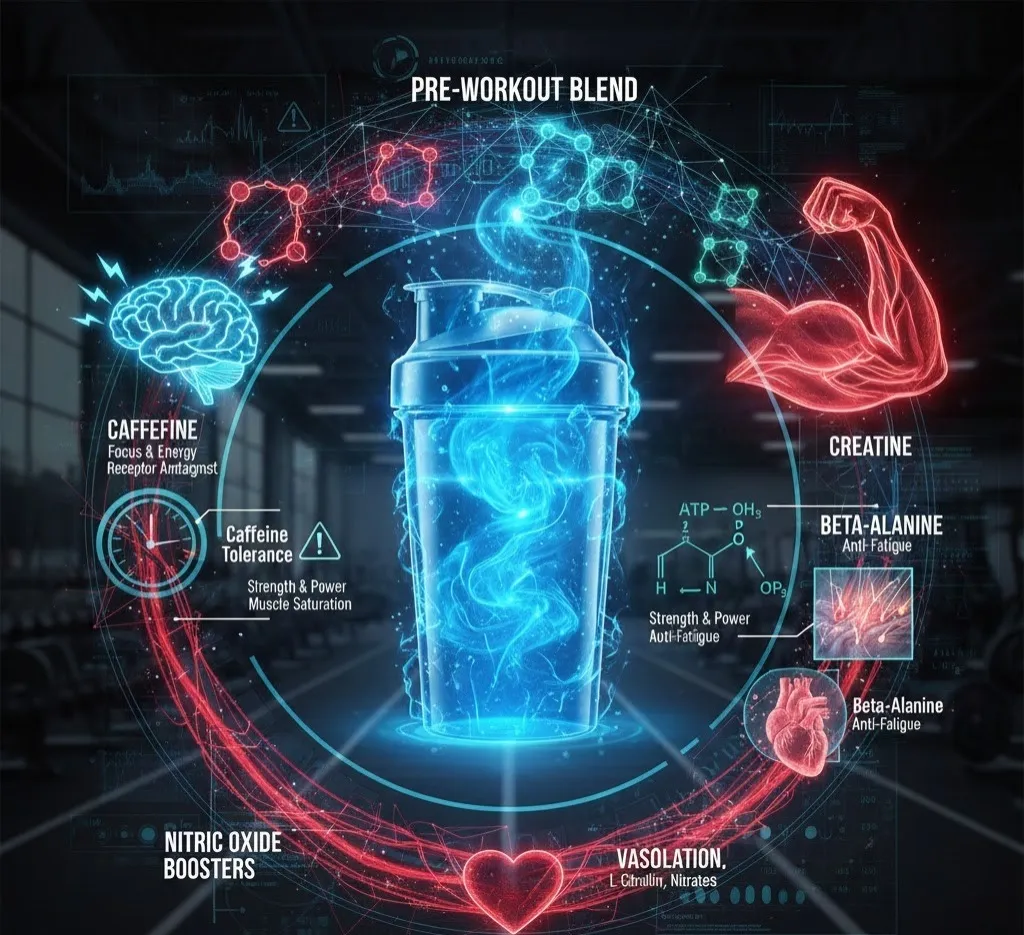
Learn dosages & science.
Pre-workout supplements—often consumed as a flavored powder mixed with water—are multi-ingredient dietary formulas designed to be taken 20–45 minutes before a workout. The goal is simple: to boost energy, enhance focus, improve performance, and delay fatigue. These benefits are not magic; they are the result of potent, scientifically-validated compounds working together in a carefully crafted pre-workout blend.
Understanding the role of each component is vital for maximizing results and minimizing side effects. While a complete ingredient breakdown reveals dozens of possibilities, three compounds consistently form the bedrock of almost every effective formula: Caffeine, Creatine, and Beta-Alanine.
Caffeine: The Universal Powerhouse
Caffeine is the most widely consumed psychoactive substance in the world and, for good reason, the undisputed king of the pre-workout. It is a potent central nervous system (CNS) stimulant that directly impacts perceived exertion and energy levels.
Physiological Effects and Mechanism of Action
The primary way caffeine works is by acting as an adenosine receptor antagonist. Adenosine is a neurotransmitter that promotes relaxation and drowsiness. By binding to and blocking these receptors, caffeine effectively prevents the body from recognizing fatigue. The result is a reduced perception of effort, meaning you feel like you can push harder for longer.
Furthermore, caffeine stimulates the release of adrenaline (epinephrine), a "fight or flight" hormone that prepares the body for intense activity. This process mobilizes fat stores, allowing the body to use fat as fuel, which can spare muscle glycogen stores and further enhance endurance.
Benefits:
- Increased alertness, sharpened focus, enhanced endurance (aerobic and anaerobic), improved power output, and a reduction in exercise-induced pain perception.
Typical Dosage:
- The clinically effective dose ranges from 3 to 6 mg per kilogram (mg/kg) of body weight, generally falling between 150–300 mg per serving for most individuals. Novices should start at the lower end.
Side Effects:
- Jitters, anxiety, increased heart rate, and insomnia. These side effects are highly dependent on the user's caffeine tolerance.
Managing Caffeine Tolerance
For those who consume high levels of caffeine daily through coffee, soda, or other sources, performance benefits from a pre-workout may diminish over time. This development of tolerance is a common phenomenon. To reset caffeine tolerance, a "stimulant break" or "washout period"—typically 1 to 2 weeks of minimal to zero caffeine intake—is often recommended. Alternatively, one can opt for a "stim-free" pre-workout formulation.
Creatine Monohydrate: Strength, Power, and ATP
Creatine is one of the most researched and effective supplements for increasing muscle strength, power, and size. While often included in a pre-workout blend, it’s crucial to understand that creatine’s effects are chronic (cumulative over time), not acute (immediate).
Physiological Effects and Mechanism of Action
Creatine’s role is fundamental to cellular energy production. In the body, it is converted into phosphocreatine (PCr), which acts as a reserve of high-energy phosphate groups.
When your muscles perform quick, intense actions (like a heavy squat or a sprint), they rely on Adenosine Triphosphate (ATP) for fuel. ATP quickly loses a phosphate group, becoming Adenosine Diphosphate (ADP), which is useless for power output. PCr rapidly donates its phosphate group to ADP, essentially re-charging it back into ATP. This process, known as the phosphocreatine system, allows for brief, explosive bursts of energy. Supplementing with creatine saturates your muscles with PCr, allowing you to sustain high-intensity efforts for a few precious seconds longer, ultimately leading to greater training volume and superior long-term strength gains.
Benefits:
- Increased maximum strength and power, enhanced performance in high-intensity exercise, increased lean body mass, and potential cognitive benefits.
Typical Dosage:
- The maintenance dose is 3–5 grams per day, taken daily, regardless of whether it's a training day or not. Loading phases (20g/day for 5–7 days) accelerate saturation but are not strictly necessary.
Side Effects:
- The most common side effect is temporary water retention and slight weight gain, as creatine pulls water into the muscle cells.
Beta-Alanine: The Muscle Fatigue Buffer
Beta-Alanine is a non-essential amino acid that is a staple in most pre-workouts because of its unique, palpable effect and proven efficacy in high-intensity, middle-duration exercise (sets lasting 60-240 seconds).
Physiological Effects and Mechanism of Action
Beta-Alanine is the rate-limiting precursor to the dipeptide carnosine. Carnosine is stored in high concentrations in skeletal muscle and functions as an intramuscular buffer. During high-intensity exercise, your body produces hydrogen ions ($\mathrm{H}^{ }$) as a metabolic byproduct, which rapidly lowers muscle $\mathrm{pH}$ (makes the muscle acidic). This acidity is what causes the infamous muscle "burn" and forces you to stop the set—a process called metabolic acidosis.
Carnosine essentially "soaks up" these $\mathrm{H}^{ }$ions, stabilizing the muscle $\mathrm{pH}$ and delaying the onset of that burning fatigue. This allows you to squeeze out extra repetitions or maintain a sprint for a longer period.
Benefits:
- Increased muscular endurance, especially in the 60-240 second range of activity, and delayed neuromuscular fatigue.
Typical Dosage:
- The effective dose requires a daily intake of 3.2–6.4 grams. Like creatine, it must be taken consistently to build up carnosine stores.
Side Effects and the Beta-Alanine Tingle:
- The most distinctive, though harmless, side effect is a tingling or prickling sensation on the skin, known as paresthesia. This beta-alanine tingle is caused by beta-alanine binding to nerve receptors just under the skin. While some find it distracting, it is completely benign and a sign that the ingredient is active. To reduce the intensity of the tingle, users can split their daily dose or use a sustained-release form.
The Vasodilation Effect: Nitric Oxide Boosters
Beyond energy and endurance, another primary driver for pre-workout formulas is the desire for an enhanced muscle pump—the temporary increase in muscle size due to swelling from increased blood flow. This is achieved through the use of nitric oxide boosters.
Nitric Oxide Boosters and The Pump
Nitric Oxide (NO) is a signaling molecule naturally produced by the body that causes vasodilation, the widening of blood vessels. Increased vasodilation means a larger capacity for blood flow to the working muscles, delivering more oxygen and nutrients while also clearing out metabolic waste products like lactic acid.
The rush of nutrient-rich blood to the muscle tissue is what causes the vascular appearance and tight, full feeling that bodybuilders call "the pump." Ingredients that support NO production are collectively known as nitric oxide boosters and are the key components of any effective pump supplement.
| Ingredient | Mechanism of Action | Typical Dose |
|---|---|---|
| L-Citrulline | The amino acid L-Citrulline is the most effective and preferred NO booster. It converts to L-Arginine in the kidneys, bypassing the digestive system's breakdown, leading to more efficient NO production. | 6–8 grams of L-Citrulline or 8–10 grams of Citrulline Malate (usually a 2:1 ratio). |
| L-Arginine | An immediate precursor to NO production. However, it is poorly absorbed orally due to extensive breakdown in the gut (first-pass metabolism), making L-Citrulline the superior choice. | 3–6 grams of the non-standard forms like Arginine Alpha-Ketoglutarate (AAKG) are generally used. |
| Nitrates (e.g., Beetroot Extract) | Nitrates follow the nitrate-nitrite-NO pathway, which is independent of L-Arginine. They are reduced to nitrite, then to NO, especially in conditions of low oxygen (like during intense exercise). | Typically dosed for 400–500 mg of true nitrate content. |
The Supporting Cast: Other Key Ingredients
While the core four (Caffeine, Creatine, Beta-Alanine, and Citrulline) handle energy, strength, and the pump, many other ingredients are included in a comprehensive pre-workout blend to support focus, hydration, and metabolism. This is where a detailed ingredient breakdown becomes essential, especially when assessing a formula's overall value.
Nootropics (Focus and Cognitive Enhancement)
- L-Tyrosine: This amino acid is a precursor to several important neurotransmitters, including dopamine, norepinephrine (noradrenaline), and epinephrine (adrenaline). Supplementation can help improve mental focus and alertness, particularly in stressful conditions or during periods of fatigue.
- L-Theanine: Often paired with caffeine. L-Theanine is an amino acid found primarily in tea leaves. It promotes relaxation without drowsiness. When combined with caffeine, it smooths out the stimulant's effect, reducing the potential for jitters and anxiety while enhancing focus—a classic synergistic pairing.
- Alpha-GPC (Alpha-glycerophosphocholine): A compound that releases choline, a precursor to acetylcholine, a key neurotransmitter involved in muscle contraction and learning. It is included to enhance the mind-muscle connection and power output.
Performance and Hydration
- Betaine Anhydrous (Trimethylglycine): Derived from choline, Betaine acts as an osmolyte, helping cells maintain fluid balance. This mechanism is thought to increase muscle cell volume, contributing to the pump and cell hydration. It is also shown to support power output and strength, similar to creatine.
- Taurine: A conditional essential amino acid that is also an osmolyte, helping with hydration and cell volume. It has been shown to reduce muscle damage and may play a role in optimizing nerve function and mitigating the side effects of high-dose stimulants.
- B Vitamins (B6, B12, Niacin): Often included for their role in energy metabolism (converting food into ATP). Niacin (Vitamin B3) specifically can cause a transient "niacin flush" (skin redness and warmth) due to vasodilation.
Safety, Stacking, and Finding Your Formula
The true effectiveness of any pre-workout blend hinges on two things: the quality and quantity of the ingredients (transparency is key—avoid proprietary blends that hide dosages) and your body’s individual response.
Dosage and Safety
It is a common error for users to think "more is better." This is rarely true in sports nutrition. Exceeding recommended dosages, especially with stimulants, can increase the risk of adverse effects without providing additional performance benefits.
- Jitters and Anxiety: Almost always the result of too much caffeine. Respect your caffeine tolerance. If you are highly sensitive, start with a half scoop or choose a formula with less than 150 mg of caffeine.
- Digestive Distress: High doses of certain osmotic agents (like Creatine) or nitric oxide boosters (like Citrulline or Arginine) can pull too much water into the gut, leading to discomfort, bloating, or diarrhea. Proper hydration and splitting doses can mitigate this.
- Insomnia: Taking a stimulant pre-workout blend too close to bedtime is a recipe for a sleepless night. Caffeine’s half-life means it can remain active in your system for many hours. As a general rule, avoid stimulant pre-workouts for at least six to eight hours before you intend to sleep.