Explore how 5G/6G and LEO satellite broadband are revolutionizing cruise ship connectivity, enabling high-speed maritime internet
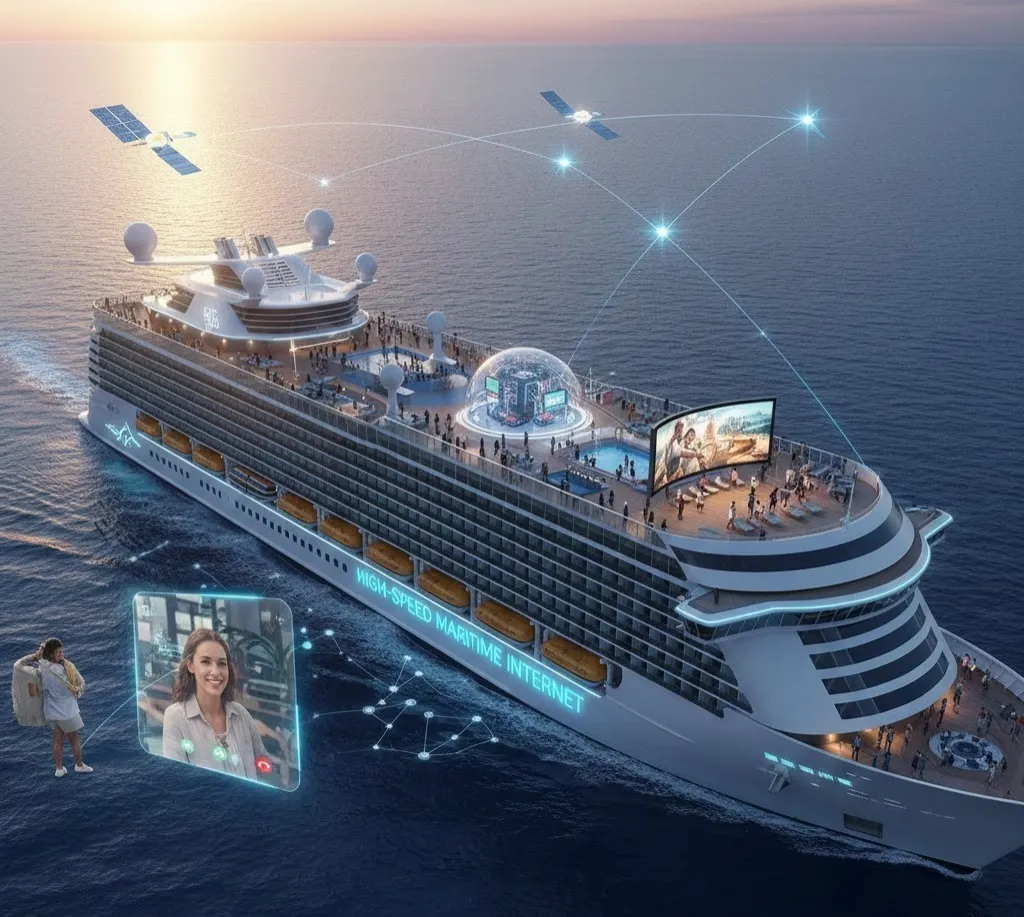
The era of slow, unreliable, and prohibitively expensive internet access at sea is rapidly drawing to a close. The convergence of next-generation cellular standards—5G and the emerging 6G—with a revolution in satellite broadband is completely transforming the passenger and operational experience across the maritime sector. This shift is turning a luxury vessel into a truly floating, connected smart city, offering high-speed maritime internet that is challenging the performance of terrestrial networks.
Advances in Satellite and Cellular Technology
Reliable, high-speed internet access on luxury cruise ships and remote expeditions has traditionally been a challenge due to the massive distance and physical obstructions between the vessel and the signal source. Recent technological advances, however, have created a powerful, multi-layered solution.
The LEO Satellite Revolution
The most significant recent advancement is the proliferation of Low Earth Orbit (LEO) satellite constellations (e.g., Starlink, OneWeb, Telesat Lightspeed).
Geostationary Orbit (GEO) vs. LEO: Traditional satellite broadband relied on GEO satellites, which orbit at approximately 35,786 km. While providing wide coverage, the immense distance resulted in high latency (often 600-800ms) and limited bandwidth per user.
Near-Terrestrial Performance: LEO satellites orbit much closer, at around 550 km. This proximity drastically reduces data travel time, achieving ultra-low latency mitigation (as low as 20-40ms) comparable to fiber optic broadband on land. This is critical for real-time applications like video calls and cloud-based services.
High-Speed Throughput: The sheer number of LEO satellites creates a massive capacity network, enabling speeds that can exceed 200 Mbps for a single vessel—a paradigm shift for cruise ship connectivity.
Shutterstock
The 5G and 6G Onboard Cellular Backbone
While satellites handle the external "backhaul" connection, 5G technology is deployed onboard the ship to create a private, high-capacity local network.
Private 5G Networks: Cruise operators are installing private 5G networks that act like a miniature, hyper-efficient cellular tower. This network supports high connection density and ultra-high bandwidth to seamlessly distribute the satellite connection to thousands of passengers and crew simultaneously.
Network Slicing: 5G’s core feature, network slicing, allows the network to be logically divided and optimized for specific use cases (e.g., prioritizing operational data, guaranteeing bandwidth for executive remote work at sea, and allocating resources for passenger entertainment).
6G & The Future: The forthcoming 6G standard promises even greater throughput, near-zero latency mitigation, and a deeper integration of AI and sensing capabilities. This will unlock autonomous vessel operations, hyper-personalized passenger services, and robust security monitoring through real-time video analytics.
Transforming the Passenger Experience
The fusion of high-speed LEO backhaul and onboard 5G/6G networks fundamentally changes the purpose of cruise ship connectivity from a communication lifeline to a full-fledged digital amenity.
The Rise of Remote Work at Sea
Previously, a cruise was a necessary digital detox. Now, low-latency, high-bandwidth connectivity enables professionals to maintain full productivity from anywhere, blurring the line between travel and work.
Seamless Video Conferencing: The reduction in latency mitigation provided by LEO satellites makes it possible for passengers to participate in real-time, high-definition video calls and webinars without the frustrating delays and drop-outs common with older GEO systems.
Cloud Access: Accessing corporate Virtual Private Networks (VPNs) and cloud-based applications (like Google Workspace or Office 365) becomes instant and reliable, making remote work at sea a viable reality for digital nomads and extended cruise-goers.
Unprecedented Integrated Entertainment
The high throughput of these new networks supports an enhanced level of digital consumption and integrated entertainment that mimics a home environment.
4K/HDR Streaming: Passengers can reliably stream high-definition video services (Netflix, YouTube, etc.) on multiple personal devices concurrently.
Virtual and Augmented Reality (VR/AR): Low latency is essential for immersive applications. 5G/6G will enable ship operators to offer high-fidelity VR experiences, such as virtual tours, interactive games, and AR overlays for navigation or educational content about ports of call.
Operational Efficiency and Safety
The impact of this robust high-speed maritime internet extends far beyond passenger perks, driving significant gains in ship operations and safety.
Predictive Maintenance and IoT
By connecting thousands of onboard sensors, the vessel itself becomes a massive, intelligent IoT (Internet of Things) device.
Real-Time Monitoring: 5G's massive machine-type communications (mMTC) capability allows engineers to collect real-time data on everything from engine performance and fuel consumption to HVAC systems.
Data-Driven Maintenance: This flow of data enables predictive maintenance, where shoreside teams can analyze performance trends using AI, diagnose potential equipment failures remotely, and dispatch parts or technicians only when needed, significantly reducing downtime and operational costs.
Enhanced Safety and Security
Real-Time Surveillance: High-resolution video feeds from security cameras can be streamed and analyzed in real-time using on-ship edge computing and AI, improving security and crowd management.
Augmented Navigation: Real-time access to high-definition weather data and digital charts, coupled with low-latency communication, enhances navigational safety, particularly for future semi-autonomous or fully autonomous vessels.
Challenges and the Path Forward
Despite the revolutionary technology, implementing seamless cruise ship connectivity still faces hurdles. The need for constant latency mitigation in a dynamic ocean environment requires a hybrid approach.
Hybrid Networks: The most effective solution is a dynamic network that seamlessly switches between the ultra-low latency mitigation LEO satellite connection (in open water) and the high-bandwidth 5G terrestrial cellular network (when close to shore) to ensure uninterrupted service.
Cost and Infrastructure: The initial investment in LEO terminals, onboard 5G infrastructure, and subscription costs for massive data usage remains significant, though competitive pricing and increased efficiency are making it more accessible.
Cybersecurity: With increased connectivity comes a larger attack surface. Robust cybersecurity measures are paramount to protect sensitive passenger data and critical vessel operational systems from threats.
In conclusion, the partnership between next-generation cellular standards (5G/6G) and LEO satellite broadband is not just an upgrade—it's a foundational transformation. It has moved cruise ship connectivity from a compromise to a competitive advantage, fully supporting the demand for remote work at sea and delivering true integrated entertainment on the global ocean.