Learn how liquidity pools, on-chain trading, and DeFi are challenging CEXs and mitigating slippage risk.
The financial world is undergoing a seismic shift, driven by the emergence of blockchain technology and the philosophy of decentralization. At the forefront of this transformation are Decentralized Exchanges (DEXs), platforms that are fundamentally reshaping how digital assets are traded. By operating without a central authority, custodian, or intermediary, DEXs are pioneering a new era of trustless, transparent, and globally accessible finance. They represent the practical application of Decentralized Finance (DeFi) principles, offering a powerful alternative to the traditional models embodied by centralized exchanges (CEXs). The trajectory of modern trading points undeniably toward a future dominated by the innovative mechanisms of on-chain trading facilitated by these non-custodial powerhouses.
Challenging the Centralized Citadel: How DEXs Redefine Trading
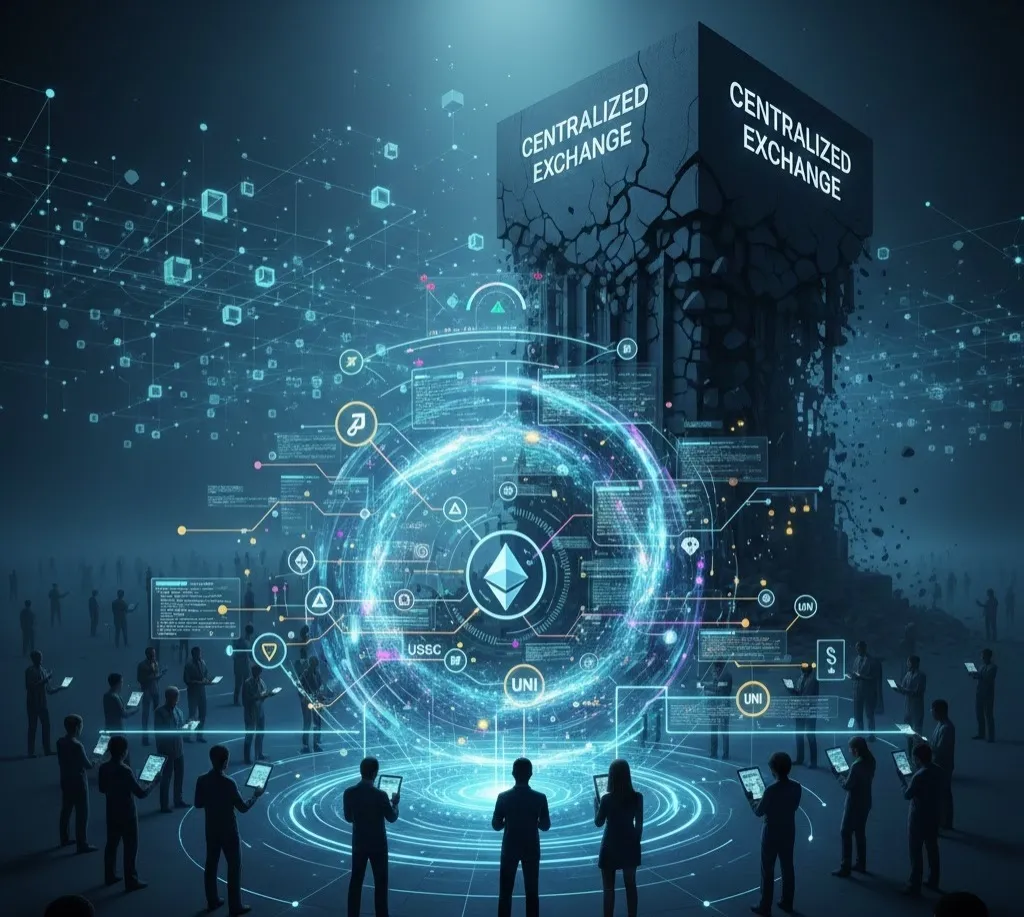
For decades, centralized exchanges have served as the primary gateways to financial markets. These platforms, like traditional stock exchanges, require users to deposit funds into a custodial account, essentially transferring control and ownership to the third-party operator. While offering high liquidity and user-friendly interfaces, this model carries inherent risks: single points of failure, vulnerability to catastrophic hacks, lack of privacy due to stringent Know Your Customer (KYC) requirements, and susceptibility to censorship or government seizure of funds.
DEXs are challenging centralized exchanges by eliminating these vulnerabilities through a radical shift in architecture. Instead of relying on a central company to manage user funds and execute trades via an internal ledger, DEXs utilize smart contracts to automate every aspect of the exchange process. This non-custodial nature means traders maintain full control over their private keys and, crucially, their assets at all times.
The core distinction lies in custody. A centralized exchange holds your funds; a DEX merely provides the software (the smart contract) that allows you to swap assets directly from your own wallet. This fundamental difference is the foundation of the revolution, giving rise to DeFi trading—a paradigm of finance where trust is engineered into the code, not delegated to an institution. The shift empowers individuals, transforming them from clients of a financial service into active participants in a decentralized network.
The Engine of Decentralization: Automated Market Makers (AMMs)
The most significant innovation enabling the widespread success of DEXs is the automated market maker (AMM) model. Unlike traditional CEXs, which rely on a centralized order book to match buyers and sellers, an AMM replaces the intermediary with an algorithmic protocol.
The Mechanics of Liquidity Pools
At the heart of an AMM are liquidity pools. These pools are essentially reserves of two or more tokens locked within a smart contract. Traders execute swaps directly against the assets held in these pools, rather than waiting for an opposing order from another individual.
Community-Provided Liquidity
The assets in a pool are supplied by ordinary users, known as liquidity providers (LPs). LPs deposit an equal value of two tokens (e.g., ETH and USDC) into the smart contract and, in return, receive LP tokens that represent their share of the pool.
Algorithmic Pricing
The ratio of the tokens in the pool is what determines the price. A pre-defined mathematical formula—such as Uniswap's constant product formula, $x \cdot y = k$ (where $x$ and $y$ are the quantities of the two tokens, and $k$ is a constant)—ensures that the pool always maintains liquidity. When a trader buys token $Y$ with token $X$, the supply of $X$ increases while the supply of $Y$ decreases. To maintain the constant $k$, the price of $Y$ must increase relative to $X$, programmatically creating the market.
Incentives for LPs
LPs are incentivized to provide this crucial liquidity by earning a portion of the trading fees generated by the pool. This unique mechanism effectively automates the market-making function—a task traditionally performed by large, centralized institutions—and distributes the profits to the community.
DEXs are challenging centralized exchanges by automating trading via smart contracts and providing liquidity through community pools because they democratize market access. Anyone can become a market maker (a liquidity provider) or a trader, twenty-four hours a day, seven days a week, with nothing more than a crypto wallet.
On-Chain Trading: Transparency and Finality
A defining characteristic of DEXs is the execution of all trades as on-chain trading. This means that every transaction—from the initial order to the final settlement—is written directly onto the blockchain and verified by the distributed network.
The benefits of true on-chain trading are manifold:
- Transparency: Every trade is publicly visible on the blockchain, allowing for complete auditing and eliminating the possibility of wash trading or hidden manipulation often associated with centralized, opaque systems.
- Security: All transactions are secured by the cryptographic strength and consensus mechanisms of the underlying blockchain (e.g., Ethereum, Solana, etc.), making trade settlement immutable and tamper-proof.
- Trustlessness: Traders do not need to trust the exchange operator to accurately execute and record their transaction; they only need to trust the open-source code of the smart contract.
While highly secure, the nature of on-chain trading introduces a unique complexity: the issue of slippage risk.
Mitigating Slippage Risk in DEX Environments
Slippage risk is the critical difference between the expected price of a trade and the price at which the trade is actually executed. In a DEX, this risk is amplified by the mechanism of the AMM and the asynchronous nature of blockchain processing.
Causes and Consequences
- Pool Depth (Liquidity): If a liquidity pool is shallow, a large trade will significantly alter the ratio of assets within the pool, causing the price to move dramatically against the trader. This is known as price impact, which contributes heavily to slippage.
- Network Congestion: When a blockchain network is busy, the time between a trade being submitted and it being confirmed can increase. If the price of the asset moves during this delay, the final executed price will differ from the quoted price.
- Front-Running: Malicious actors can observe pending transactions in the mempool and execute their own transaction first, causing the target trade to execute at a worse price.
To manage this, DEXs allow users to set a slippage tolerance—a maximum percentage difference they are willing to accept. If the actual price of the executed trade exceeds this tolerance, the transaction automatically fails. As DEX technology matures, solutions like Layer 2 scaling, better liquidity aggregation, and concentrated liquidity pools are continually being developed to minimize this risk, bringing the execution quality closer to that of centralized exchanges.
The Expanding Universe of DeFi Trading
The rise of Decentralized Exchanges (DEXs) is inseparable from the broader explosion of DeFi trading. DEXs are not just venues for spot trading; they are the foundational layer upon which complex, permissionless financial primitives are built.
- Asset Variety: DEXs allow for the trading of nearly any token created on their host blockchain, including governance tokens, yield-bearing assets, and synthetic derivatives, without the need for a central listing authority. This rapid, permissionless asset onboarding contrasts sharply with the selective, often lengthy listing process of CEXs.
- Yield Generation: LPs are essentially participating in yield farming, a key component of the DeFi ecosystem, where they earn fees and often additional tokens (like the DEX's native governance token) for providing liquidity. This turns the typically passive role of a user into an active, income-generating one.
- Composability: Because everything is built on smart contracts, different DeFi protocols are "composable." A user can take their LP tokens, deposit them into a lending protocol as collateral, and borrow funds, all without leaving the decentralized ecosystem. This interlocking financial infrastructure is the true power of DeFi trading.
Technological Advancements and The Road Ahead
The future of trading is one where DEXs continue to chip away at the market share of their centralized counterparts. This progress is fueled by ongoing technological breakthroughs:
- Layer 2 Scaling Solutions: Innovations like optimistic rollups and ZK-rollups are dramatically increasing the speed and lowering the cost of on-chain trading, directly addressing the historical issues of slow execution and high gas fees that plagued early DEXs.
- Concentrated Liquidity: Newer AMM models, like Uniswap V3, allow LPs to concentrate their capital within a specific price range. This results in far greater capital efficiency and creates "deeper" liquidity in common trading ranges, directly reducing slippage risk for traders.
- Interoperability: Cross-chain bridges and protocols are allowing assets from one blockchain (e.g., Ethereum) to be traded on a DEX on another chain (e.g., Polygon or Avalanche), creating a more unified and liquid global market.
The evolution of DEXs is a testament to the power of open-source innovation. While challenges remain—including user experience complexity, regulatory uncertainty, and the inherent slippage risk for low-volume tokens—the fundamental value proposition of non-custodial, permissionless access ensures that Decentralized Exchanges (DEXs) will continue to be a dominant and transformative force in the world of finance, solidifying the importance of automated market makers (AMMs) and liquidity pools as cornerstones of the new financial reality.
The future of trading is not just about faster or cheaper transactions; it is about building a financial system that is fundamentally fairer, more robust, and accessible to everyone, everywhere, thanks to the principles of DeFi trading and the power of smart contracts.