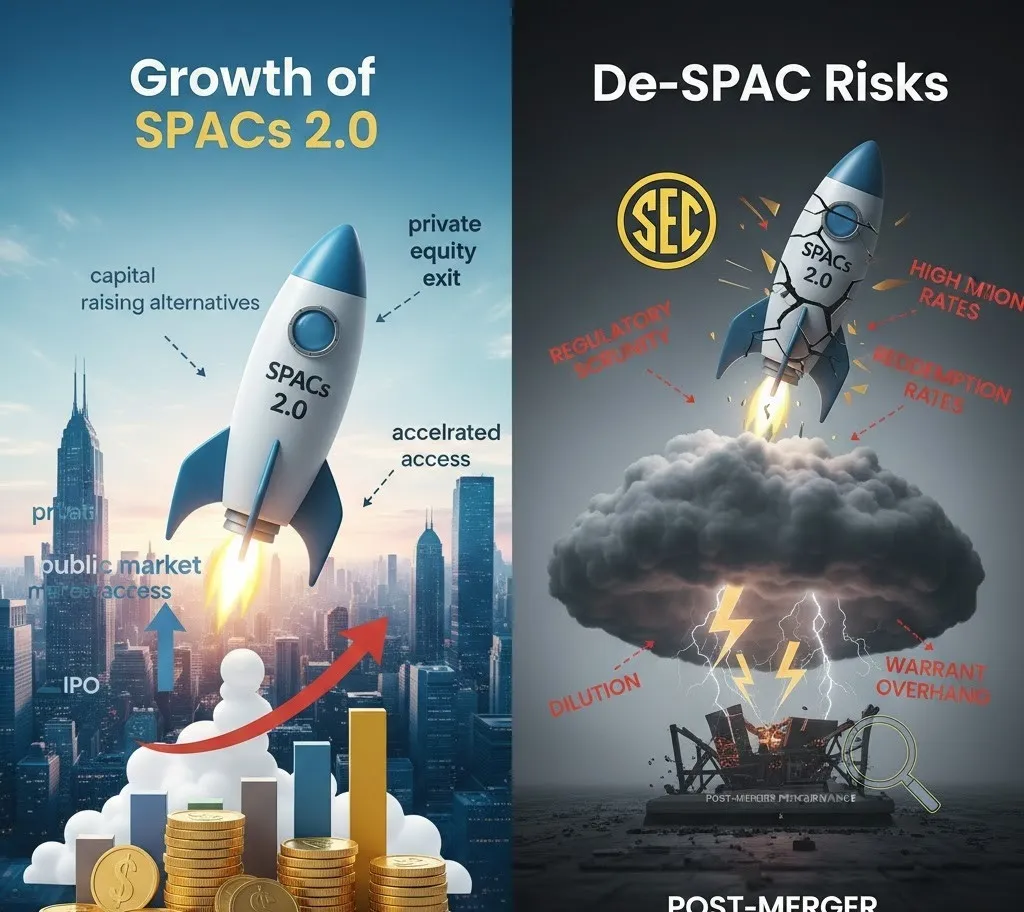
Explore SPACs as a capital raising alternative and private equity exit.
The Re-Emergence: The Growth of SPACs 2.0 and De-SPAC Risks
The financial markets have always been characterized by periods of innovation and resurgence, and few phenomena exemplify this better than the recent explosion and subsequent recalibration of Special Purpose Acquisition Companies (SPACs). Once considered a niche, sometimes risky, path to the public markets, SPACs underwent a dramatic renaissance, leading to the "SPAC 2.0" era—a period defined by unprecedented fundraising volumes, high-profile deals, and, crucially, intense regulatory scrutiny.
This comprehensive analysis delves into the mechanics of this resurgent market, the inherent risks associated with the post-merger phase, or De-SPAC transactions, and the evolving landscape of investor protection. The SPAC model has established itself as a significant capital raising alternative to the traditional Initial Public Offering (IPO), offering private companies accelerated public market access, but the real long-term performance and accompanying risks are now under the microscope.
Understanding the SPAC 2.0 Phenomenon
A SPAC is essentially a "blank-check" shell company that raises capital through an IPO with the sole purpose of merging with an existing private company within a specified timeframe (typically 18-24 months). This business combination, known as the De-SPAC transaction, effectively takes the private target public via a reverse merger.
Renewed Interest: Drivers of Growth
The exponential growth of SPACs in 2020 and early 2021 was driven by several compelling factors:
- Speed and Certainty of Execution: Compared to a traditional IPO, the De-SPAC process can be significantly faster, often taking 4–6 months versus 12–18 months for an IPO. This speed, combined with the ability to negotiate a private company's valuation upfront, offered both issuers and sponsors greater certainty in volatile markets.
- The Power of Financial Projections: Unlike traditional IPOs, which rely primarily on historical financials, SPAC deals allow companies to present forward-looking financial projections to investors. This was particularly attractive for high-growth, pre-revenue, or early-stage technology companies.
- The Private Equity Exit Strategy: SPACs offered private equity and venture capital firms a new, flexible, and often lucrative liquidity event for their portfolio companies. The De-SPAC route became an increasingly popular private equity exit channel, sometimes executed more quickly and with more favorable terms than a traditional sale or IPO.
- Investor Appetite: Low interest rates and a bull market created enormous investor appetite for high-growth, disruptive companies. SPACs provided a mechanism for retail and institutional investors to get "in early" on promising, pre-public companies, a privilege often reserved for institutional players in the past.
The 'SPAC 2.0' Shift
The initial SPAC boom was followed by a sharp contraction in late 2021 and 2022, largely due to poor post-merger performance and increased scrutiny. However, the subsequent SPAC 2.0 resurgence, observed in later periods, suggests a market correction leading to a more disciplined and regulated environment:
- Increased Sponsor Quality: The sponsors behind successful SPAC 2.0 deals are often more reputable financial institutions and proven operators, signaling a flight to quality and better alignment of interests.
- Tighter Deal Terms: Modern SPAC deals often feature stricter terms, including performance-based "earn-outs" for sponsors and longer lock-up periods, which tie sponsor compensation to the post-merger stock performance.
- Focus on Fundamentals: There is a clearer focus on targets with stronger financial fundamentals, existing revenues, and clearer paths to profitability, moving away from purely speculative ventures.
Analysis of Regulatory Scrutiny
The rapid growth of SPACs caught the attention of regulators, most notably the U.S. Securities and Exchange Commission (SEC), which stepped up its oversight to address investor protection concerns. This regulatory intervention has been a defining feature of the SPAC 2.0 era.
Key Areas of Scrutiny:
- Investor Protection and Disclosure: A major concern was the difference in disclosure requirements between a traditional IPO and a De-SPAC. The SEC has aimed to level the playing field, proposing new rules that would subject SPAC and De-SPAC transactions to more rigorous disclosure requirements, particularly regarding the sponsors' interests, conflicts of interest, and the use and basis of financial projections.
- Liability Risk: Regulators have clarified that the safe harbor for forward-looking statements—often cited as a key advantage of the SPAC route—is not absolute, increasing the potential liability for those involved in the De-SPAC transaction. This has compelled all parties to undertake more thorough due diligence, similar to a traditional IPO.
- Accounting Treatment of Warrants: A significant regulatory action was the SEC's guidance on the accounting treatment of SPAC warrants. Many SPACs had incorrectly classified warrants as equity, requiring numerous companies to restate their financial statements. This increased compliance complexity and slowed down the market.
The Risks of De-SPAC: Post-Merger Performance
The true test of a SPAC is not the initial IPO, but the performance of the newly public company following the De-SPAC transaction. The track record, particularly from the peak of the boom, reveals significant challenges and inherent risks.
1. Poor Post-Merger Stock Performance
- Underperformance vs. IPOs: Analysis has consistently shown that a vast majority of companies that go public via a De-SPAC have underperformed the broader market indices (like the S&P 500) and companies that chose the traditional IPO route. Many De-SPACed entities saw their valuations collapse dramatically in the months following the reverse merger.
- Valuation Challenges: The lack of traditional market testing and the reliance on aggressive projections often led to inflated valuations during the De-SPAC phase. When these companies became fully public and their projected growth failed to materialize, a sharp correction in stock price was inevitable.
2. High Redemption Rates
A unique feature of the SPAC structure is the right of the original SPAC investors to redeem their shares for the original IPO price (plus interest) if they disapprove of the announced target or the deal terms.
- Cash Shortfalls: High redemption rates, which have soared in the high-interest-rate environment, significantly reduce the amount of cash that the target company receives from the SPAC's trust account. This shortfall often forces the SPAC sponsor to seek additional financing, usually through a Private Investment in Public Equity (PIPE) at unfavorable terms, or to renegotiate the deal.
- Deal Viability: When redemptions are excessive, the De-SPAC transaction can become capital-starved, undermining the target's ability to fund its growth plans, which was the primary reason for seeking public market access.
3. Dilution and Warrant Overhang
The capital structure of a SPAC is complex and presents significant dilution risks for non-redeeming shareholders.
- The Sponsor Promote: The SPAC sponsors typically receive "founder shares" or a "promote," which is a grant of stock (usually 20% of the SPAC's equity) for a nominal price. This stake is highly dilutive to public investors.
- Warrants: SPAC units are often sold with detachable warrants, which grant the holder the right to buy stock at a future date at a set price (e.g., $11.50). Once these warrants are exercised, they increase the total share count, further diluting the ownership of existing shareholders. This "warrant overhang" can depress the stock price.
Conclusion: The Future of SPACs 2.0
The initial SPAC boom was a period of exuberance, driven by low-interest rates and a seemingly insatiable hunger for high-growth assets. The subsequent downturn and the rise of SPACs 2.0 demonstrate a necessary market maturation. The intense regulatory scrutiny from the SEC and the poor post-merger performance of many De-SPACed companies have instilled greater discipline in the market.
For private companies, the reverse merger remains a vital capital raising alternative and an accelerated path to public market access. It is particularly compelling as a private equity exit route when market windows for traditional IPOs are volatile or closed. However, the future success of the SPAC model, now in its SPAC 2.0 phase, hinges on the quality of the sponsors, the strength of the target company's business model, and greater transparency for investors.
The key takeaway for market participants is a more cautious and due-diligence-intensive approach. Investors must carefully assess the potential for dilution, the likelihood of high redemptions, and the realism of financial projections, rather than simply betting on the celebrity of the sponsor. The SPAC is here to stay, but it has evolved from a speculative shortcut into a more scrutinized and structured route to the public markets, where successful De-SPAC outcomes are earned, not assumed.