Explore Decentralized Science (DeSci) investment models,
The Imperative for Change in Scientific Funding
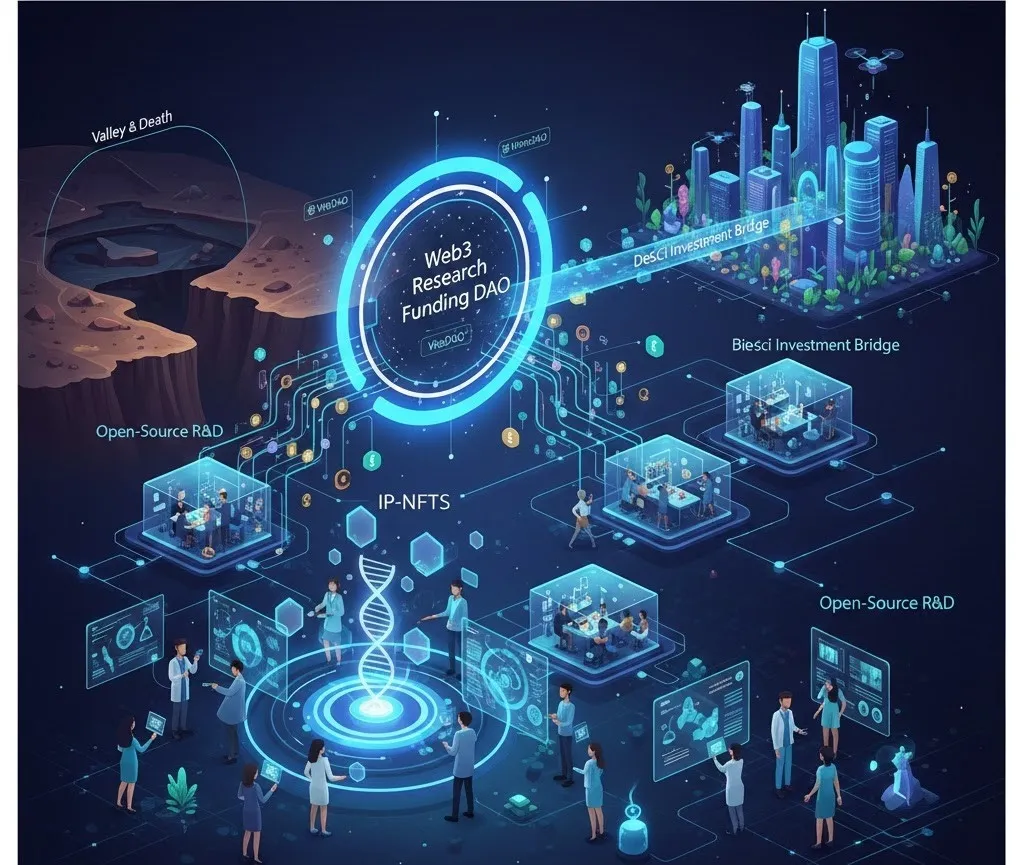
The traditional ecosystem for scientific research and development (R&D) is characterized by bottlenecks: opaque funding processes, restrictive intellectual property (IP) rights, a "publish or perish" culture that disincentivizes replication, and the infamous "Valley of Death"—the funding gap between early-stage academic discovery and clinical translation. This centralized, hierarchical system, primarily reliant on government grants and large pharmaceutical companies, often favors low-risk, established research over high-impact, transformative, or niche areas like rare diseases or longevity science.
The resulting lack of efficiency and accessibility has spurred a radical movement: Decentralized Science (DeSci).
DeSci is an emergent movement that applies the principles of Web3—namely, blockchain technology, smart contracts, and Decentralized Autonomous Organizations (DAOs)—to the entire scientific lifecycle, from funding and data sharing to peer review and IP ownership. By leveraging these decentralized tools, DeSci seeks to dismantle the gatekeeping mechanisms of the traditional scientific-industrial complex and create a more transparent, collaborative, and incentive-aligned system.
The most profound immediate impact of this transformation is on how science is funded and invested in, giving rise to entirely new DeSci investment models. These models are not merely incremental improvements; they represent a fundamental shift in capital allocation, risk management, and ownership, particularly for high-growth sectors like biotech investment and healthcare innovation.
The Dawn of Web3 Research Funding
The core of the DeSci investment thesis lies in Web3 research funding, which replaces traditional, centralized grant-making institutions with transparent, community-governed mechanisms. This shift democratizes who decides what science gets funded and how the returns are distributed.
Decentralized Autonomous Organizations (DAOs)
Decentralized Autonomous Organizations (DAOs) are the principal vehicle for Web3 research funding. Projects like VitaDAO (focused on longevity research), AthenaDAO (focused on women's health), and ValleyDAO (focused on synthetic biology and climate) operate as pools of capital governed by their token holders.
Community Vetting and Allocation: Scientists submit research proposals directly to the DAO. Token holders—who can be a mix of scientists, patients, investors, and enthusiasts—vote on which projects to fund. This process bypasses the slow, often biased, and highly competitive grant system. Since voting is recorded on the blockchain, the funding decision is transparent and auditable.
Agile Capital Deployment: Unlike the years-long cycle for federal grants, DAOs can deploy capital rapidly, minimizing the translational delay between discovery and development.
Incentive Alignment: Investors and community members who hold the DAO's governance token are directly incentivized to see the funded research succeed, creating a powerful, motivated stakeholder community around a scientific objective.
Quadratic Funding and Crowdfunding
DeSci platforms also utilize innovative crypto-native funding models:
Quadratic Funding (QF): QF is a mathematical mechanism that prioritizes research projects supported by a larger number of unique contributors over projects that simply receive large, singular donations. It acts as a matching fund, giving more weight to community preference than to capital volume alone. This ensures smaller, highly popular projects receive disproportionate financial support, helping to avoid "whale" domination and supporting public-good research.
Tokenized Crowdfunding: Researchers can issue project-specific tokens to raise funds. These tokens can represent various rights, from simple utility (access to early data) to a slice of future royalties. This gives individual investors, patient groups, and foundations a direct, liquid way to participate in and own a piece of the research from the earliest stages.
This architecture of Web3 research funding transforms the act of funding science into a global, peer-to-peer investment opportunity, effectively broadening the capital base available for R&D.
Tokenized Intellectual Property: The Revolution in Ownership
Perhaps the most transformative innovation in DeSci investment models is the concept of tokenized intellectual property (IP), specifically through the use of IP-NFTs (Intellectual Property Non-Fungible Tokens).
Defining and Fractionalizing Scientific Assets
Historically, IP—such as a patent for a novel drug compound or a unique dataset—is an illiquid asset owned by a university or a corporation. Its transfer is slow, expensive, and opaque. Tokenized intellectual property changes this by representing the legal rights, royalties, or ownership stake of a scientific discovery as a digital asset on a blockchain:
IP-NFTs as the Wrapper: A Non-Fungible Token (NFT) acts as a unique, verifiable, and immutable digital certificate of authenticity and ownership for a piece of IP. It can be linked to the underlying legal agreements (e.g., licensing terms, royalty splits).
Fractional Ownership: The IP-NFT can then be fractionalized into many Fungible Tokens (IP-FTs). This allows an investor to buy a small share of a complex, high-value asset, which was impossible in traditional finance. For example, a patent covering a promising longevity molecule can be fractionalized, allowing thousands of investors to collectively own the future royalty stream.
Liquidity for Researchers: Scientists and institutions can monetize their early-stage discoveries quickly by selling a portion of the IP-NFT/IP-FTs, providing the necessary liquidity to bridge the "Valley of Death" and secure further funding for clinical trials, rather than waiting years for a traditional licensing deal. Projects like Molecule act as Web3 marketplaces where researchers can tokenize their IP and connect with funding DAOs.
This mechanism directly addresses the massive risk associated with early-stage biotech investment. By fractionalizing the IP, the risk is distributed across a wider investor base, and investors gain a liquid, tradable asset representing a stake in a scientific breakthrough.
Open Science and the Rise of Open-Source R&D
DeSci is fundamentally aligned with the principles of open science, but it goes a step further by introducing powerful financial incentives.
Incentivizing Open-Source R&D
Traditional R&D is a proprietary, closed system where secrecy is necessary to secure patents. Open-source R&D in the DeSci paradigm flips this model. By recording all research artifacts—protocols, datasets, null results, and peer reviews—on an immutable blockchain, transparency becomes the default, which in turn enhances data integrity and reproducibility.
Community Review and Vetting: Platforms incentivize quality assurance. Researchers can earn tokens for contributing rigorous, constructive peer reviews, helping to validate and improve the scientific record far more efficiently than the closed, volunteer-based traditional journal system.
Rewarding All Contributions: In the traditional model, only the final, positive result is published and rewarded. In DeSci, tokens can be used to reward every valuable contribution, including the sharing of negative results (which prevents others from pursuing dead ends), cleaning datasets, or running replication studies. This broadens the incentive structure to promote scientific rigor over publishing sensationalism.
Shared Infrastructure: Open-source R&D extends to shared, decentralized infrastructure. Projects like OriginTrail provide a Decentralized Knowledge Graph (DKG) to organize and verify scientific data, ensuring provenance and interoperability across different DeSci platforms.
This shift toward incentivized open-source R&D leads to faster, more robust, and less redundant scientific progress—a key factor that makes biotech investment in the DeSci space more appealing.
Blockchain Platforms: Accelerating Biotech and Health Innovation
The foundational infrastructure enabling all these new models are Blockchain platforms that allow decentralized funding and ownership of scientific research, accelerating biotech and health innovation.
Leading platforms, primarily built on Ethereum or alternative Layer 1/2 chains, are providing the essential tools:
| Platform/Protocol | Primary Focus | Mechanism and Acceleration |
| Molecule | IP Marketplace | Provides the technical standards (IP-NFTs) for researchers to tokenize their IP, allowing immediate fundraising and fractional ownership, directly reducing the early-stage biotech investment risk. |
| VitaDAO | Longevity Research Funding | A DAO that directly purchases and governs longevity IP-NFTs. It pools capital from a global community and allocates it instantly to cutting-edge research, dramatically accelerating a traditionally neglected area of health innovation. |
| Hippocrat | Clinical Trial Data | Creates a decentralized network for secure, transparent, and auditable clinical trial data management. This accelerates trials by building trust in the data, ensuring regulatory compliance, and empowering patient-owned health data. |
| ResearchHub | Open Access & Publishing | Incentivizes the sharing of papers, comments, and reviews with the ResearchCoin (RSC) token, breaking down paywalls and accelerating the dissemination and validation of scientific knowledge. |
| GenomesDAO | Genomic Data Ownership | Allows individuals to securely store, control, and monetize their own genetic data for research purposes via a secure data vault. This directly connects patients/owners to research efforts, accelerating personalized medicine and drug discovery. |
These platforms collectively form a new, open bio-economy. For example, a researcher with a promising molecule can mint an IP-NFT using the Molecule protocol, secure funding from VitaDAO based on a community vote, and use Hippocrat to manage the data from subsequent preclinical work. This integrated, permissionless approach to funding, ownership, and data management dramatically lowers the barrier to entry and speeds up the entire drug discovery pipeline, providing a powerful flywheel for biotech investment.
DeSci's Impact on Biotech Investment and Financialization
The adoption of DeSci models fundamentally changes the profile of biotech investment by addressing liquidity and risk, two major pain points of the traditional life sciences sector.
Enhanced Liquidity and Early-Stage Investment
Traditional venture capital in biotech involves high-risk, long lock-up periods (often 10 years), and an illiquid exit only via IPO or acquisition. DeSci offers an alternative:
Liquid Assets: Tokenized intellectual property (IP-FTs) are liquid assets that can be traded on decentralized exchanges, offering investors an exit path long before clinical trials are complete. This shortens the investment horizon and makes early-stage scientific funding accessible to a much broader pool of retail and institutional capital.
Fractionalized Risk: Fractionalization lowers the entry barrier for investors, enabling portfolio diversification across dozens of high-risk, early-stage research projects instead of concentrating capital in a few.
The Role of Prediction Markets and Reputational Capital
New incentives align investment with accurate scientific prediction:
Scientific Prediction Markets: DeSci platforms can utilize prediction markets where investors and scientists stake tokens on the likelihood of a research outcome (e.g., "Will Compound X pass Phase I trials?"). This mechanism acts as an early, decentralized vetting layer, providing a public signal of a project's scientific merit and investment potential.
Reputation and Trust: Blockchain-verified reputations for researchers and peer reviewers become tangible assets, enhancing trust. Investors are more likely to fund projects led by individuals with high on-chain reputation scores built from transparent, rewarded contributions to open-source R&D.
By introducing market mechanisms, transparency, and liquidity into scientific investment, DeSci is poised to unlock billions in previously stagnant capital, specifically targeting the high-risk, high-reward frontier of biotech investment and health innovation.
Conclusion: The Future of Scientific Investment
DeSci represents a profound and necessary evolution away from the centralized, often inefficient, and restrictive model that has governed science for decades. By leveraging Web3 research funding mechanisms like DAOs and transparent smart contracts, it is creating a vibrant, global marketplace for scientific capital. The innovative use of tokenized intellectual property and a commitment to incentivized open-source R&D are accelerating the pace of discovery, lowering the barrier to investment, and creating liquid ownership models.
The blockchain platforms dedicated to this movement are not just funding science; they are creating a new, verifiable, and equitable infrastructure for knowledge production itself. For biotech investment, DeSci is the bridge over the "Valley of Death," transforming illiquid patents into tradable digital assets and democratizing access to the returns of scientific progress. While regulatory clarity remains a challenge for these novel financial instruments, the potential for DeSci to unleash a new era of accelerated health and technological innovation is undeniable. The movement is poised to make scientific research a collective, global, and highly rewarding endeavor.