Explore the future of travel with Biometric check-in, facial recognition boarding, and keyless hotel access.
The modern traveler is no longer content with just reaching a destination; they demand an experience that is fluid, personal, and instantaneous. This expectation is driving a profound digital transformation in the travel and hospitality sectors, with biometrics emerging as the key to unlocking true seamless travel. By leveraging unique physiological characteristics—such as facial features, fingerprints, or iris patterns—the industry is moving away from friction-filled checkpoints and paper-based processes toward a world where the traveler's face is their ticket, passport, and hotel room key.
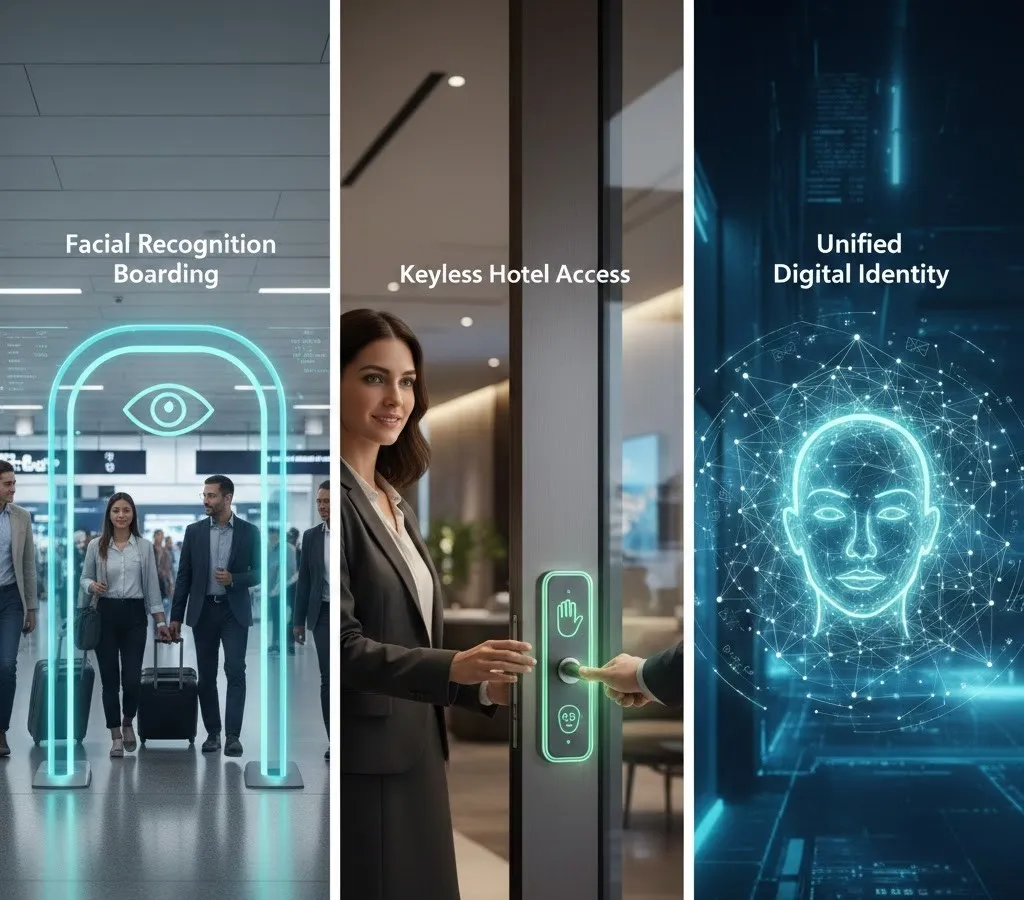
This revolution is about creating a unified digital identity that acts as a secure, invisible thread weaving together every touchpoint of the journey, from the moment a traveler leaves their home to the second they check out of their hotel. The result is a radically simplified guest experience, underpinned by unprecedented levels of security and operational efficiency for airlines, airports, and hotels.
The Airport Transformation: Smart Operations and Biometric Integration
The airport environment has traditionally been the most complex and friction-filled part of any journey. Long queues, repeated document checks, and stress-inducing security procedures have been the norm. Biometrics is changing this by introducing a layer of intelligence that enables smart airport operations, dramatically enhancing both security and passenger flow.
Enrollment and Pre-Travel Verification
The journey begins before the traveler even arrives at the terminal. Many airline and border agencies now offer remote biometric check-in and enrollment through mobile applications.
A passenger can upload a photo of their passport and take a real-time selfie on their mobile device. The system then uses sophisticated algorithms to match the live photo against the government-issued document photo, creating a highly secure and verified single digital token. This token, a component of the unified digital identity, contains all necessary travel and identity data, replacing the need for physical documents at various touchpoints.
Security and Boarding: Facial Recognition as the Key
Once at the airport, the digital identity takes center stage, beginning with security and moving through to the departure gate.
- Security Checkpoints: At pre-security gates, instead of presenting a passport and boarding pass, the traveler simply glances at a camera. The system instantly verifies their identity against the stored biometric template, confirming their eligibility to pass. This process is far quicker and more accurate than manual checks, enhancing both speed and security.
- Lounge Access: For premium travelers, the same unified digital identity grants entry to airport lounges. The traveler bypasses the need to present a physical card or boarding pass; their face is automatically recognized at the entrance, and access is approved based on their linked flight status and loyalty membership.
- Facial Recognition Boarding: The culmination of the airport journey is facial recognition boarding. As the traveler approaches the gate, a camera captures their face, matching it against the stored token. The gate opens automatically, and the passenger is free to board the aircraft without slowing down to hand over a paper or mobile boarding pass. This hands-free, document-free approach dramatically reduces boarding times, especially on wide-body aircraft, enabling faster turnarounds and more efficient smart airport operations. This process is the ultimate expression of seamless travel in the aviation sector.
The End-to-End Integration: From Runway to Room Entry
The true power of biometrics is realized when the technology is integrated across the entire travel ecosystem—not just within the confines of the airport. The vision of a truly seamless travel experience requires a handoff of the unified digital identity from the aviation sector to the hospitality sector.
The end-to-end integration of biometrics from airport security and lounge access to hotel check-in and room entry represents a paradigm shift. It transforms disjointed processes into a continuous, flowing guest journey.
Automated Hotel Arrival
Upon arrival in the destination city, the traveler's digital identity follows them.
- Immigration and Customs: Many major international borders are now implementing biometric exit and entry programs, where the face scan used at the departure airport can be used again for efficient, automated customs clearance at the arrival airport.
- Baggage Reclaim: Even baggage claim is becoming biometric-enabled. The traveler’s face can be used to authorize the release of their checked luggage from a carousel, adding a layer of security to ensure only the correct person retrieves their bags.
Keyless and Contactless Hospitality
The handoff to the hotel is where the seamless travel concept takes a new dimension. Historically, hotel check-in involved queuing at a front desk, presenting an ID and credit card, and waiting for a key card to be encoded. Biometrics eliminates all of this.
Biometric Check-in and Keyless Access
A forward-thinking hotel, part of an integrated biometric ecosystem, allows the traveler to use their existing unified digital identity for a true biometric check-in.
- Instant Registration: Upon entering the lobby, a simple face scan at a kiosk or a mobile app interaction confirms the guest's reservation. Their identity is verified using the same biometric data linked to their flight, eliminating the need to show a passport or ID for a second time. Any necessary payment details are already linked and verified.
- Keyless Hotel Access: The most tangible benefit in hospitality is keyless hotel access. The guest's biometric data is securely linked to the digital lock on their assigned room. They simply approach the door, and a facial or palm scan grants them immediate entry. This eliminates lost key cards, demagnetization issues, and the friction of returning keys at check-out. It extends to all areas of the hotel, including:
- Access to Executive Floors and Amenities: The unified digital identity instantly verifies access privileges for VIP lounges, spa facilities, or executive floors.
- In-Hotel Transactions: Some systems allow the guest's biometric ID to authorize charges to their room account at hotel restaurants or bars, creating a truly wallet-free experience.
The entire stay, from the moment of arrival to the point of departure, is facilitated by the guest's intrinsic identity, making the journey feel less like a series of transactions and more like a continuous, personalized experience.
The Strategic Advantages of Biometrics
Beyond the elevated guest experience, the adoption of biometrics delivers profound strategic benefits to the travel and hospitality industry.
Enhanced Security and Fraud Prevention
Biometric systems offer a level of security that paper documents and manual checks simply cannot match. Unlike passports or ID cards, biometrics are incredibly difficult to forge.
- High-Trust Verification: The use of multi-modal biometrics (e.g., combining facial and iris recognition) creates a highly accurate and secure unified digital identity that significantly reduces the risk of identity fraud and unauthorized access at all checkpoints.
- Real-Time Alerts: In smart airport operations, biometric systems can be integrated with watchlist databases, providing real-time alerts to security personnel when a person of interest is identified, often before they reach a critical security area.
Operational Efficiency and Cost Savings
The automation provided by biometrics translates directly into reduced operational costs and improved efficiency.
- Optimized Staff Deployment: By automating the mundane tasks of ID checks and boarding pass scanning, airline and hotel staff are freed up to focus on higher-value customer service, improving personalization and exception handling.
- Increased Throughput: Facial recognition boarding and biometric check-in significantly increase the speed at which passengers can be processed through a system. This is critical for airports facing capacity constraints, allowing for more efficient use of gates and terminals.
- Data Accuracy: Automated systems reduce the potential for human error in data entry or identity verification, leading to cleaner, more reliable customer data.
Personalization and Loyalty
The unified digital identity serves as the foundation for deep personalization. When a guest's identity is seamlessly confirmed across all touchpoints, the system can instantly retrieve their preferences.
- Hyper-Personalization: An airline can use the biometric ID to ensure a traveler's pre-ordered meal or seat preference is correct. A hotel can use keyless hotel access linked to the guest's profile to automatically set the room temperature, lighting, and even the TV welcome screen to their preferred language the moment they open the door. This level of anticipatory service drives loyalty and positive guest reviews.
- Frictionless Loyalty Programs: Biometrics eliminate the need for physical loyalty cards or app lookups. A customer is instantly recognized as a high-value member at the biometric check-in desk or lounge, and their benefits are applied automatically, reinforcing the value of their membership.
Challenges and the Path Forward
While the benefits are clear, the path to a fully integrated seamless travel ecosystem is not without challenges.
Privacy and Data Security
The primary concern for consumers and regulators is the privacy and security of sensitive biometric data. The industry must adopt a Privacy by Design approach, ensuring:
- Transparency and Consent: Travelers must be given clear information about how their data will be used and the option to opt in or out of the biometric program.
- Secure Storage and Deletion: Biometric templates should be stored securely, often encrypted, and in decentralized systems, with a clear policy for deleting the data once the journey is complete. The goal is to move to a unified digital identity that is controlled by the traveler, not a multitude of third parties.
Interoperability and Standardization
For the end-to-end vision to succeed, there must be a common standard for how biometric data is captured, stored, and shared between airlines, airports, border control agencies, and hotels. Global initiatives like IATA’s One ID are working to establish the technical and legal frameworks for this cross-border, cross-industry interoperability, turning the single-entity concept into a global, operational reality.
Conclusion
The convergence of biometrics and the travel and hospitality industries is more than just a technological upgrade; it is a fundamental redefinition of the guest journey. From smart airport operations and facial recognition boarding to biometric check-in and keyless hotel access, the adoption of a unified digital identity is dismantling the traditional silos of travel.
By focusing on security, efficiency, and hyper-personalization, biometrics are transforming the often-stressful experience of travel into a true seamless travel flow. As technology advances and global standards solidify, the future of the guest journey is one where identity is effortless, secure, and inherently personal—a truly end-to-end experience powered by the simple act of being yourself.