Discuss the evidence & consult your doctor.
For millions managing Type 2 diabetes (T2D), the prescription drug Metformin is the undisputed first-line treatment, often referred to as the gold standard. However, a powerful compound sourced from ancient herbal medicine has gained significant attention in recent years: berberine. Frequently dubbed "nature's Metformin," this bright yellow alkaloid, extracted from plants like goldenseal, barberry, and Chinese Coptis, presents a compelling case for a natural blood sugar control alternative or complementary treatment.
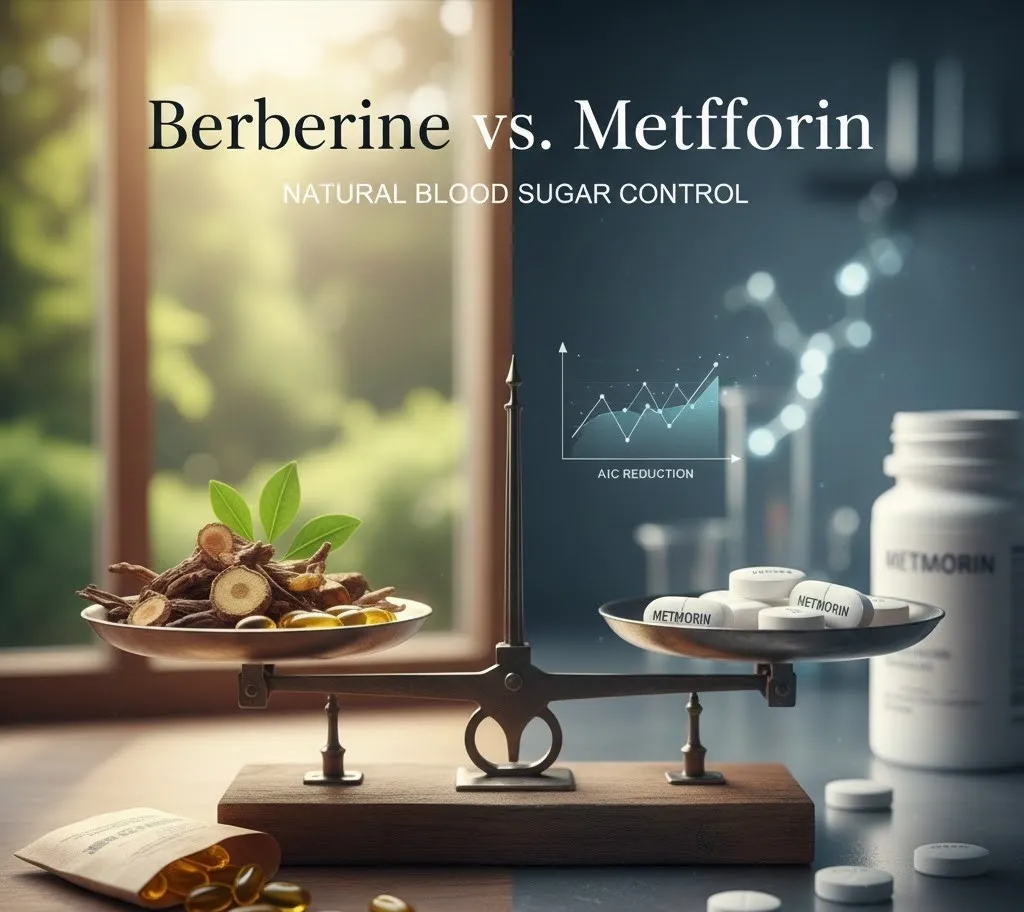
The rise of berberine has sparked a critical, evidence-based discussion: How does this natural compound compare to one of the most widely prescribed drugs in the world? This comprehensive comparison dives into the pharmacology, clinical efficacy—including A1C reduction—and safety profiles of both berberine and Metformin to help you understand their roles in T2D management and overall metabolic health.
Mechanisms of Action: The Shared Metabolic Pathway
The reason berberine is so often compared to Metformin lies in their remarkably similar mechanism of action within the body's metabolic engine. Both compounds are known to primarily work by activating a critical cellular enzyme: AMP-activated protein kinase (AMPK).
What is AMPK?
AMPK is essentially a "master switch" for cellular energy. When activated, it signals to the cell that energy reserves (ATP) are low. To compensate, the cell shifts into an energy-saving and fuel-burning state. This metabolic shift is what drives the blood sugar-lowering effects of both Metformin and berberine.
Metformin: Targeting the Liver
Metformin, a synthetic biguanide, primarily functions by:
- Decreasing Hepatic Glucose Production: It inhibits the liver's ability to create and release glucose (a process called gluconeogenesis) into the bloodstream, especially during fasting. This is considered its main mechanism for reducing high fasting blood sugar.
- Improving Insulin Sensitivity: It makes muscle and fat cells more responsive to insulin, allowing them to absorb glucose more efficiently. This increases glucose uptake from the blood into the cells for energy.
Berberine: Multifaceted Metabolic Modulation
The berberine benefits go beyond a single mechanism, demonstrating a more complex and multifaceted action:
- AMPK Activation: Like Metformin, berberine strongly activates AMPK, leading to improved insulin sensitivity and reduced liver glucose production.
- Enhanced Insulin Secretion: Some research suggests berberine can also promote insulin secretion in a glucose-dependent manner, offering a unique advantage.
- Modulation of Gut Microbiota: Berberine has been shown to positively reshape the gut microbiome, which influences glucose metabolism and overall health.
- Inhibition of α-Glucosidase: This action slows the digestion of carbohydrates in the intestine, leading to a smaller, more gradual rise in blood sugar after meals (post-prandial glucose).
Clinical Efficacy: A Comparative Look at Blood Sugar Control
When evaluating any T2D treatment, the most important metric is its ability to lower blood sugar and improve long-term glycemic control, typically measured by the $\text{A1C}$ test.
Berberine vs. Metformin: Lowering $\text{A1C}$
Multiple meta-analyses and randomized controlled trials (RCTs), particularly in Chinese populations, have directly compared the glucose-lowering effects of the two compounds.
- Comparable $\text{A1C}$ Reduction: Several studies involving newly diagnosed T2D patients found that berberine, typically dosed at $500\text{ mg}$ two or three times daily, demonstrated a comparable effect to Metformin ($500\text{ mg}$ three times daily) in reducing key glycemic markers. For instance, some trials reported that berberine reduced $\text{HbA1c}$ levels from a baseline of $8.1\%$ to $7.3\%$.
- Fasting and Post-Meal Glucose: Both agents have been shown to significantly decrease fasting blood glucose (FBG) and post-prandial blood glucose (PBG) levels. The reduction magnitude in small trials suggests berberine’s blood sugar control is similar to Metformin comparison, though more large-scale, long-term studies are needed to solidify this claim across diverse global populations.
Synergy: The Power of Combination Therapy
One of the most intriguing findings is the potential for synergy. Clinical data suggests that combining berberine with Metformin (or other oral hypoglycemic agents) can be more effective than either agent alone. This combination therapy offers enhanced $\text{A1C reduction}$ and FBG lowering, potentially allowing for lower doses of the prescription medication and mitigating some of its more severe side effects.
A Note on Speed of Action
While the ultimate $\text{A1C reduction}$ may be comparable, Metformin often works much faster, with effects noticeable within a week. Berberine, conversely, may require consistent use for three to six months before its maximal natural blood sugar control benefits are fully realized.
Beyond Glucose: Additional Metabolic Benefits
The treatment of T2D is holistic, requiring the management of related metabolic disorders. Here, berberine benefits often shine, providing advantages that may exceed those of Metformin in specific areas.
Lipid Profile Improvement
For many T2D patients, hyperlipidemia (high cholesterol and triglycerides) is a major concern, significantly increasing cardiovascular risk.
- Berberine: Research indicates that berberine has a more pronounced effect on improving lipid profiles. It significantly lowers total cholesterol, LDL ("bad") cholesterol, and triglycerides. Its mechanism includes reducing a protein called PCSK9, which helps clear LDL receptors, leading to lower circulating LDL.
- Metformin Comparison: While Metformin has positive effects on lipids, particularly triglycerides, the effects are generally less dramatic or consistent than those observed with berberine.
Cardiovascular and Organ Protection
Both agents offer protective qualities due to their broad metabolic effects, including anti-inflammatory and antioxidant properties. Berberine has demonstrated potential benefits in protecting against diabetes-induced complications such as nephropathy, neuropathy, and cardiovascular disorders, suggesting it offers a more comprehensive metabolic and vascular protection profile.
Polycystic Ovary Syndrome (PCOS)
Both Metformin and berberine are frequently used to manage PCOS—a condition often marked by insulin sensitivity and metabolic dysfunction. Studies suggest berberine may be more effective than Metformin in improving insulin resistance, lipid metabolism, and promoting better menstrual and ovulation patterns in women with PCOS.
Safety, Side Effects, and Regulation
The decision between a supplement and a prescription drug must heavily weigh safety, side effect profile, and regulatory status.
Safety and Regulation: Prescription vs. Supplement
- Metformin: It is an FDA-approved medication with decades of extensive, large-scale clinical use, making its long-term safety profile well-understood. The dosage is strictly regulated and standardized.
- Berberine: As a dietary supplement, berberine is not regulated by the FDA for efficacy or purity in the same way as a prescription drug. Quality and concentration can vary significantly between brands, and long-term, large-scale safety data is less robust than for Metformin.
Side Effect Profile
Both compounds commonly cause gastrointestinal (GI) side effects, which are typically dose-dependent.
- Metformin: Common side effects include nausea, diarrhea, stomach pain, bloating, and gas. A rare but serious side effect is lactic acidosis, though this is primarily a risk for individuals with severe kidney or liver disease.
- Berberine: Common side effects are also GI in nature, including constipation, flatulence, abdominal discomfort, and diarrhea (though often reported as less frequent or severe than with Metformin).
One key distinction is the risk of hypoglycemia (low blood sugar). Because Metformin's action is less dependent on glucose concentration, there is a theoretical, though low, risk of hypoglycemia, particularly in combination with other drugs. Berberine's glucose-lowering effect appears to be more "hyperglycemia-dependent," meaning it works best when blood sugar is high, potentially reducing the risk of a dangerous crash.
The Critical Role of a Doctor Consultation
The comparison between berberine and Metformin is not about definitively replacing a proven medication but exploring options for personalized, comprehensive care. The choice should never be made unilaterally.
Why Doctor Consultation is Essential
- Accurate Diagnosis and Monitoring: Only a healthcare provider can diagnose T2D and monitor progress through regular $\text{A1C}$ and blood work. Self-medication with berberine without monitoring can mask a worsening condition.
- Drug Interactions: Berberine can inhibit certain liver enzymes (CYP450), which are responsible for metabolizing a wide range of medications, including some statins, blood thinners, and other diabetes drugs. Starting berberine while on other medications requires a doctor consultation to manage potential drug interactions.
- Dosage and Formulation: The effective dose of berberine ($900\text{ mg}$ to $1500\text{ mg}$ daily, divided) is based on studies that need to be carefully translated to individual needs. Your doctor consultation can help determine a safe and appropriate starting point.
Conclusion: Which Option is Right for You?
The evidence strongly suggests that berberine is a powerful metabolic compound with blood sugar-lowering effects comparable to Metformin in many head-to-head, short-term trials. Its superior benefits for lipid metabolism and its potential role in PCOS management make it an attractive option.
- Metformin remains the gold-standard first-line therapy due to its established long-term safety data, standardized dosing, and proven efficacy across large, diverse populations.
- Berberine is best viewed as a potent, research-backed *adjuvant* therapy. It is an excellent option for patients seeking a natural blood sugar approach, those who cannot tolerate the GI side effects of Metformin, or those who require additional support for managing cholesterol and triglycerides.
Ultimately, the best path for managing Type 2 diabetes involves lifestyle changes—diet and exercise—supported by the most appropriate medical or natural treatment. Always engage in a detailed discussion with your doctor consultation before beginning, changing, or discontinuing any medication or supplement regimen. The future of T2D management lies in the integration of powerful pharmaceuticals and evidence-based natural compounds tailored to the individual patient.