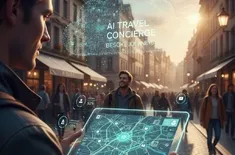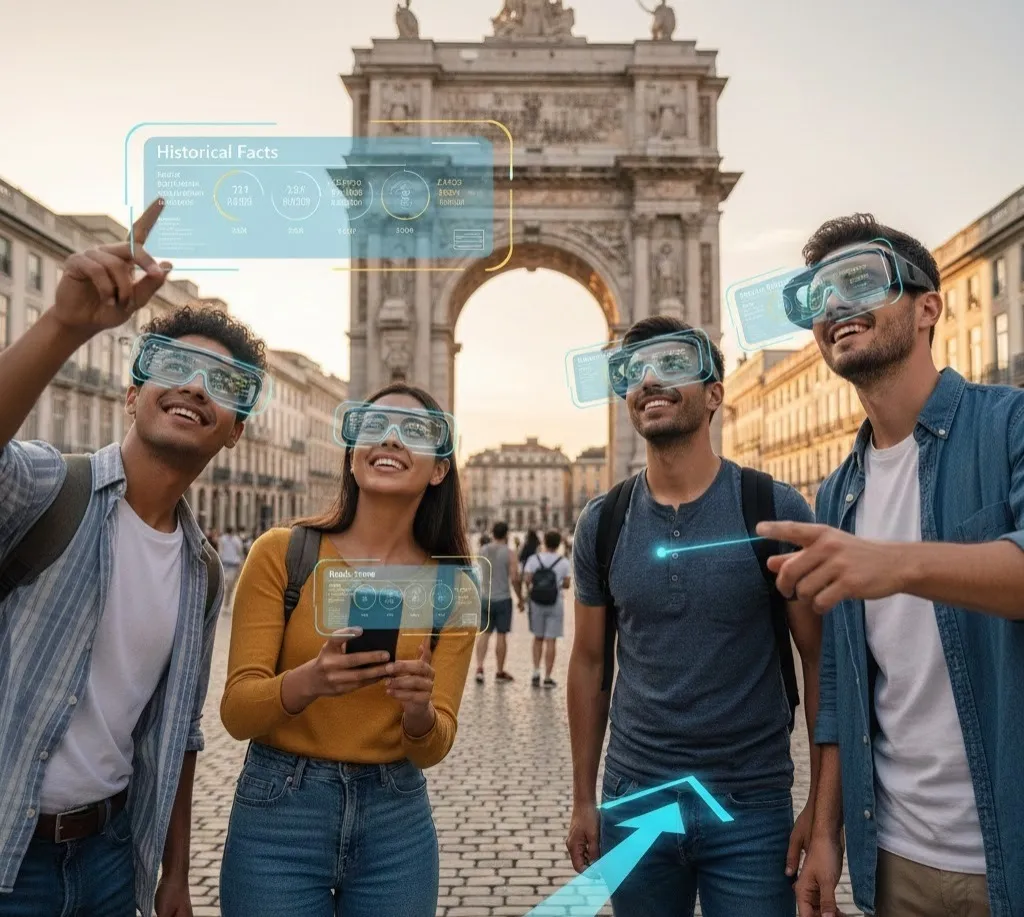
Get hyper-contextual information via digital overlays on your phone or glasses.
The Hyper-Contextual Future: AR Wayfinding and Intelligent Information
The convergence of Augmented Reality (AR) and sophisticated location technology is heralding a new era of human-environment interaction. This paradigm shift moves beyond simple GPS dots on a map to create a truly hyper-contextual information layer overlaid onto the real world. At the core of this revolution is AR wayfinding, a powerful application that transforms complex, unfamiliar, and even mundane environments into intuitive, information-rich spaces. Whether navigating a massive airport, exploring a historical city, or finding a specific product in a vast retail store, AR is delivering guidance, facts, and essential utility with unparalleled immediacy and relevance.
AR Wayfinding: A Non-Intrusive Digital Guide
AR wayfinding uses a device—most commonly a smartphone camera or specialized AR glasses—to perceive the physical environment, track the user's location and orientation, and seamlessly overlay digital information directly onto the live view. This technique bypasses the cognitive load associated with constantly glancing down at a map, instead integrating directions and details directly into the user's line of sight.
Directing the Path with Digital Overlays
The primary function of AR wayfinding is to provide directional guidance. Unlike traditional mapping services that rely on 2D lines, AR overlays dynamic, real-time visual cues in the 3D space.
- Turn-by-Turn Guidance: Bright, animated arrows or pathways appear to be painted onto the floor, guiding the user through complex junctions in an airport, hospital, or shopping mall. This is far more intuitive than trying to match a tiny blue dot on a digital floor plan to one's surroundings.
- Virtual Landmarks: In outdoor environments, a virtual pin or a highlighted ring might circle a building or entrance, confirming that the user is pointing in the correct direction. This visual confirmation is crucial in dense urban areas where landmarks are plentiful. These digital overlays ensure the guidance is always anchored to the real world, eliminating ambiguity.
Technology Under the Hood
For AR wayfinding to work seamlessly, especially indoors where GPS signals are weak or non-existent, sophisticated technologies are employed:
- Simultaneous Localization and Mapping (SLAM): This core technology allows a device to simultaneously build a map of an unknown environment while keeping track of its own location within that map. For indoor applications, a precise "digital twin" of the venue is often pre-scanned.
- Visual Positioning Systems (VPS): By comparing the live camera feed with a database of pre-captured images of the location, the system can instantly and accurately determine the user's exact position and orientation, ensuring the digital overlays are perfectly anchored.
- Sensor Fusion: A combination of camera data, inertial measurement units (IMUs), Wi-Fi, and Bluetooth Low Energy (BLE) beacons work together to maintain stable, centimeter-level accuracy, providing a reliable guidance experience.
Hyper-Contextual Information: Enriching the Environment
The true power of this technology lies not just in directing traffic, but in delivering contextual information—the right piece of data, in the right format, at the exact moment the user needs it. This hyper-contextuality transforms a navigation tool into a powerful informational lens.
AR in Cultural and Augmented Reality Tourism
For visitors and tourists, AR elevates the experience from passively observing to actively learning. This is the heart of augmented reality tourism.
- Historical Facts: Pointing a phone or wearing AR glasses at an ancient monument or historical building can instantly trigger an interactive, three-dimensional reconstruction or a pop-up display of historical facts about its construction, age, and significance. Instead of reading a plaque, the story is told right where it happened.
- Museum Narratives: Within a museum or gallery, looking at an artifact can bring up a heads-up display tour overlaying curator commentary, a timeline of its origin, or a 3D model that can be rotated on-screen. This is a personalized, self-guided experience that adapts to the user's pace.
- Cultural Translation: A foreign-language sign, menu, or monument inscription can be instantly scanned and displayed on the user's screen in their native language—a seamless, on-the-spot real-time translation. This non-intrusive utility breaks down language barriers and dramatically enhances the independence of the traveler.
Real-World Utility and Application
Beyond tourism, hyper-contextual AR delivers essential utility across various sectors:
- Retail: In a supermarket, looking at a product can pull up its nutritional information, customer reviews, or whether it’s on sale, effectively merging the in-store experience with the richness of online data.
- Healthcare: In a large hospital, AR can guide a patient to their exact room or department, while also providing real-time information about appointment wait times or necessary preparation instructions, significantly reducing patient stress and staff burden.
- Industrial/Maintenance: Technicians can use AR glasses to view wiring diagrams or step-by-step repair instructions digitally overlaid onto a piece of complex machinery, providing hands-free guidance and accessing technical contextual information without a manual.
The Non-Intrusive Experience of AR
The most significant advantage of using AR via a phone or, increasingly, AR glasses, is the non-intrusive manner in which it delivers information. Traditional methods—like constantly checking a paper map, fumbling with a guidebook, or staring at a phone screen—interrupt the user's engagement with the real world. AR addresses this:
The Heads-Up Display Paradigm
Using AR glasses transforms the experience into a heads-up display tours system. The user's field of view remains dominated by the physical world, while digital information is subtly layered onto their perception.
- Safety and Awareness: By keeping the user's eyes on the environment, AR maintains situational awareness, making navigation safer in busy, dynamic spaces.
- Hands-Free Operation: AR glasses allow for true hands-free interaction, which is critical for complex tasks, carrying luggage, or in professions like field service and logistics.
- Ambient Information: The system can be designed to only display information when it's critically relevant. Directional arrows might fade away when walking straight, only to reappear brightly at the next decision point. This filtering prevents cognitive overload and keeps the information truly contextual.
The Role of Real-Time Translation
The integration of real-time translation into AR is a powerful example of non-intrusive utility. Instead of pulling out a separate app, taking a picture, and waiting for a translation, the user simply looks at the foreign text, and the translated version instantly replaces the original in their field of view. This is essential for spontaneous, on-the-go comprehension in any multilingual environment.
Conclusion: The Future is Contextual
The fusion of AR wayfinding and hyper-contextual information is more than a technological novelty; it's a fundamental improvement to how we interact with the complex, information-dense world around us. By using devices like phones and AR glasses to project digital overlays—be it a clear directional arrow or a real-time translation of a sign—this technology facilitates seamless movement and effortless understanding. From creating personalized augmented reality tourism experiences to providing critical guidance in hospitals, AR is becoming the essential heads-up display tours system for modern life, offering an intuitive, non-intrusive, and profoundly contextual digital layer over our physical reality.