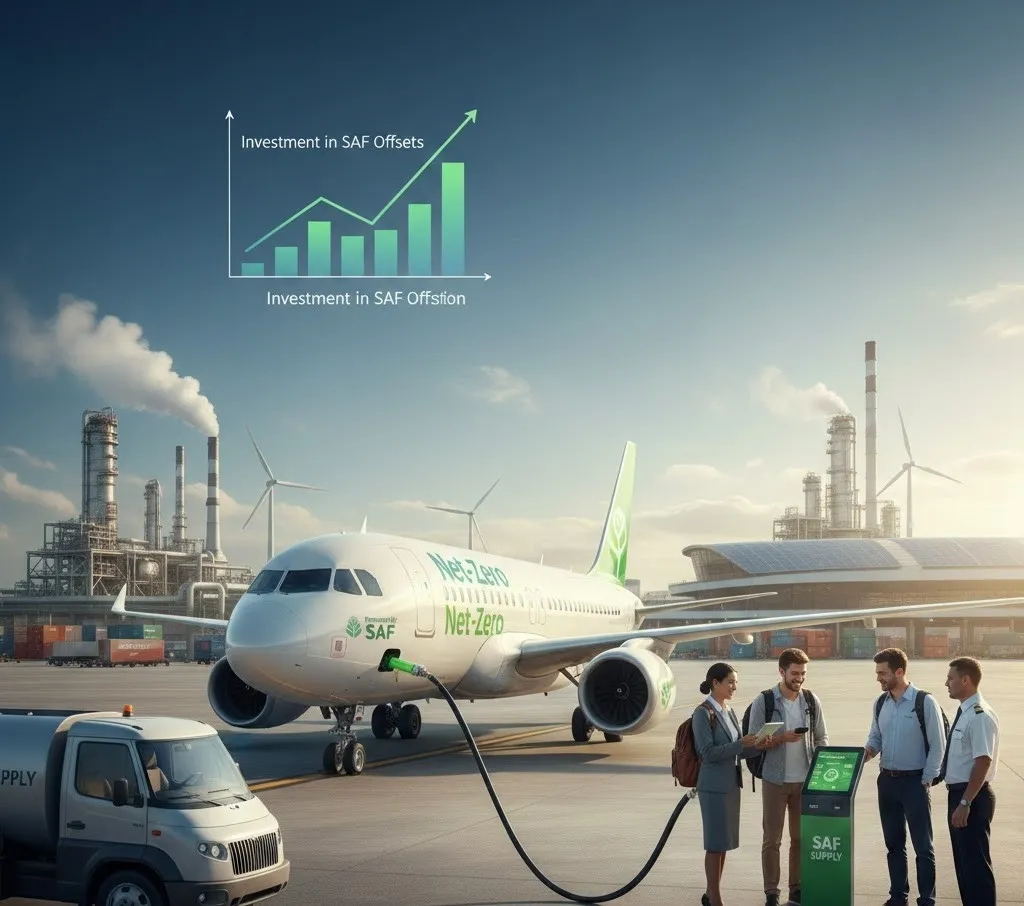
Invest in premium offsets for long-haul travel decarbonization.
Fueling a Net-Zero Future: Investing in Sustainable Aviation Fuel (SAF) Offsets
The global aviation industry stands at a critical juncture. While air travel remains an essential driver of global commerce, tourism, and connectivity, its carbon footprint presents a formidable challenge to global climate goals. With long-haul travel, in particular, lacking commercially viable alternatives to liquid fuels in the near term, the focus has shifted intensely to a single, scalable solution: Sustainable Aviation Fuel (SAF).
SAF is not merely an alternative; it is the industry’s most immediate, drop-in solution, capable of reducing lifecycle greenhouse gas (GHG) emissions by up to 80% compared to conventional jet fuel. However, its current low production volume and high cost present an enormous hurdle. This is where the innovative mechanism of SAF offsets, distinct from traditional carbon offsets, has emerged as a crucial financial instrument, driven by a growing consumer and corporate focus on funding the development and use of SAF to mitigate the carbon footprint of long-haul travel.
The Decarbonization Imperative and the SAF Solution
Aviation accounts for roughly 2% of global human-induced $\text{CO}_2$ emissions, a share that is projected to grow significantly as passenger demand is expected to more than double by 2050. In response, international bodies like the International Air Transport Association (IATA) have set a net-zero travel commitment by 2050—a target heavily dependent on the widespread adoption of SAF.
The path to net-zero requires a multi-faceted approach, with IATA projecting that 65% of the necessary $\text{CO}_2$ abatement will come directly from SAF use. Other levers, such as new aircraft technology, operational efficiencies, and remaining emissions covered by carbon capture and carbon offsets, are also vital.
SAF, a "drop-in" fuel that can be blended with traditional jet fuel without requiring modifications to existing aircraft or airport infrastructure, is produced from a variety of sustainable feedstocks, including:
-
Waste Fats and Oils: Primarily used cooking oil (UCO) and animal fats (HEFA pathway), which currently constitute the majority of SAF production.
-
Agricultural and Forestry Residues: Non-food cellulosic biomass.
-
Synthetic Fuels (Power-to-Liquids or PtL): Utilizing captured $\text{CO}_2$ and green hydrogen (produced via renewable electricity) to create a synthetic hydrocarbon jet fuel. This pathway holds the most significant long-term potential but is currently the most expensive and least mature.
The challenge remains one of scale and price. SAF is currently two to five times more expensive than fossil jet fuel, and its production volume constitutes less than 1% of global jet fuel demand. Bridging this gap requires billions of dollars in capital expenditure (CapEx) for new biorefineries and synthetic fuel plants—estimated at over €1,000 billion by 2050.
Differentiating SAF Offsets from Traditional Carbon Offsets
To understand the investment shift, it is essential to distinguish between traditional carbon offsets and SAF funding mechanisms, often referred to as SAF offsets or Book-and-Claim systems.
Traditional Carbon Offsets: Mitigation vs. Reduction
Traditional carbon offsets involve a financial contribution to an external project that either prevents one tonne of $\text{CO}_2$ from entering the atmosphere or removes one tonne already present. Examples include forest preservation, clean cookstove distribution, or renewable energy projects in developing nations.
While these offsets are valuable for global climate action, they face criticism in the aviation sector due to:
-
Non-Additionality: The challenge of proving that the offset project would not have happened without the funding from the offset purchase.
-
Time Lag: Forestry projects, for instance, take decades to sequester the promised carbon.
-
Mitigation Deterrence: The risk that relying on cheap offsets reduces the incentive for the emitting sector (aviation) to invest in direct emissions reduction technology.
Essentially, traditional carbon offsets are an out-of-sector mitigation tool—they compensate for the flight’s emissions elsewhere but do not reduce the actual carbon intensity of the fuel used in the plane.
SAF Offsets (Book-and-Claim): Direct In-Sector Investment
SAF offsets, facilitated primarily through a Book-and-Claim system, are a direct market mechanism designed to stimulate SAF production.
-
The "Book" (Investment): A corporate traveler or passenger pays a premium to cover the difference between the cost of conventional jet fuel and the higher cost of SAF. This purchase is a direct investment in the reduction of emissions within the aviation sector.
-
The "Claim" (Reduction): The purchaser receives a certificate or "claim" for the measured environmental benefit (the $\text{CO}_2$ lifecycle reduction) associated with a specific volume of physically produced and delivered SAF, even if the SAF is not physically delivered to the buyer’s specific flight or airport.
This system is vital because SAF supply remains geographically constrained. An airline purchasing SAF in Seattle can transfer the associated certified carbon reduction to a corporate client flying from London to Tokyo, ensuring the financial investment directly supports scaling up global SAF production. SAF offsets are thus a form of premium offsets because they fund the incremental cost of a measurable, in-sector emissions reduction.
The Consumer and Corporate Focus on Funding SAF
The shift toward funding SAF is driven by two main pillars: the corporate demand for immediate, credible decarbonization and the conscious consumer seeking green flight options.
1. The Corporate Demand: Fueling the Value Chain
Global corporations, particularly those with a significant travel footprint, have established ambitious science-based targets and net-zero travel commitments that require more than just traditional offsets. For these companies, investing in SAF through Book-and-Claim is a strategic necessity.
-
Decarbonizing Value Chain (Scope 3): For many companies, employee travel is a significant part of their Scope 3 (indirect) emissions. Funding SAF offsets provides a clear, auditable pathway to reduce these emissions at the source, which is far more credible than purely relying on external offsets.
-
Guaranteed Offtake Agreements (The "Bankability" Factor): The single biggest barrier to new SAF production facilities is the risk for investors. Producers need assurance that the expensive fuel will be purchased long-term. Corporations, by signing long-term Virtual Power Purchase Agreements (VPPAs) or similar financial instruments for SAF, create "bankable" demand. This guaranteed long-term offtake reduces investor risk and unlocks the massive capital required for facility construction.
-
Airline Sustainability Partnerships: Companies are increasingly partnering directly with major airlines and fuel suppliers to create dedicated SAF funds or purchase agreements. For example, a tech company might commit to purchasing 10 million gallons of SAF over five years, which the airline sustainability department then uses to negotiate a long-term contract with a producer. This corporate money acts as the vital bridge to cover the green premium (the extra cost of SAF).
2. The Conscious Consumer: Choosing Green Flight Options
While corporate funding dominates the market, passenger demand is growing, particularly in the long-haul sector where travelers feel the greatest guilt over their high-impact journey. Airlines are responding by integrating green flight options directly into the booking process.
-
Tiered Carbon Contributions: Instead of a simple forest offset, airlines now offer customers a choice: a low-cost traditional offset, or a higher-cost, dedicated SAF contribution. This allows passengers to fund the incremental cost of fueling a specific portion of their journey with SAF.
-
Premium Offsets for Transparency: Consumers are increasingly skeptical of generic carbon offsets due to past greenwashing scandals. The transparency of the SAF offset model—where the money is tracked to a specific SAF volume that physically reduced emissions in the sector—justifies the higher price and is seen as a higher-quality, or premium offsets, choice.
-
Driving Policy and Market Signals: Every SAF contribution, however small, sends a powerful market signal to fuel producers, refiners, and governments that there is a willingness to pay a premium for green flight options. This public demand reinforces the case for favorable government policy and investment incentives.
The Ecosystem of SAF Investment and Offsets
The scaling of SAF through offsets is not a simple transaction; it involves a complex ecosystem requiring coordinated effort from governments, the financial sector, and the industry itself.
Government and Policy Interventions
For SAF production to reach the required scale, government incentives are indispensable to close the cost gap. These include:
-
Blending Mandates: Regulatory requirements, such as the EU’s ReFuelEU Aviation initiative, which set minimum SAF blending targets for fuel suppliers (starting at 2% in 2025 and rising to 70% by 2050). These mandates create a guaranteed floor for demand, stabilizing the market for investors.
-
Tax Credits and Incentives: The US Clean Fuel Production Credit, for instance, provides a tax break to SAF producers, helping to lower the fuel’s final price and making it more competitive with fossil kerosene.
-
"Green Flight Paths" (GFPs): The concept of establishing specific, supported routes between international hubs (e.g., UK-UAE) where a high blend of SAF is mandated, thereby de-risking early, large-scale investment by guaranteeing an end-user.
The Role of Financial and Institutional Investment
The investment community views SAF as a crucial green asset class. Institutional investors, committed to their own net-zero travel commitments and climate objectives, are exploring ways to deploy capital:
-
De-Risking Finance: Innovative financing structures are emerging to mitigate the technology and market risks associated with new SAF pathways like PtL. This includes government loan guarantees and joint ventures between airlines, oil companies, and financial institutions.
-
Asset Diversification: SAF infrastructure offers long-term, predictable returns once off-take agreements are secured, providing diversification benefits for large institutional portfolios.
Airline Sustainability Strategies: The Long-Haul Focus
For airlines, especially those specializing in long-haul travel, SAF is a foundational element of their airline sustainability strategy. Since hydrogen or electric propulsion is not feasible for journeys over 1,500 km in the foreseeable future, SAF is the only immediate decarbonization solution.
Airlines are adopting strategies such as:
-
Direct Equity Investments: Taking a stake in SAF production companies to secure supply and influence the feedstock and production method.
-
Fuel Hedging with SAF: Integrating SAF purchase agreements into fuel procurement to manage price volatility and guarantee volume, demonstrating a long-term commitment.
-
Voluntary SAF Programs (V-SAF): Implementing the Book-and-Claim mechanism to allow corporate partners and individual passengers to contribute, effectively distributing the "green premium" across the value chain.
The Future of Premium Offsets: Quality and Transparency
As the market matures, the debate over the quality and integrity of offsets will intensify. The focus is increasingly shifting toward premium offsets that offer a verifiable, measurable, and highly additional climate benefit.
SAF offsets, when administered through certified systems like the International Sustainability and Carbon Certification (ISCC) or the Roundtable on Sustainable Biomaterials (RSB), meet this premium offsets criteria because:
-
Direct Causation: The funding directly causes the use of lower-carbon fuel in the sector where the emissions occurred.
-
Measurable Impact: The life-cycle $\text{CO}_2$ reduction is quantified and certified from "well-to-wake" (feedstock production to flight combustion).
-
No Leakage/Permanence Issues: Unlike forestry offsets, which face risks from fires or re-sale ("leakage"), the carbon benefit of SAF is immediately realized in the combustion chamber.
This shift signals an evolution from "compensating for the bad" (traditional offsets) to "funding the good" (direct investment in a scalable, in-sector solution). The continued consumer and corporate focus on funding the development and use of SAF is the financial engine that will drive the production scale necessary for the entire industry to fulfill its net-zero travel commitment.