Learn the seamless edit and subtle ending that fuels the viral replay factor.
The Psychology Behind The Unfinished Loop
The foundation of the Unfinished Loop Strategy lies in the Zeigarnik Effect, a psychological phenomenon discovered by Soviet psychologist Bluma Zeigarnik. It posits that people remember uncompleted or interrupted tasks better than completed ones. Our brains crave closure; an open loop creates cognitive tension that demands resolution.
In the context of short-form video content—such as TikToks, Instagram Reels, and YouTube Shorts—this effect is a golden ticket. A viewer scrolling through a feed has an infinite stream of content. The moment they perceive a video has ended, their brain gives a "closure signal," prompting them to scroll away. The Unfinished Loop's primary goal is to never send that closure signal, keeping the viewer hooked in a perpetual cycle of re-engagement.
How to Edit the End of Your Video to Seamlessly Blend into the Beginning
Achieving a true, flawless loop requires precise technical execution, making the edit itself a subtle form of performance art. The goal is to make the transition so smooth that the viewer's brain is tricked into believing the narrative or action is simply continuing, achieving a perfect seamless edit.
-
The Principle of Motion and Action Continuity
The most effective loops rely on continuing the action from one clip to the next. The final frame of the video should depict a state of motion that logically leads into the first frame.
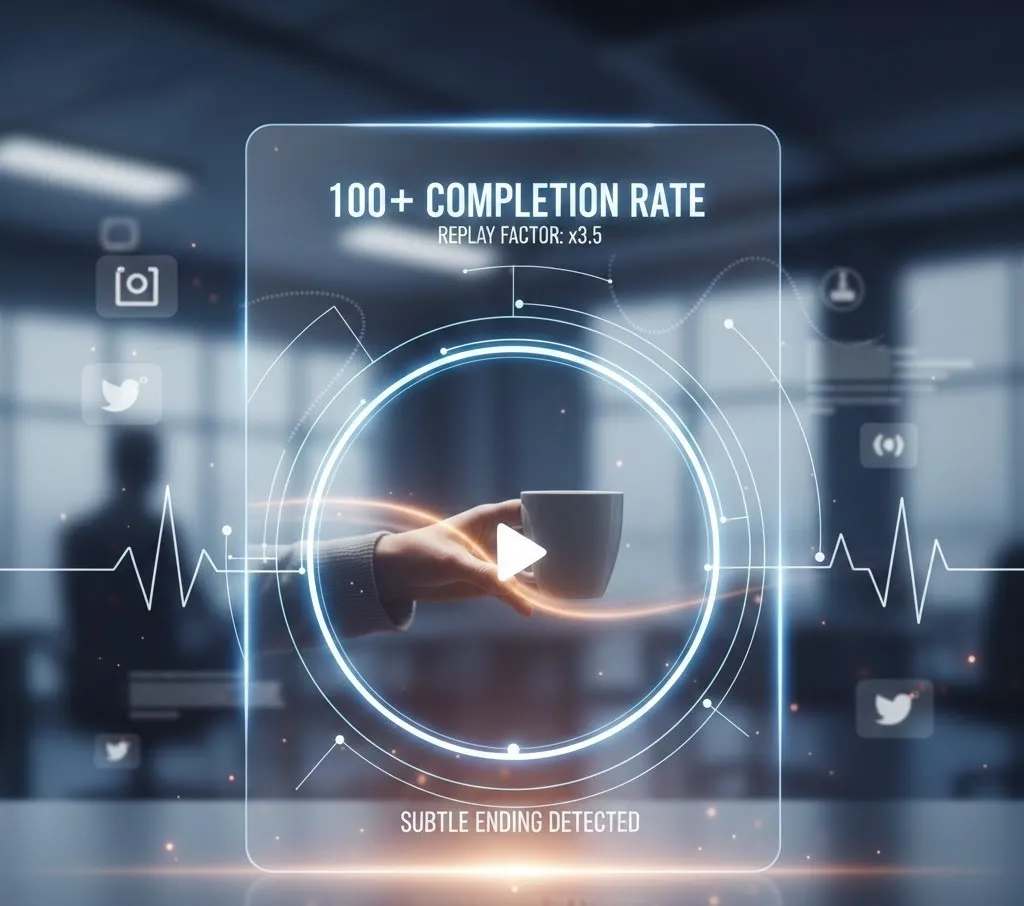
- Cut on Action: If a person is reaching for an object in the final seconds, ensure the first seconds of the loop show the motion before the reach is completed. For example, a clip of a hand reaching out to grab a coffee cup might end mid-reach. The start of the loop immediately shows the hand moving from its starting position towards the cup. The viewer's brain registers the continuous movement, ignoring the cut.
- Camera Movement: If the camera is panning or zooming at the end, the start of the video should pick up the exact same speed and direction of that pan or zoom. The camera’s final position must perfectly match its starting position.
-
Matching Visual and Audio Cues
Visual and audio elements must be identical at the cut point.
- The Match Cut: This technique involves cutting from one shot to another where the two shots are matched by the action, composition, or subject matter. In a looping video, the subject's position, lighting, and background should be nearly identical in the last and first frames. For example, a visual of a spinning object should have the object in the same rotational phase at the beginning and end.
- Audio Bridges: A constant, non-obtrusive audio track (like music or an ambient sound effect) is crucial. Instead of cutting the music, try to choose a track that is inherently loopable video music, meaning its own final beat or chord resolves perfectly into its opening. This "audio bridge" masks any subtle visual jump that might occur. If a voiceover is used, ensure the final word or phrase is slightly cut off or fades under the music, so the brain anticipates the next part of the phrase which is provided by the very beginning of the clip.
-
The Role of the Subtle Ending
This is the strategic heart of the Unfinished Loop. The video must end not with a clear conclusion, but with a momentary state of suspense or anticipation.
- The Question Mark Ending: Instead of a definitive conclusion, the video ends right as the final, most interesting action is about to take place, or immediately after a crucial piece of information is revealed that seems to contradict what will follow. The subtle ending should trick the viewer into thinking a technical glitch or a sudden cut prevented them from seeing the 'real' ending, compelling them to re-watch for the missing part.
- The In-Process Revelation: If the video is a tutorial, the final step should be shown, but the final result should only be hinted at or briefly glimpsed. The loop then restarts, and the viewer thinks, "Wait, did I miss how they did that first step?" or "I must have blinked, let me see the final product again."
The Power of 100% Completion Rate and Replay Factor
The Unfinished Loop Strategy is one of the only content techniques that allows for a 100% completion rate—and, statistically, even higher.
The "100% Completion Rate" Metric
In social media analytics, a "view" is typically registered when a video is watched for 3 seconds or an equivalent period. A "completion" is watching to the end.
- Scenario 1: Perfect Loop: A 10-second video is watched once. Completion Rate = 100%. The loop begins, the viewer takes another 5 seconds to realize they are re-watching (or not at all), and scrolls. The platform registers two views, but the metric tracks that the viewer watched the full 10-second duration twice. In a perfect loop, this can be recorded as two "100% completions" for a single viewer, artificially driving the overall average completion rate far beyond 100% (e.g., if 100 people watch it twice, your completion rate is 200%).
- Scenario 2: The Replay Factor: The addictiveness of the loop drives a high replay factor. Even if the viewer realizes it's a loop on the second run, the initial "trick" of the seamless edit has already boosted the VCR, and the engaging nature of the content encourages manual re-watching. This sends a powerful signal to the platform's algorithm: This video is exceptionally engaging.
Algorithm Favoritism
Social media algorithms prioritize content that maximizes 'time spent' on the app. A video with a high completion rate, and especially a VCR over 100%, is instantly flagged as "scroll-stopping" and "highly addictive." This boosts its distribution, leading to a massive increase in organic reach and impressions, which is the ultimate goal of the strategy.
Step-by-Step Implementation Guide
Phase 1: Planning and Pre-Production
- Script for the Loop, Not the Funnel: Your narrative shouldn't have a clear beginning, middle, and end, but a continuous flow. The script must contain a phrase or action that makes perfect sense whether it is the start or the end.
- Example: A baking video could start with a shot of flour spilling slightly onto the counter, and end with a shot of the flour bag being put down, causing a slight spill.
- Establish a Circular Prop/Set: Use a consistent prop or setting. The background, lighting, and primary object must remain perfectly static, only the action should change. This maintains the visual continuity necessary for the seamless edit.
- Filming the Action: Shoot the beginning and ending sections of your video simultaneously or with meticulous consistency. The camera position must be locked down (tripod is mandatory). The actor's final pose/action should physically mirror their starting pose/action as closely as possible.
Phase 2: Post-Production and the Seamless Edit
- Identify the Loop Point: Find the exact frame where the action in the final shot can be perfectly replaced by the action in the first shot. This often involves a moment of rapid movement or a visual distraction (a hand moving past the lens, a quick head turn). This is your cut frame.
- The Audio Loop: Lay your loopable video music track underneath. Find a part of the music that feels rhythmically circular. Cut the music track at the exact video cut point and ensure the wave forms align for a perfect sonic re-start. Use a cross-fade of just 1-2 frames on the audio to prevent any 'pop' sound.
- Refine the Subtle Ending: Review the final 1 second of the clip. Does the viewer feel like they got all the information? If yes, the loop is too complete. Introduce a subtle element of incompletion: a curious look from the actor, a very fast text flash, or the sound of an alarm going off. This open-loop cue encourages the immediate re-watch.
- Export and Testing: Export the video and immediately play it back-to-back with a copy of itself. If your brain registers a "jump," you have failed. The true test of a successful Unfinished Loop is that you have to consciously look for the edit to find it.